Account Aggregator vs Consent Manager vs CMP under DPDP Act
Understand Account Aggregator vs Consent Manager vs CMP under Indias DPDP Act. Discover how Consent Server helps businesses simplify DPDP compliance.
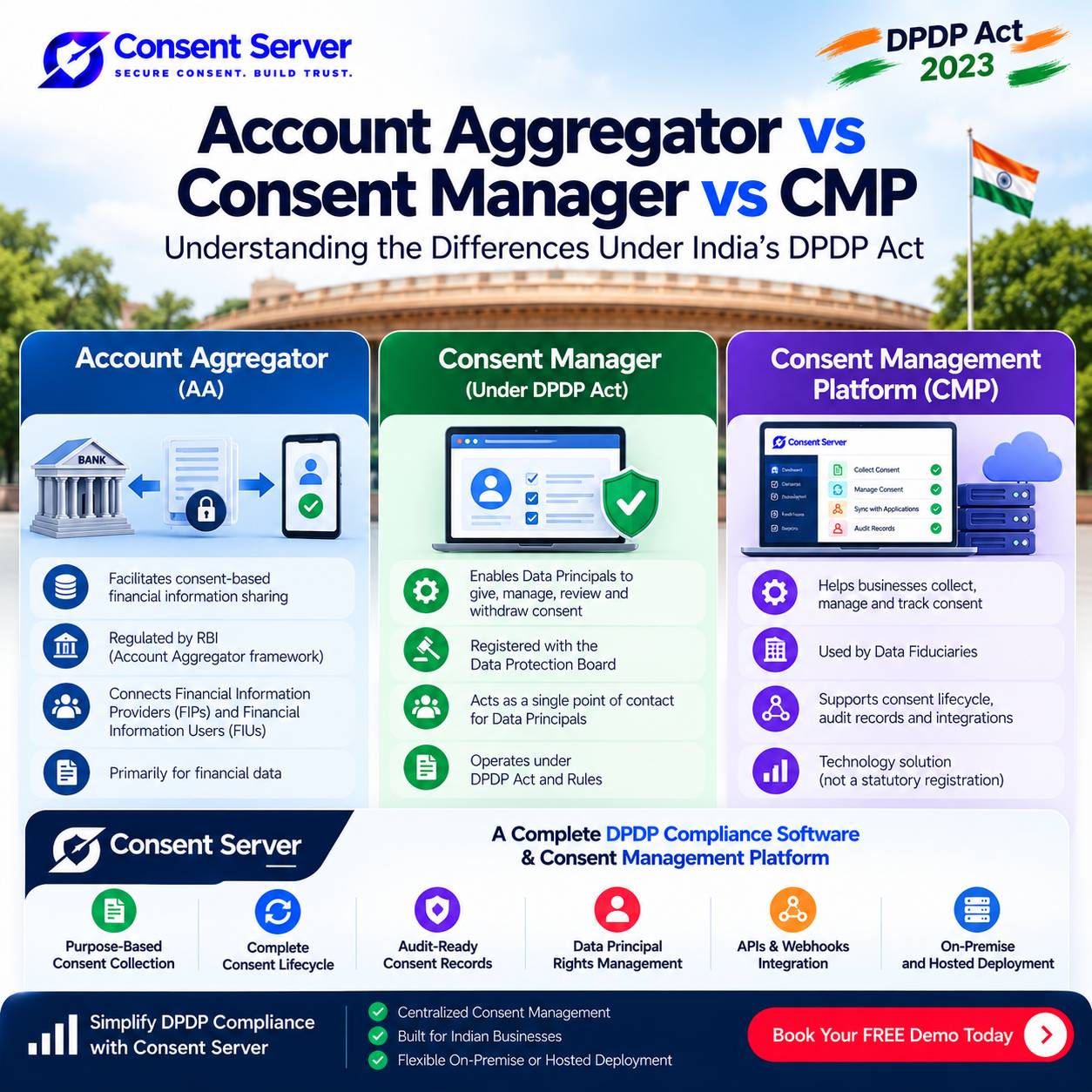
Account Aggregator vs Consent Manager vs CMP: Understanding the Differences Under India's DPDP Act
By Jitendra Yadav | Founder, Consent Server
As India strengthens its digital data protection framework, businesses are increasingly encountering three important terms: Account Aggregator (AA), Consent Manager, and Consent Management Platform (CMP).
Although all three involve consent and personal data, they serve different purposes, operate under different regulatory frameworks, and address different business requirements.
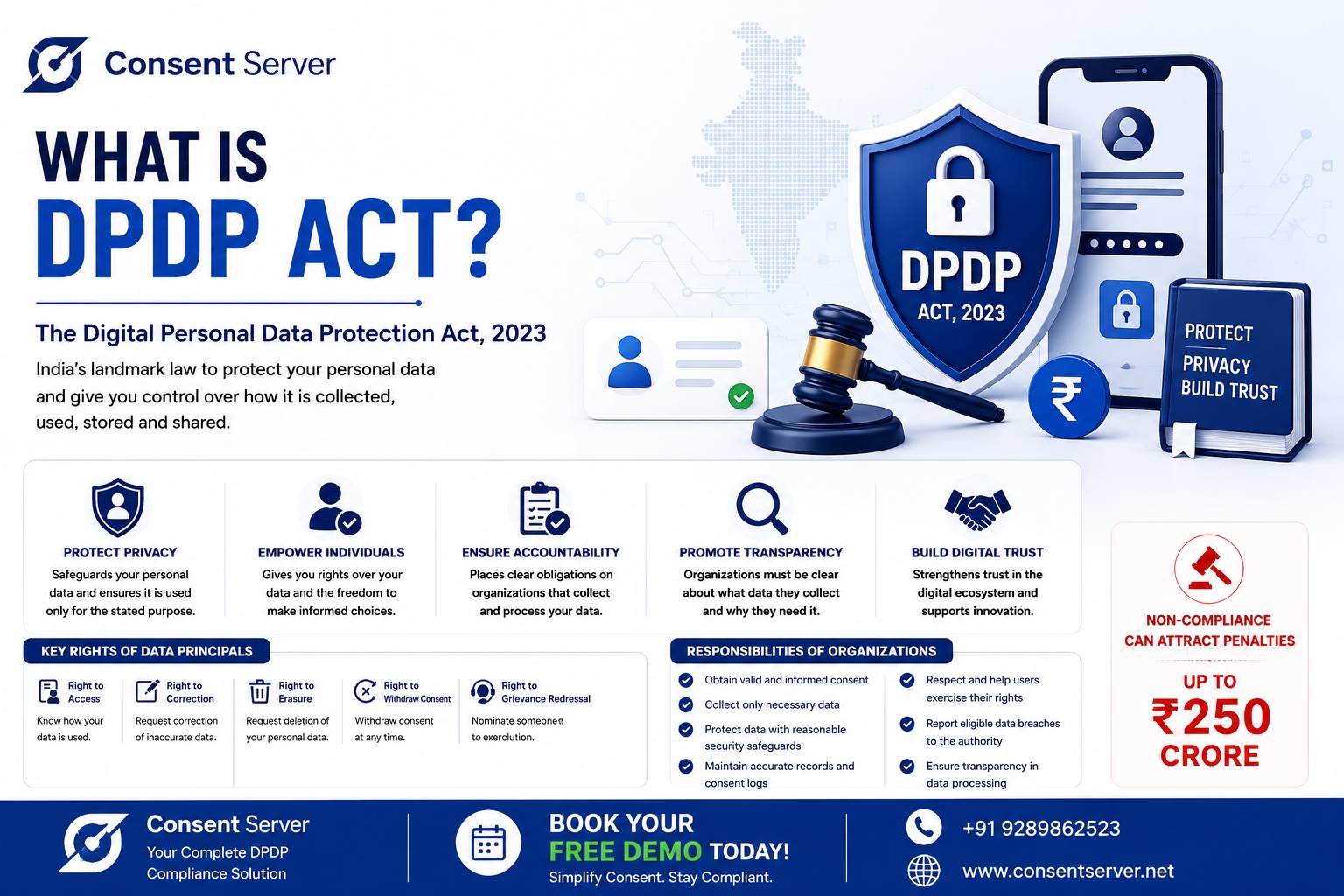
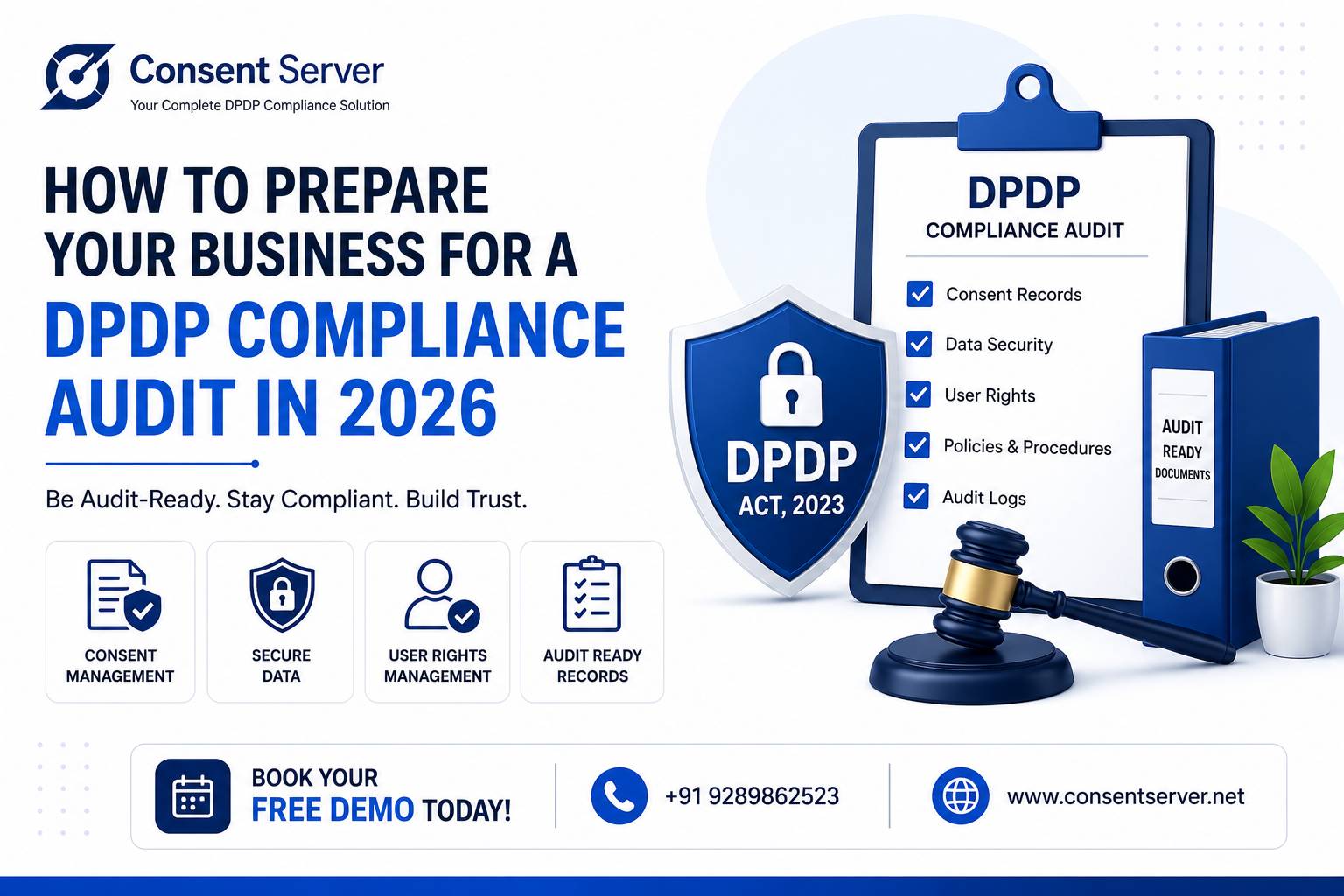
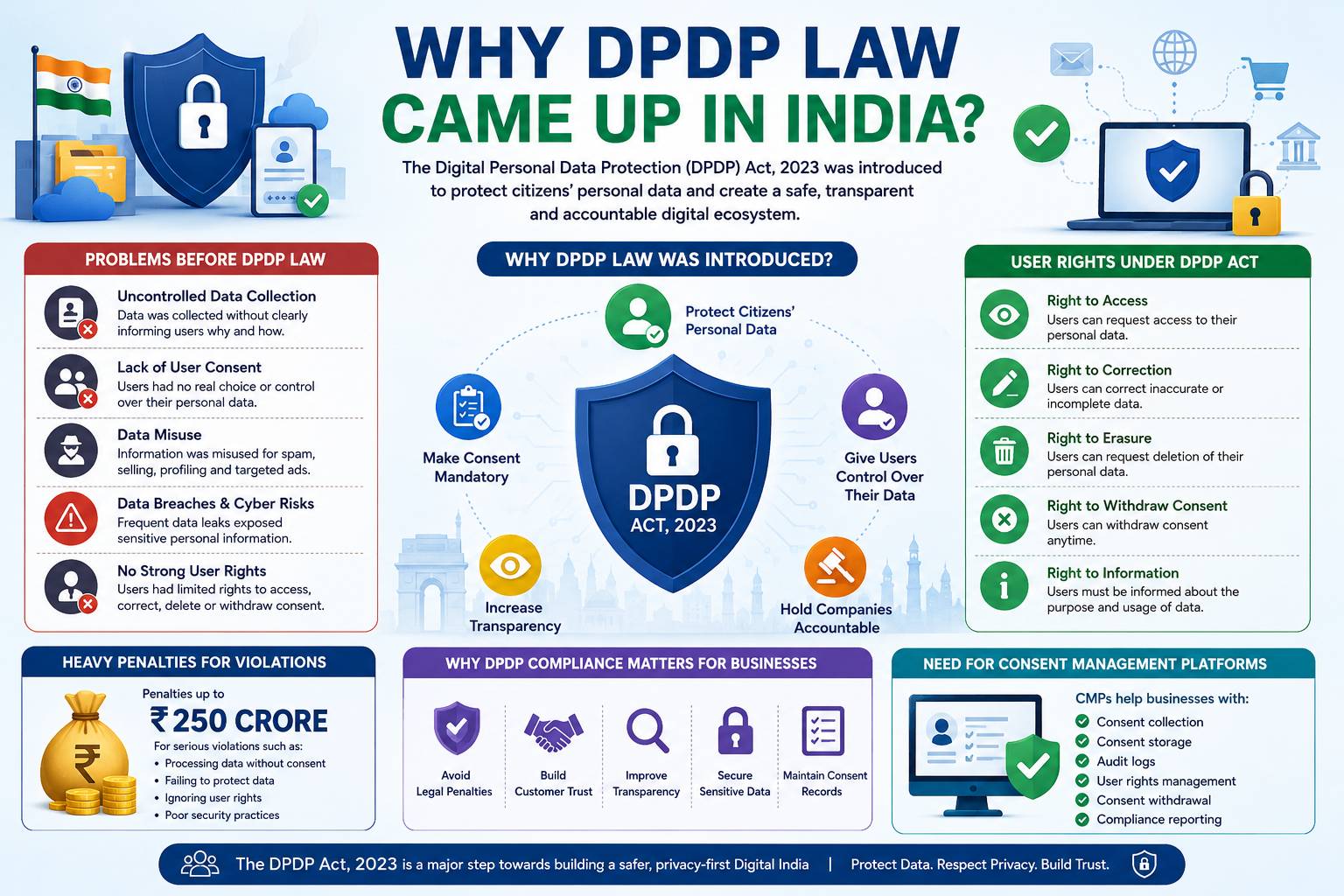
Understanding these differences is essential for organizations preparing for DPDP compliance under the Digital Personal Data Protection (DPDP) Act, 2023.
For businesses evaluating DPDP Software or a DPDP Consent Management Platform, choosing the right solution begins with understanding what each system actually does.
1. What Is an Account Aggregator (AA)?
An Account Aggregator is a regulated intermediary within India's financial data-sharing ecosystem.
The Account Aggregator framework is regulated by the Reserve Bank of India (RBI) and enables individuals to securely share supported financial information between participating financial institutions with their consent.
For example, when a customer applies for a loan, a participating lender may request financial information from another financial institution through the Account Aggregator framework.
The customer can authorize the relevant data-sharing request.
Key Functions of an Account Aggregator
- Facilitates consent-based financial information sharing.
- Connects participating Financial Information Providers (FIPs) and Financial Information Users (FIUs).
- Enables customers to authorize specific financial data-sharing requests.
- Operates within the RBI-regulated Account Aggregator framework.
Important: An Account Aggregator is not a general-purpose DPDP compliance solution. Its primary role is facilitating regulated financial information sharing.
2. What Is a Consent Manager Under the DPDP Act?
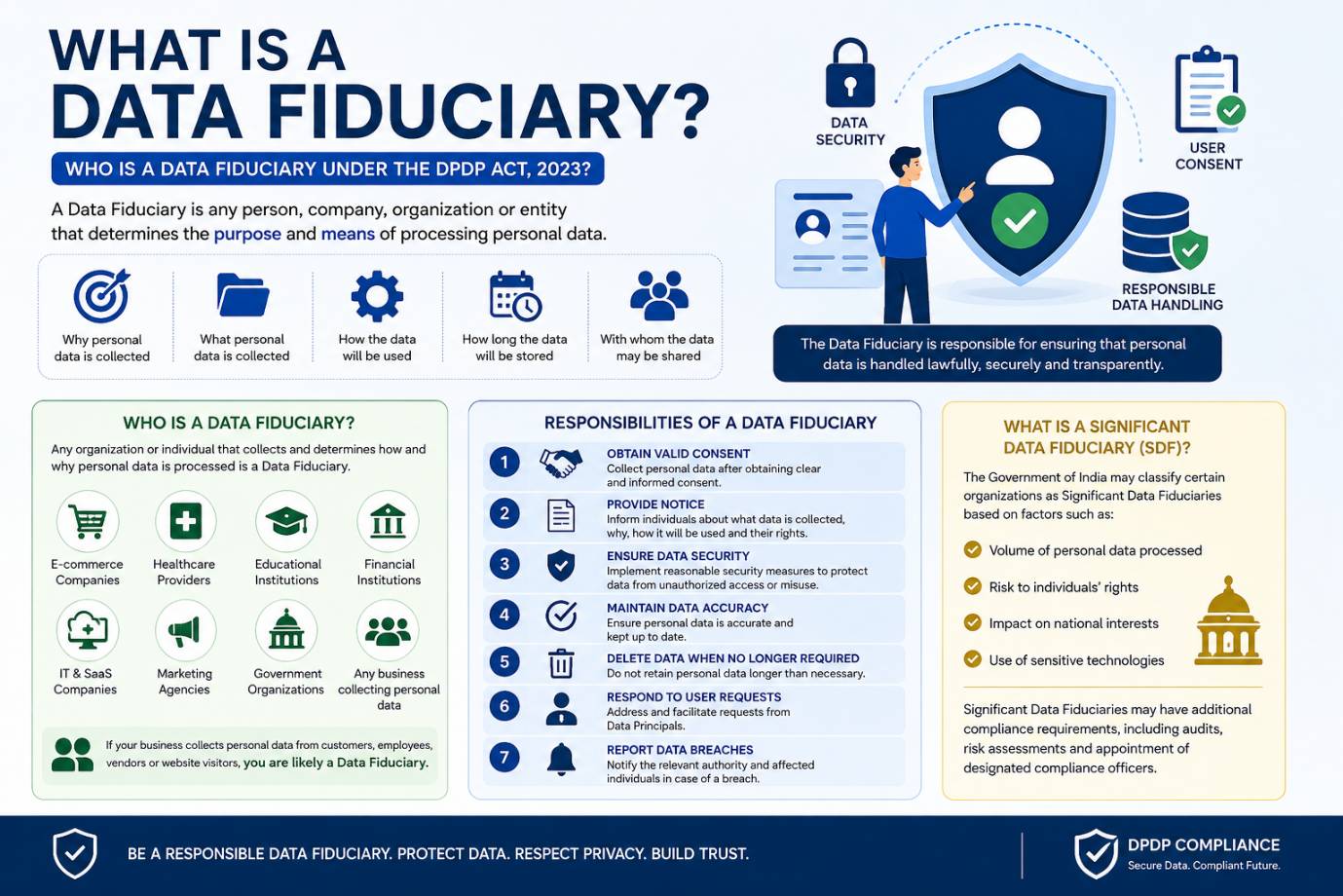
A Consent Manager is a specific legal role defined under India's DPDP Act, 2023.
Under the Act, a Consent Manager is a person registered with the Data Protection Board who acts as a single point of contact to enable Data Principals to give, manage, review, and withdraw consent through an accessible, transparent, and interoperable platform.
This is a regulated role, not merely a software product category.
The DPDP Rules, 2025 establish additional requirements relating to Consent Manager registration, eligibility, obligations, and operations.
Key Functions of a DPDP Consent Manager
- Enables Data Principals to manage consent through a common interface.
- Facilitates giving, reviewing, managing, and withdrawing consent.
- Operates within the statutory framework applicable to registered Consent Managers.
- Supports interoperability and transparency as required by applicable rules.
Important: A company cannot call itself a registered DPDP Consent Manager simply because it develops consent-management software. Registration with the Data Protection Board is a separate legal requirement.
3. What Is a Consent Management Platform (CMP)?
A Consent Management Platform (CMP) is a technology solution used by businesses to collect, manage, track, and maintain records of consent.
Unlike a statutory Consent Manager, a commercial CMP is not automatically a separately registered intermediary under the DPDP Act.
A CMP generally operates as part of a company's compliance infrastructure, helping the organization implement consent-related processes.
A modern DPDP CMP may provide:
- Purpose-based consent collection.
- Consent updates, withdrawal, renewal, and expiry.
- Consent histories and notice versioning.
- Audit-ready consent records.
- Data Principal request management.
- APIs and webhooks for connected business applications.
- Centralized consent management across websites and applications.
For example, an e-commerce company may collect customer consent through its website, maintain the consent record in its CMP, and communicate relevant consent changes to its marketing systems.
This is where a DPDP Consent Management Platform becomes useful for businesses preparing for compliance.
4. Account Aggregator vs Consent Manager vs CMP: Key Differences
| Feature | Account Aggregator | DPDP Consent Manager | Consent Management Platform |
|---|---|---|---|
| Primary purpose | Financial information sharing | Data Principal consent management | Business consent operations |
| Regulatory framework | RBI Account Aggregator framework | DPDP Act and Rules | Applicable DPDP obligations and other relevant laws |
| Typical users | Financial ecosystem participants and customers | Data Principals | Businesses and Data Fiduciaries |
| Registration | RBI-regulated NBFC-AA authorization | Registration with Data Protection Board | No separate DPDP CMP registration merely for providing CMP software |
| Data scope | Supported financial information | Consent relating to personal data under DPDP framework | Consent information relevant to the organization's processing activities |
| Main focus | Consent-based financial data sharing | Independent consent-management intermediary | Consent collection, lifecycle management, records, and integrations |
The biggest difference is their role: an Account Aggregator facilitates financial data sharing, a registered Consent Manager enables Data Principals to manage consent through a statutory intermediary, and a CMP helps businesses operate their own consent-management processes.
These systems are not necessarily competitors. They can serve complementary purposes within India's digital ecosystem.
5. Does Every Business Need an Account Aggregator or Registered Consent Manager?
No.
An Account Aggregator is relevant primarily to eligible participants and use cases within the regulated financial information-sharing ecosystem.
Similarly, the DPDP Act does not impose a universal requirement that every business must engage a registered Consent Manager for all personal data processing.
Organizations must first determine which DPDP obligations apply to their processing activities.
Where consent is the applicable legal basis, businesses need processes for obtaining valid consent, maintaining relevant records, and enabling withdrawal in accordance with the law.
A Consent Management Platform can help implement these processes.
However, the DPDP Act also recognizes certain legitimate uses of personal data, meaning consent is not the legal basis for every processing activity.
6. Why Businesses Need a DPDP Consent Management Platform
Most organizations collect personal data through multiple digital channels, including websites, mobile applications, CRM systems, ERP platforms, and customer portals.
Managing consent separately across these applications creates operational challenges.
For example, a customer may withdraw marketing consent through a website, but the organization's marketing application may continue using an outdated preference.
A centralized Consent Management Platform helps businesses coordinate relevant consent information and changes across their systems.
It can also help maintain consent histories, support Data Principal requests, and prepare evidence for compliance reviews.
For organizations evaluating DPDP Compliance Software, the most important consideration is whether the platform supports their actual consent-management and integration requirements.
7. How Consent Server Helps Businesses Manage DPDP Compliance
Understanding the difference between an Account Aggregator, a registered Consent Manager, and a CMP helps businesses select the right technology.
Consent Server is a DPDP Compliance Software and Consent Management Platform designed to help Indian businesses implement and manage consent-related requirements under the DPDP Act.
Rather than acting as a financial Account Aggregator or claiming the statutory role of a registered Consent Manager, Consent Server focuses on helping Data Fiduciaries manage consent-related processes within their organizations.
Centralized Consent Management
Consent Server enables businesses to manage consent information across multiple websites, applications, and business systems through a centralized platform.
Complete Consent Lifecycle
Businesses can manage consent collection, updates, withdrawals, renewals, and expiry while maintaining historical records.
Audit-Ready Consent Records
Consent Server maintains consent timestamps, notice versions, purpose selections, and activity histories to support compliance reviews and consent-related evidence.
Data Principal Rights Management
The platform supports access, correction, erasure, consent withdrawal, and grievance-related workflows through a Data Principal portal.
APIs and Webhook Integration
Consent Server helps businesses communicate consent changes to CRM, ERP, marketing, and other connected applications.
Its event-management capabilities support delivery tracking, acknowledgements, retries, escalation, and action-completion evidence where integrated applications provide the required responses.
On-Premise and Hosted Deployment
Consent Server offers on-premise deployment for businesses seeking greater control over their consent-management infrastructure, alongside hosted options.
By combining centralized consent management, lifecycle tracking, audit-ready records, and application integration, Consent Server provides a practical foundation for businesses strengthening their DPDP compliance readiness.
It does not replace the legal role of a registered Consent Manager or independently guarantee full compliance with the DPDP Act.
8. Which Solution Does Your Business Actually Need?
The answer depends on your business requirements.
If your organization needs to facilitate regulated financial information sharing between participating financial institutions, the Account Aggregator framework may be relevant.
If the requirement concerns providing Data Principals with an independent, interoperable consent-management service under the DPDP Act, the registered Consent Manager framework is relevant.
If your business needs to collect, manage, withdraw, synchronize, and maintain evidence of consent across its own systems, a DPDP Consent Management Platform is generally the relevant technology category.
For most businesses evaluating consent-related DPDP Compliance Software, the priority should be finding a CMP that supports their actual processing activities, integrates with existing applications, and provides reliable records.
Conclusion: Account Aggregator, Consent Manager, or CMP?
Although Account Aggregators, Consent Managers, and Consent Management Platforms all involve consent, their functions are fundamentally different.
An Account Aggregator facilitates regulated financial information sharing.
A DPDP Consent Manager is a registered intermediary that enables Data Principals to manage consent through an interoperable platform.
A Consent Management Platform helps businesses implement and operate their own consent-management processes.
For Indian businesses preparing for the DPDP Act, selecting the right CMP can simplify consent collection, withdrawal management, recordkeeping, and coordination across connected applications.
Consent Server brings these capabilities together in a comprehensive DPDP Consent Management Platform, helping businesses move beyond basic consent collection toward structured, centralized, and audit-ready consent management.