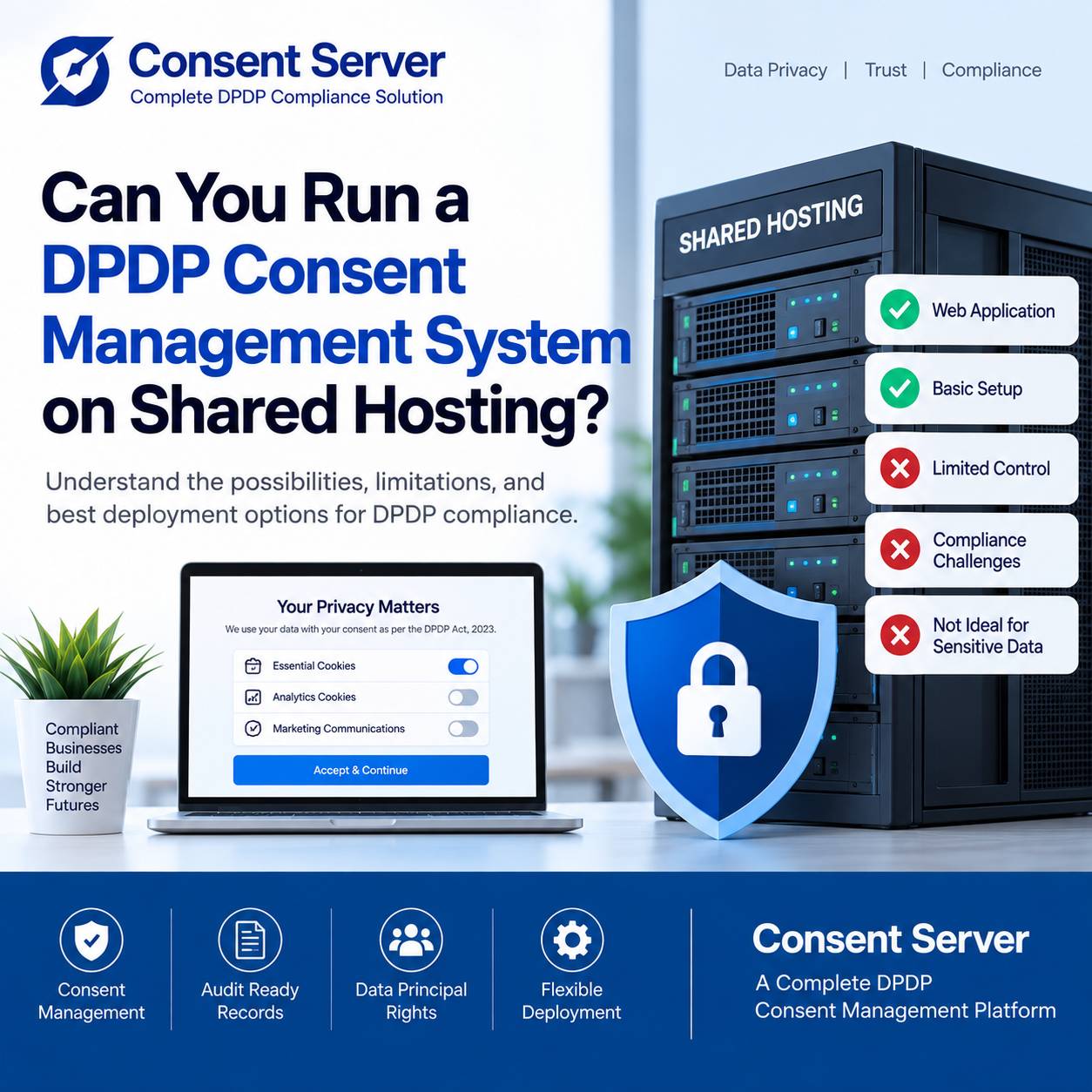
Can You Run a DPDP Consent Management System on Shared Hosting?
As businesses in India prepare for the Digital Personal Data Protection Act, 2023 and the Digital Personal Data Protection Rules, 2025, another practical question is becoming increasingly common:
“Why do we need a dedicated server, VPS or on-premise deployment for consent management? Can’t we simply build the software and run it on our existing shared Linux hosting along with our website?”
The short answer is:
Yes, technically you can run a basic DPDP consent application on shared hosting.
A PHP application connected to MySQL can collect consent, store user information, record timestamps and provide a basic administration panel. For a small website with limited users and simple consent requirements, shared hosting may even be sufficient.
However, the more important question is not:
“Can the software run on shared hosting?”
The better question is:
“Is shared hosting the right infrastructure for the consent management requirements, security controls, scale, integrations and risk profile of our organisation?”
These are two very different questions.
What Can You Build on Shared Hosting?
Modern shared hosting plans can support a significant amount of functionality.
A developer could create a consent application containing:
• User identification
• Consent checkboxes
• Purpose selection
• Date and timestamp
• IP address
• Consent status
• Basic consent history
• MySQL database
• Basic admin dashboard
The workflow could look something like this:
For a small organisation collecting consent from a few hundred or a few thousand website visitors, this may work perfectly well.
There is nothing in the DPDP Act that creates a general requirement that every organisation must deploy its consent management system on-premise or on a dedicated VPS.
Therefore, saying that “shared hosting can never be used for DPDP” would not be accurate.
But that does not mean every organisation should use shared hosting for its consent infrastructure.
DPDP Compliance Is About Responsibilities, Not Hosting Labels
The DPDP framework focuses on obligations of the Data Fiduciary.
Section 8 of the DPDP Act requires Data Fiduciaries to implement appropriate technical and organisational measures and take reasonable security safeguards to prevent personal data breaches.
The DPDP Rules, 2025 provide more detail around reasonable security safeguards. These include measures such as encryption, obfuscation, masking or virtual tokens where appropriate, access controls, logging and monitoring, backups and measures for continued processing if confidentiality, integrity or availability is compromised.
This is an important distinction.
The law does not simply ask:
“Which hosting company are you using?”
The organisation needs to evaluate whether its overall technical and organisational environment provides appropriate protection and supports its compliance obligations.
A properly configured cloud environment can be secure.
A poorly configured on-premise server can be insecure.
Therefore:
On-premise does not automatically mean compliant.
And:
Shared hosting does not automatically mean non-compliant.
The decision has to be based on requirements.
Then Why Do Businesses Use Dedicated Servers or On-Premise Systems?
Because as consent management becomes more complex, businesses often require greater control over infrastructure.
Consider a simple marketing website.
It may only collect:
Email Marketing Consent: Yes / No
Now compare that with a hospital.
The hospital may need to manage consent across:
• Patient registration
• Website
• Mobile application
• Appointment system
• Hospital Management System
• CRM
• Laboratory systems
• Marketing communications
• Multiple branches
Or consider a financial services company with:
• Website
• Mobile application
• CRM
• Customer onboarding
• Multiple departments
• Internal applications
• SMS systems
• Email systems
• Customer support platforms
At this point, consent management is no longer simply a feature of the website.
It becomes part of the organisation’s infrastructure.
The Website May Only Be One Consent Collection Channel
This is one of the biggest reasons businesses should avoid thinking about a consent management platform purely as a website plugin.
A Data Principal may give consent through:
Website
Mobile application
Branch office
Customer onboarding process
Hospital reception
CRM
API
Employee portal
Physical-to-digital workflow
Partner application
The organisation may therefore require a central system that maintains the current consent state regardless of where that consent originated.
A typical architecture could become:
Website --> Consent Server
Mobile App --> Consent Server
CRM --> Consent Server
Internal System --> Consent Server
Branch Application --> Consent Server
The Consent Management Platform acts as the central consent repository and lifecycle engine rather than simply being part of one website.
This is where infrastructure requirements begin to change.
Shared Hosting Usually Gives You Limited Infrastructure Control
Traditional shared hosting is designed primarily to make website hosting easy and affordable.
Multiple customers generally share the underlying server resources while the hosting provider manages most of the infrastructure.
That simplicity is one of its biggest advantages.
However, depending on the hosting provider and plan, organisations may have limited control over areas such as:
• Operating system configuration
• Background services
• Long-running applications
• Database configuration
• Network policies
• Firewall rules
• Resource allocation
• Server-level monitoring
• Custom security controls
• Backup architecture
• Private networking
• Internal enterprise integrations
For a basic website, most of these limitations may not matter.
For an organisation-wide consent management system, some of them may become important.
Suppose your business initially has:
2,000 Data Principals and 2 consent forms.
Shared hosting may comfortably manage that workload.
Now imagine the organisation grows to:
10 lakh Data Principals
with:
20 consent forms
and multiple consent events per user.
A Data Principal may:
Give consent
Modify consent
Withdraw one purpose
Provide consent again
Update another preference
Exercise a data-related request
Each action can generate a new event in the consent history.
The organisation may also require dashboards, reports, exports, APIs, automated notifications and integrations.
At this level, predictable processing capacity, database performance and infrastructure monitoring become more important.
The decision is no longer simply about whether PHP and MySQL are available.
It becomes an architecture decision.
Consent Withdrawal Makes Integration Particularly Important
Under Section 6 of the DPDP Act, a Data Principal has the right to withdraw consent, and the ease of withdrawal should be comparable to the ease with which consent was given. Where processing is based on that consent, the Data Fiduciary must, within a reasonable time, cease and cause its Data Processors to cease processing unless another legal basis permits or requires continued processing.
Consider this situation.
A customer has allowed:
Order Updates: Yes
Marketing Email: Yes
Promotional SMS: Yes
Later, the customer withdraws:
Marketing Email: No
Promotional SMS: No
The consent system may now need to communicate this change to:
CRM
Email marketing platform
SMS gateway
Mobile application
Customer profile system
Other connected processors
This may require APIs, webhooks and reliable background processing.
That is fundamentally different from displaying a checkbox and updating one database field on a website.
Security Is Also More Than Installing an SSL Certificate
Another common misconception is:
“My website has HTTPS, so the consent data is secure.”
HTTPS is important, but it protects data primarily while it is travelling between systems.
A broader security architecture may also need to consider:
• Encryption of stored information
• Authentication
• Role-based access
• Audit logs
• Database protection
• Backup security
• Administrator activity
• Tamper detection
• Monitoring
• Recovery mechanisms
• Credential management
• Infrastructure access
The DPDP Rules specifically identify measures including encryption or similar protections, access control, logs and monitoring and backup-related measures as part of reasonable security safeguards.
Therefore, organisations should evaluate the complete system rather than relying simply on the fact that the website uses HTTPS.
Shared Hosting vs VPS vs On-Premise
There is no single deployment model that is right for every organisation.
Shared Hosting
May be suitable for:
Small websites
Low consent volume
Simple workflows
Few integrations
Limited administration requirements
Dedicated Cloud or VPS
May be more suitable for:
Growing organisations
API integrations
Higher transaction volume
Custom services
Greater infrastructure control
Advanced monitoring and security requirements
On-Premise or Self-Hosted Deployment
May be useful for:
Hospitals
Financial institutions
Large enterprises
Organisations with strict internal IT policies
Businesses requiring greater control over infrastructure and data environment
Companies integrating with internal systems that are not publicly accessible
The important point is that on-premise should be viewed as an infrastructure option, not as an automatic DPDP requirement.
Where Consent Server Fits
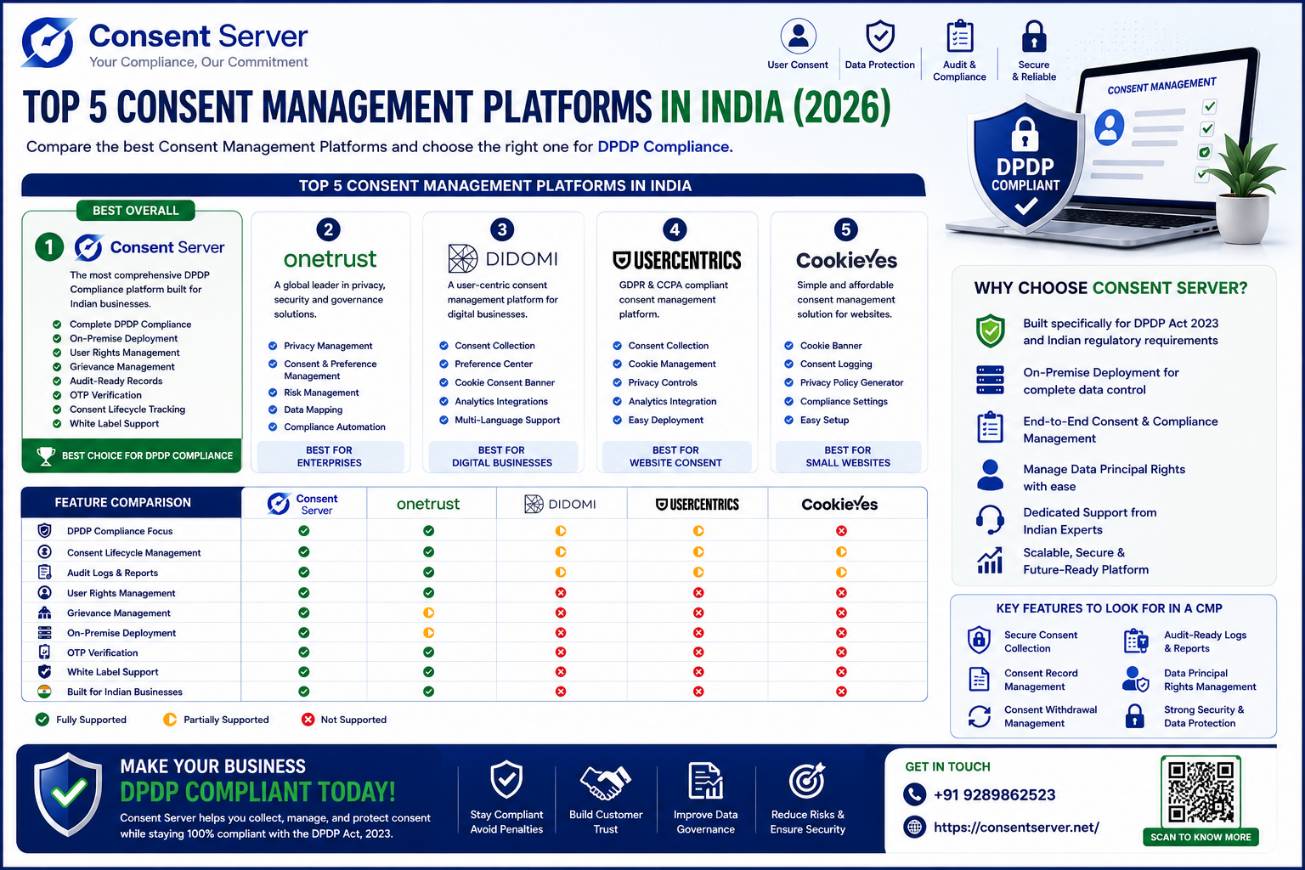
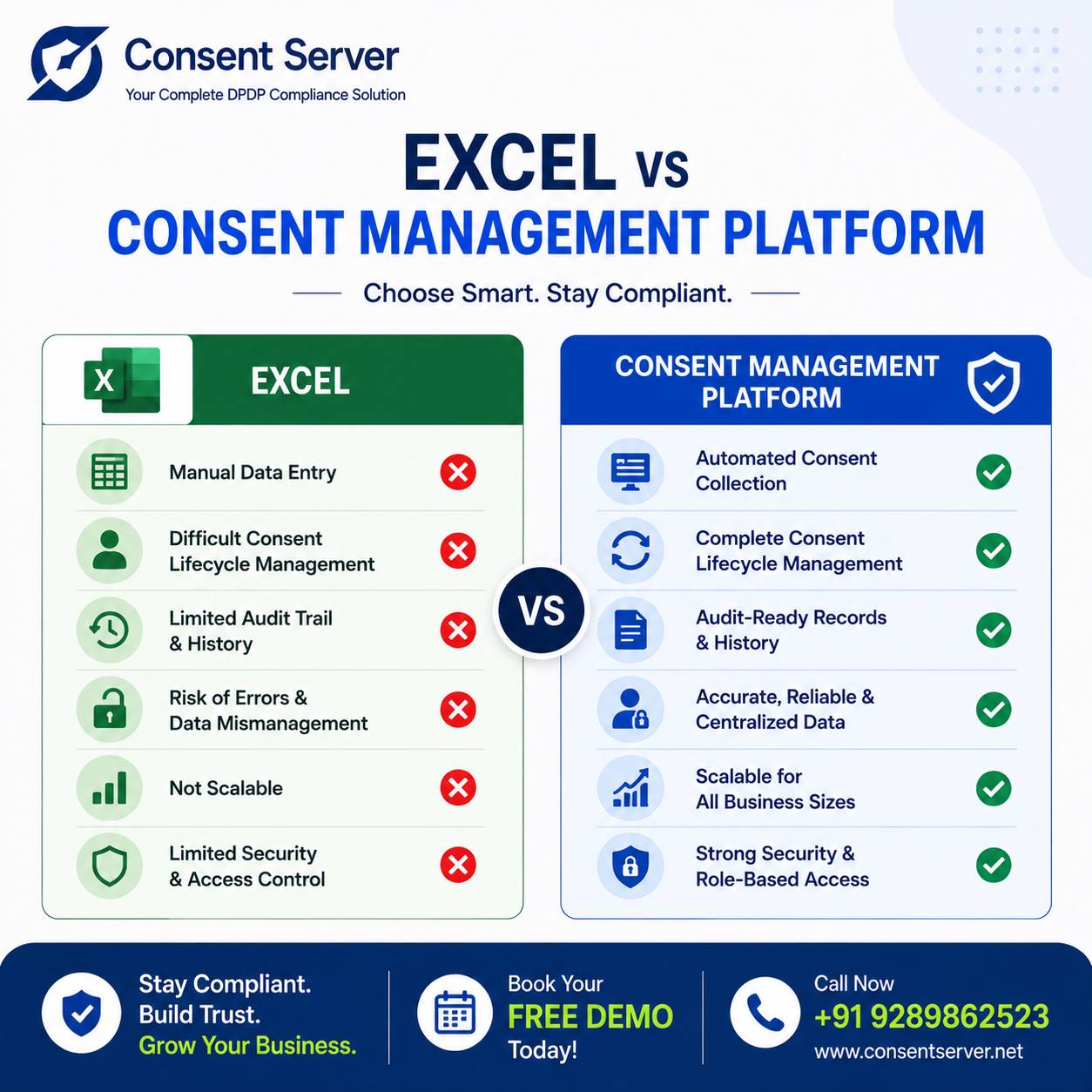
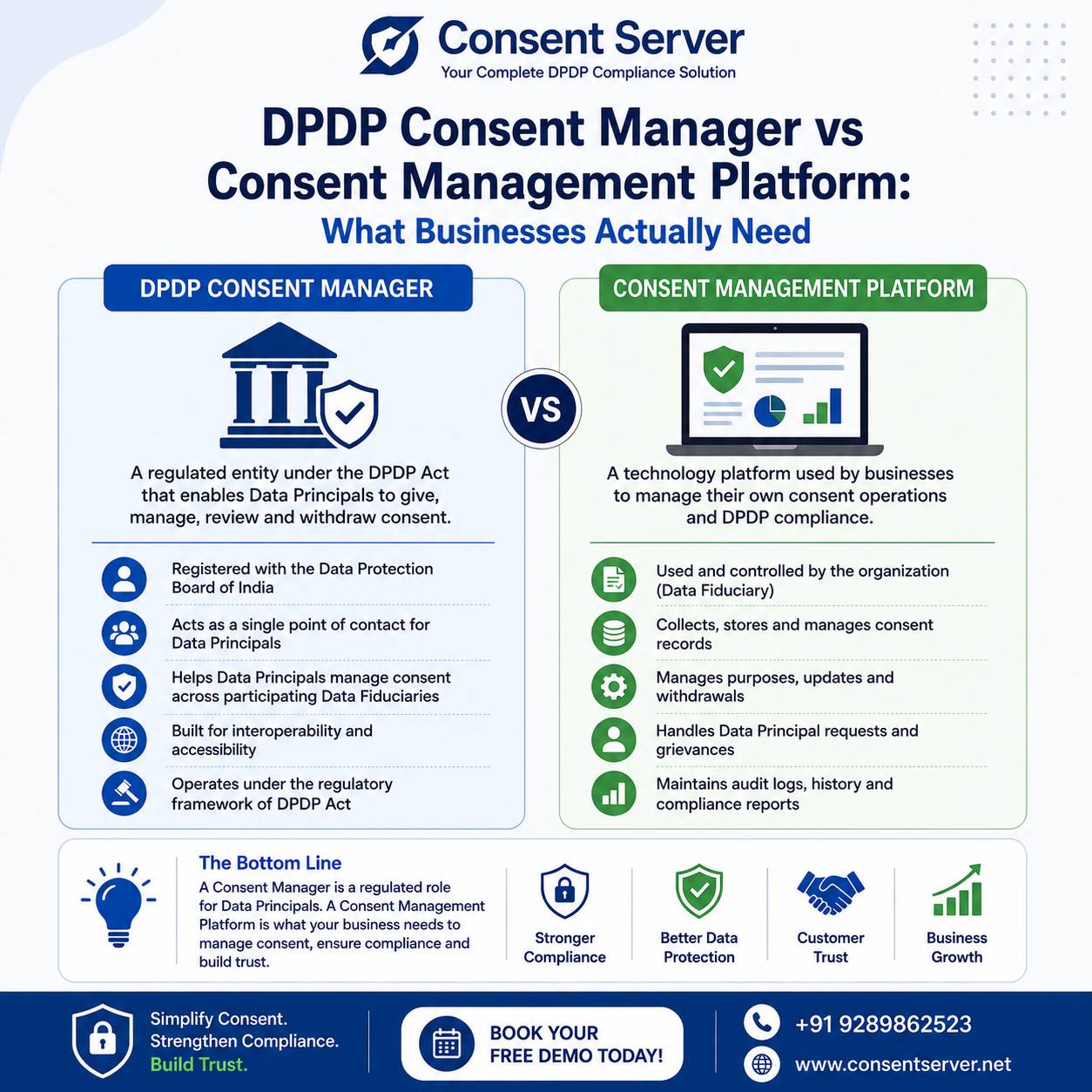
Consent Server is designed as a DPDP consent management platform for Data Fiduciaries that need more than a website consent checkbox.
It is designed to support capabilities such as:
Purpose-wise consent management
Consent form management
Consent history
Consent updates and revocation
Verification options
Data Principal self-service workflows
Audit trails
Role-based access
APIs and webhooks
Lifecycle automation
Reporting
Encrypted consent records
Tamper-detection mechanisms
Self-hosted and on-premise deployment options
The objective is to allow organisations to manage consent as a central business and compliance process rather than keeping consent logic fragmented across individual websites and applications.
For organisations that prefer greater infrastructure control, Consent Server can be deployed within their own environment.
Should You Move Away From Shared Hosting?
Not necessarily.
If you are a small organisation with a simple website, limited consent requirements and minimal integrations, building a lightweight solution on shared hosting may be completely reasonable.
The mistake would be assuming that the same architecture will automatically remain suitable when your organisation has:
Multiple applications
Large numbers of Data Principals
Different consent purposes
Multiple administrators
Consent version history
Withdrawals and updates
APIs and webhooks
Audit requirements
Complex security policies
Internal enterprise integrations
At that point, infrastructure should be evaluated again.
Final Answer
So, can you run a DPDP Consent Management System on shared hosting?
Yes.
A basic consent application can absolutely be built and operated on shared Linux hosting.
But whether you should use shared hosting depends on what you are actually trying to build.
If your requirement is:
Website --> Checkbox --> Database
shared hosting may be sufficient.
If your requirement becomes:
Collect --> Verify --> Record --> Manage --> Update --> Withdraw --> Integrate --> Monitor --> Audit --> Prove
you are dealing with a much broader consent management infrastructure problem.
At that stage, dedicated cloud infrastructure, VPS or on-premise deployment may offer advantages in control, integration, security architecture, performance and operational governance.
The correct question for a business therefore should not be:
“Can we save money by running it on our existing hosting?”
It should be:
“What infrastructure does our organisation actually require to securely and reliably manage the complete consent lifecycle?”
That answer will be different for a small website, a hospital, a FinTech company and a large enterprise.
And that is exactly why a professional DPDP Consent Management Platform should offer businesses deployment choices rather than forcing every organisation into the same infrastructure model.
Want to understand which deployment model is suitable for your organisation? Explore Consent Server and book a free demo to evaluate your DPDP consent management requirements.
Disclaimer: This article is intended for general informational purposes only and does not constitute legal advice. Organisations should evaluate their obligations, infrastructure and security requirements under the DPDP Act, DPDP Rules and other applicable laws with appropriate technical and legal professionals.