Central Consent Management System for DPDP | Consent Server
Learn how a Central Consent Management System uses APIs, webhooks, retries and escalation to sync consent changes across applications for DPDP compliance.
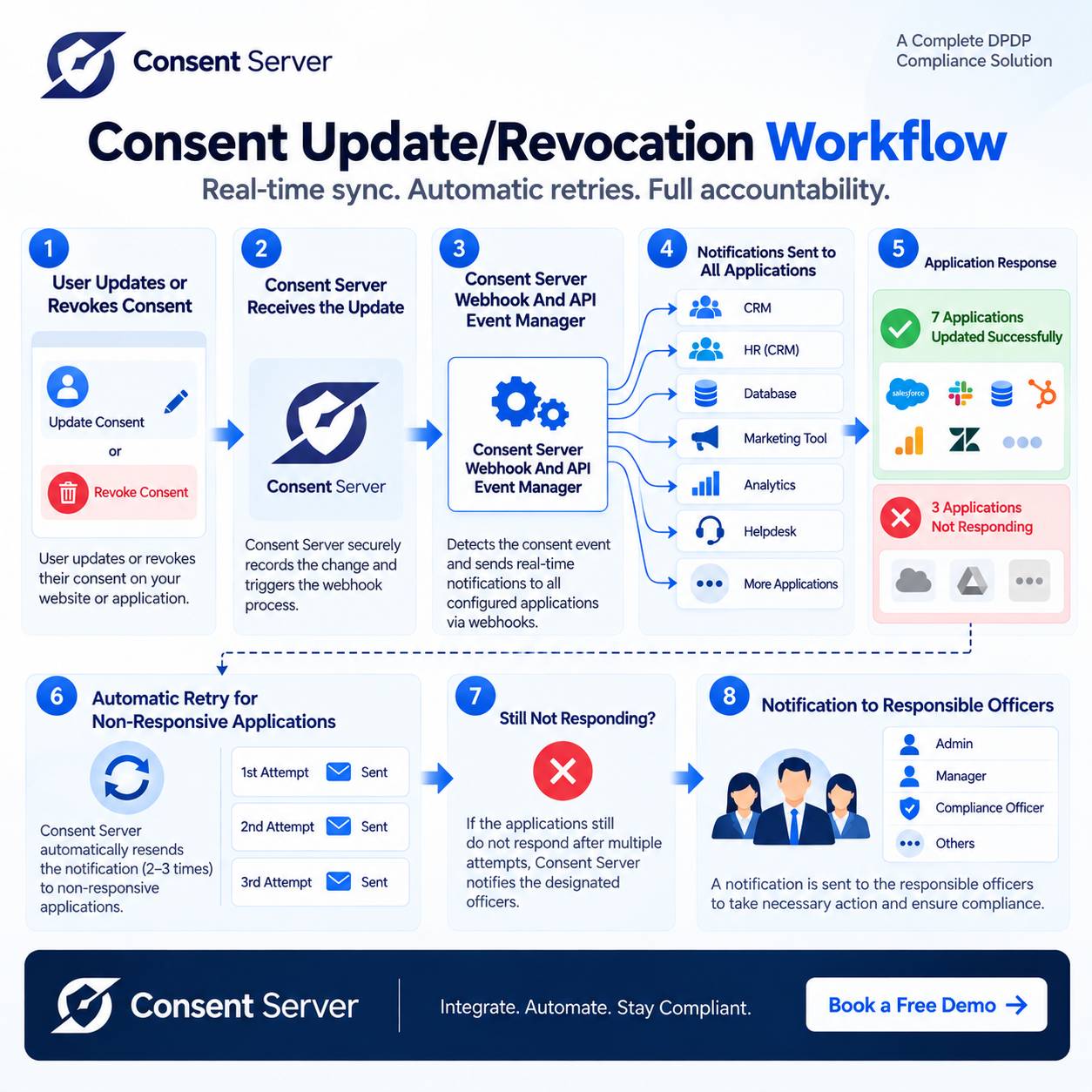
Central Consent Management System: How Consent Server Keeps Consent Updated Across Every Application
Today, personal data is rarely stored in just one system. A business may have customer information across its website, mobile application, CRM, HR platform, marketing tools, databases, analytics software, helpdesk, and multiple third-party applications.
This creates an important challenge for DPDP compliance: what happens when a Data Principal updates or withdraws consent?
Updating the consent status only inside a Consent Management Platform is not enough operationally if connected applications continue using the old consent status.
A Central Consent Management System can solve this problem by acting as the central source for consent status and coordinating consent changes across connected systems.
What Is a Central Consent Management System?
A Central Consent Management System provides one centralized platform for managing consent collected through different channels and applications.
Instead of every application independently maintaining consent, businesses can connect their systems with a central DPDP Consent Management Platform.
Consent Server is designed around this approach. It can centrally maintain consent records while APIs, webhooks, event management, audit trails, and automated workflows help communicate consent changes to relevant connected applications.
How the Consent Server Workflow Works
Consider an organisation where the same customer data is being used across 10 different applications.
1. User Updates or Revokes Consent
The process begins when a Data Principal changes their consent preference.
For example, a customer may withdraw marketing consent or change previously selected purposes through a website, application, or Data Principal interface.
2. Consent Server Receives the Change
The request reaches Consent Server, where the new consent state is securely recorded.
The system maintains the relevant consent event and history so the organisation can establish what changed and when.
3. Webhook and API Event Manager Takes Control
This is where the centralized architecture becomes particularly useful.
The Consent Server Webhook and API Event Manager detects the consent event and determines which configured applications need to receive the change.
Instead of requiring employees to manually update multiple systems, Consent Server can initiate the downstream notification workflow.
4. Connected Applications Are Notified
The consent update can then be sent to relevant configured applications, such as:
- CRM
- HR systems
- Databases
- Marketing platforms
- Analytics systems
- Helpdesk software
- Other internal or third-party applications
Each application can use the received event to perform the action configured by the organisation.
For example, when marketing consent is withdrawn, the relevant marketing or CRM system can update the customer's communication preference.
What Happens If Some Applications Do Not Respond?
Real-world integrations are not always perfect.
Suppose Consent Server sends a consent update to 10 applications. Seven applications successfully process the request, but three applications are temporarily unavailable or do not respond.
A robust DPDP Management System should not simply forget about those failed deliveries.
Consent Server's workflow can track the delivery status and identify applications where the consent event remains pending or unsuccessful.
Automatic Retry Mechanism
For non-responsive applications, the Consent Server Webhook and API Event Manager can automatically retry delivery according to the configured retry policy.
For example, the system may attempt delivery two or three times.
Each attempt can be recorded so administrators have visibility into whether the consent event was successfully communicated.
This is important because consent management is not only about storing a user's decision. Organisations also need operational processes that help relevant systems respect that decision.
Escalation to Responsible Officers
What if an application remains non-responsive even after multiple attempts?
Instead of silently leaving the event unresolved, Consent Server can escalate the issue.
A notification can be generated for designated responsible personnel such as an:
Admin, Manager, Compliance Officer, or other authorized officer.
The responsible person can then investigate why the connected application has not processed the consent event and take the necessary action.
This creates an important accountability layer.
The workflow therefore becomes:
Consent Change → Central Record → Event Manager → Connected Applications → Delivery Tracking → Automatic Retry → Human Escalation
Why This Architecture Matters for DPDP Compliance
A basic consent form or checkbox may capture a user's initial choice, but enterprise consent management requires much more.
Organisations need to know the current consent status, maintain history, communicate relevant changes, identify failed downstream updates, and maintain appropriate evidence of what happened.
A centralized DPDP Platform makes these processes easier to control.
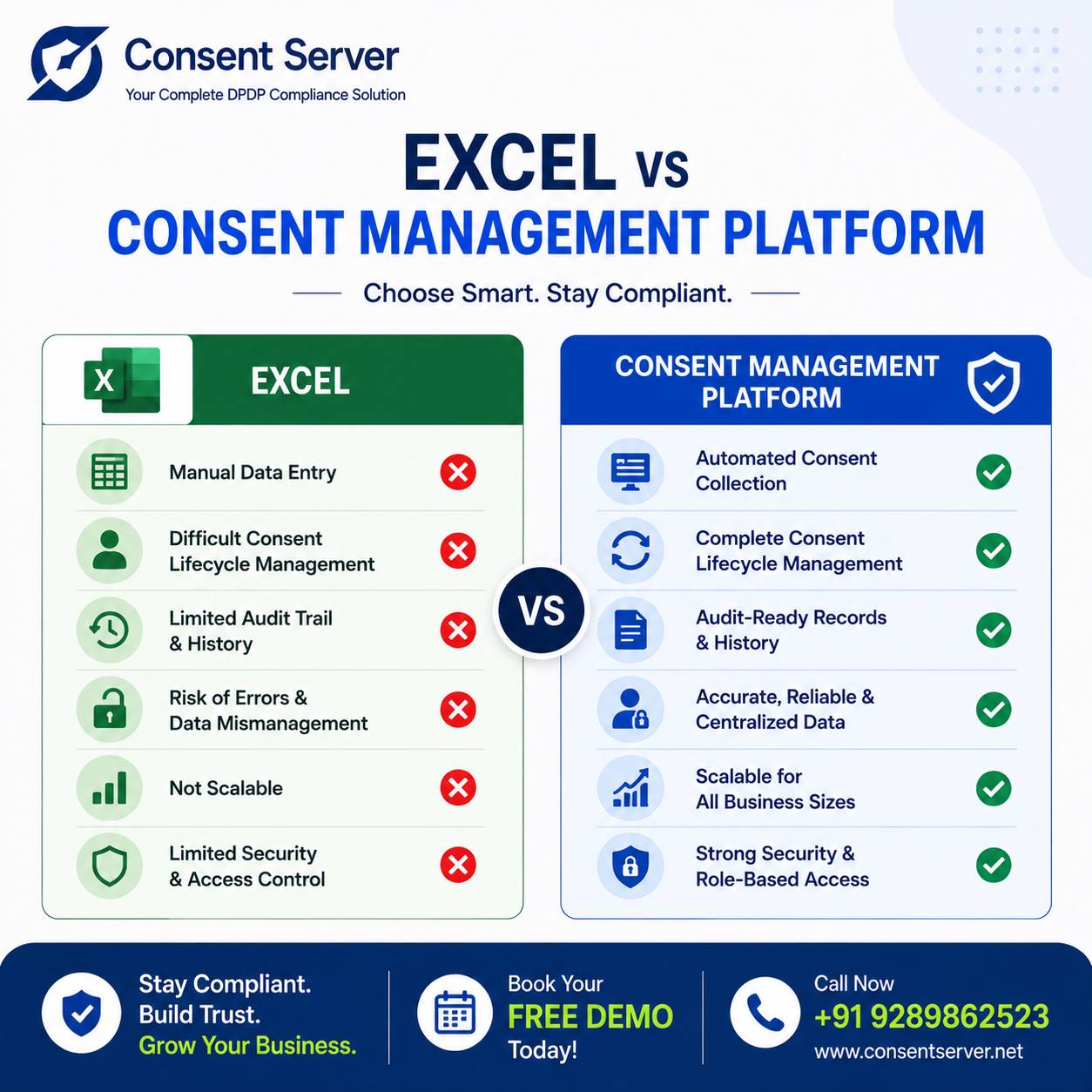
It also provides businesses with better visibility than maintaining separate consent records across CRM systems, spreadsheets, applications, and databases.
Consent Server as Your Central DPDP Consent Management Platform
Consent Server is built to provide organisations with a centralized infrastructure for managing the consent lifecycle.
It combines Consent Management, APIs, webhooks, event tracking, retry mechanisms, audit-ready records, Data Principal workflows, grievance management, lifecycle automation, reporting, and role-based administration.
Instead of replacing your existing CRM, HRMS, databases, or business applications, Consent Server can act as the central consent layer connecting them.
This makes Consent Server a strong solution for organisations looking for a Consent Management Platform, DPDP Platform, DPDP Management System, DPDP Consent Management Platform, or DPDP Consent Server for their compliance architecture.
From Consent Collection to Consent Enforcement
The real value of a Central Consent Management System is not simply collecting consent.
It is ensuring that consent remains manageable throughout its lifecycle.
When consent is given, updated, or withdrawn, the organisation needs a structured mechanism to record the event and communicate relevant changes throughout its technology ecosystem.
That is exactly where Consent Server helps businesses move from simple consent collection toward centralized, automated, and accountable consent management.
Centralize Consent. Synchronize Applications. Automate Compliance.
If your organisation is preparing for the DPDP Act and needs a complete consent management infrastructure, you can explore how Consent Server can integrate with your existing systems.