Consent Manager vs CMP: Key Differences Under DPDP Act
Consent Manager vs Consent Management Platform: Learn key differences, DPDP registration requirements, legal roles and which solution Indian businesses need.
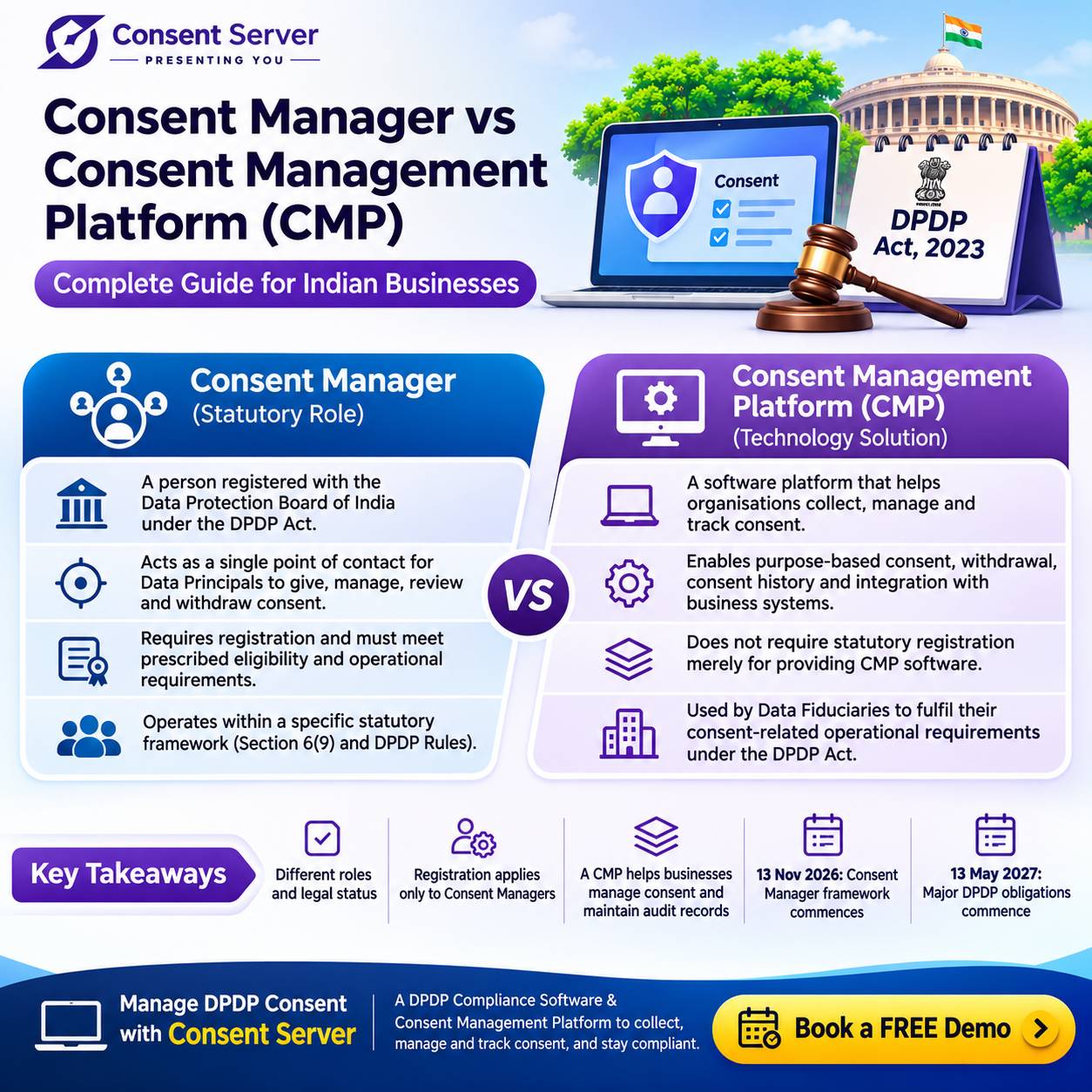
Consent Manager vs Consent Management Platform: Complete Guide for Indian Businesses Under the DPDP Act
Introduction: Consent Manager and Consent Management Platform Are Not the Same
India's Digital Personal Data Protection (DPDP) Act, 2023, has introduced significant changes to how organisations must handle digital personal data. As businesses prepare for DPDP compliance, two terms are becoming increasingly common: Consent Manager and Consent Management Platform (CMP).
Although these terms sound similar, they represent two different concepts.
A Consent Manager is a specific statutory role recognised under the DPDP Act. A Consent Management Platform is a technology solution that helps organisations collect, manage, track, and maintain records of consent.
Understanding this difference is important for Data Fiduciaries, compliance professionals, IT teams, business owners, and organisations evaluating DPDP compliance software.
A common question is:
Does every Indian business need a registered Consent Manager, or can it implement a Consent Management Platform to manage its own consent obligations?
The answer depends on the organisation's role and the activities it performs.
This guide explains the differences between a Consent Manager and a CMP, their legal responsibilities, registration requirements, technical capabilities, and how businesses can prepare for DPDP compliance.
1. What Is a Consent Manager Under the DPDP Act?
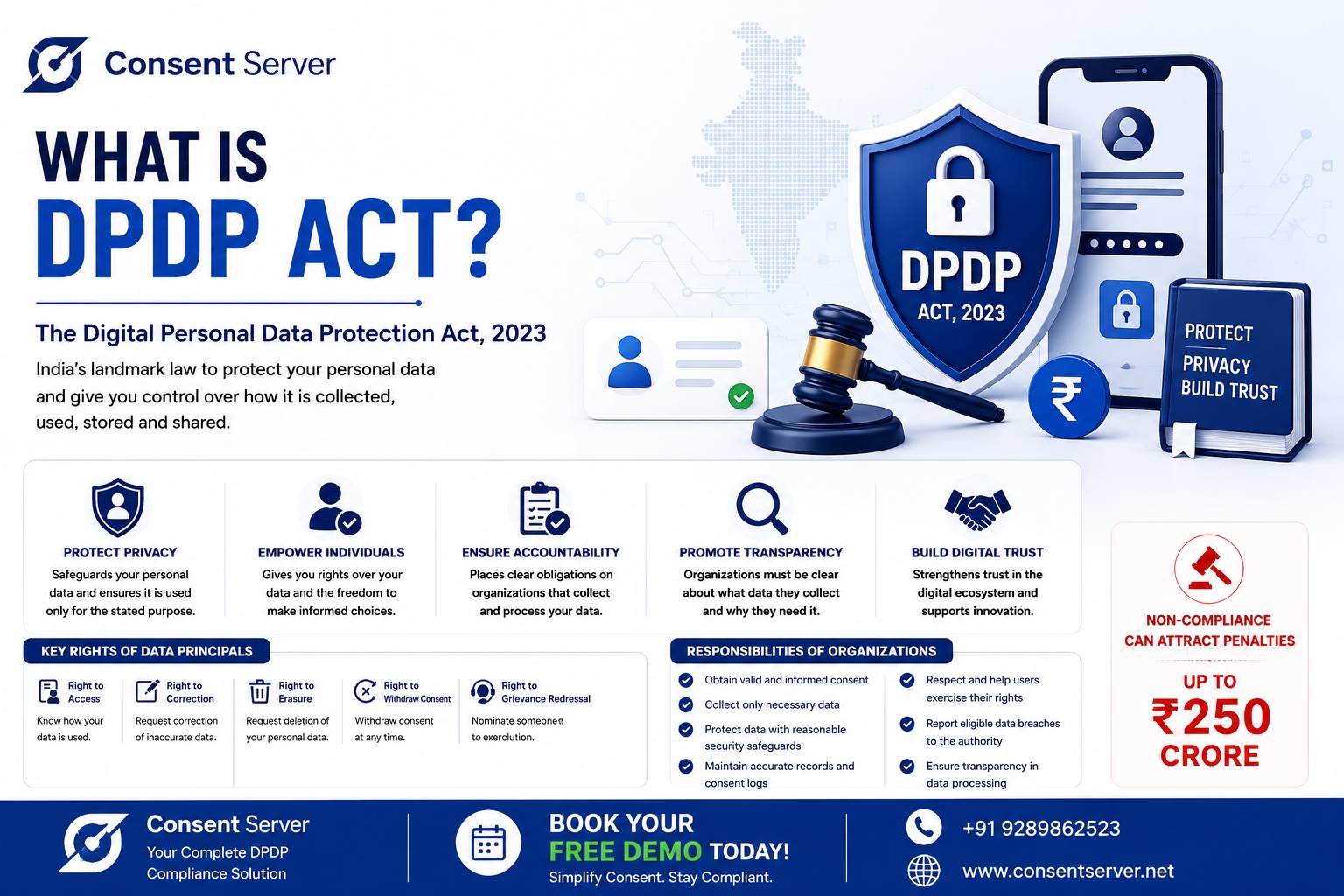
Under Section 6(9) of the Digital Personal Data Protection Act, 2023, a Consent Manager is a person registered with the Data Protection Board of India who acts as a single point of contact to enable Data Principals to give, manage, review, and withdraw their consent through an accessible, transparent, and interoperable platform.
In simpler terms, a registered Consent Manager helps individuals manage their consent choices through a legally recognised framework.
The Consent Manager operates in a specific statutory capacity and must meet the registration and operational requirements prescribed under the DPDP Rules.
Key Functions of a Registered Consent Manager
A registered Consent Manager is intended to:
- Enable Data Principals to give consent.
- Allow individuals to review and manage their consent choices.
- Facilitate withdrawal of consent.
- Provide an accessible and transparent consent-management interface.
- Support interoperability within the applicable statutory framework.
- Meet applicable registration, governance, security, and accountability requirements.
A Consent Manager is not simply a company that stores consent records.
It is an entity registered to perform a particular function under the DPDP Act.
2. What Is a Consent Management Platform (CMP)?
A Consent Management Platform (CMP) is a software system designed to help organisations manage consent-related processes across websites, mobile applications, databases, and business systems.
Unlike a registered Consent Manager, a CMP is not automatically a statutory entity under the DPDP Act.
Instead, it provides technical infrastructure that Data Fiduciaries can use to support their own legal and operational responsibilities.
For example, a hospital may use a CMP to manage consent for optional patient communications. An e-commerce business may use a CMP to manage consent for promotional marketing. An educational institution may use a CMP to maintain relevant student and parent consent records.
Key Functions of a CMP
Depending on the product, a Consent Management Platform may provide:
- Purpose-based consent collection.
- Customisable consent forms.
- Consent granting, updating, and withdrawal.
- Consent history and audit trails.
- Privacy notice and purpose versioning.
- Centralised consent dashboards.
- API and webhook integrations.
- Data Principal rights request workflows.
- Consent status synchronisation across connected applications.
- Reporting and evidence management.
- On-premise or hosted deployment.
A CMP helps organisations operationalise consent management, but the Data Fiduciary remains responsible for satisfying applicable DPDP obligations.
3. Consent Manager vs Consent Management Platform: Key Differences
The following comparison explains how the two concepts differ.
| Comparison | Registered Consent Manager | Consent Management Platform (CMP) |
|---|---|---|
| Definition | Statutory role recognised under the DPDP Act | Software solution for managing consent |
| Legal Status | Registered under the applicable statutory framework | Not automatically a registered statutory entity |
| Registration | Required to operate as a statutory Consent Manager | Not required merely for providing CMP software |
| Primary Objective | Help Data Principals manage consent through the statutory framework | Help organisations manage their consent-related operations |
| Typical Users | Data Principals and participating Data Fiduciaries | Businesses, compliance teams, IT teams, and Data Fiduciaries |
| Main Focus | Accessible, transparent, and interoperable consent management | Consent collection, lifecycle tracking, records, and system integration |
| Regulatory Requirements | Specific eligibility, registration, and operational requirements | Depends on the provider's role and applicable laws |
| Integration | Interoperability under the statutory framework | APIs, webhooks, SDKs, and enterprise application integrations |
| Audit Records | Records required under the applicable Consent Manager framework | Technical records supporting the Data Fiduciary's compliance processes |
| Example | An entity registered with the Data Protection Board as a Consent Manager | Consent Server, a commercial DPDP consent management platform |
The most important distinction: A registered Consent Manager performs a statutory function, while a CMP provides technology that businesses can use to manage their own consent processes.
4. Is Consent Manager Registration Mandatory for Every Indian Business?
No.
The DPDP Act does not require every Data Fiduciary to become a registered Consent Manager.
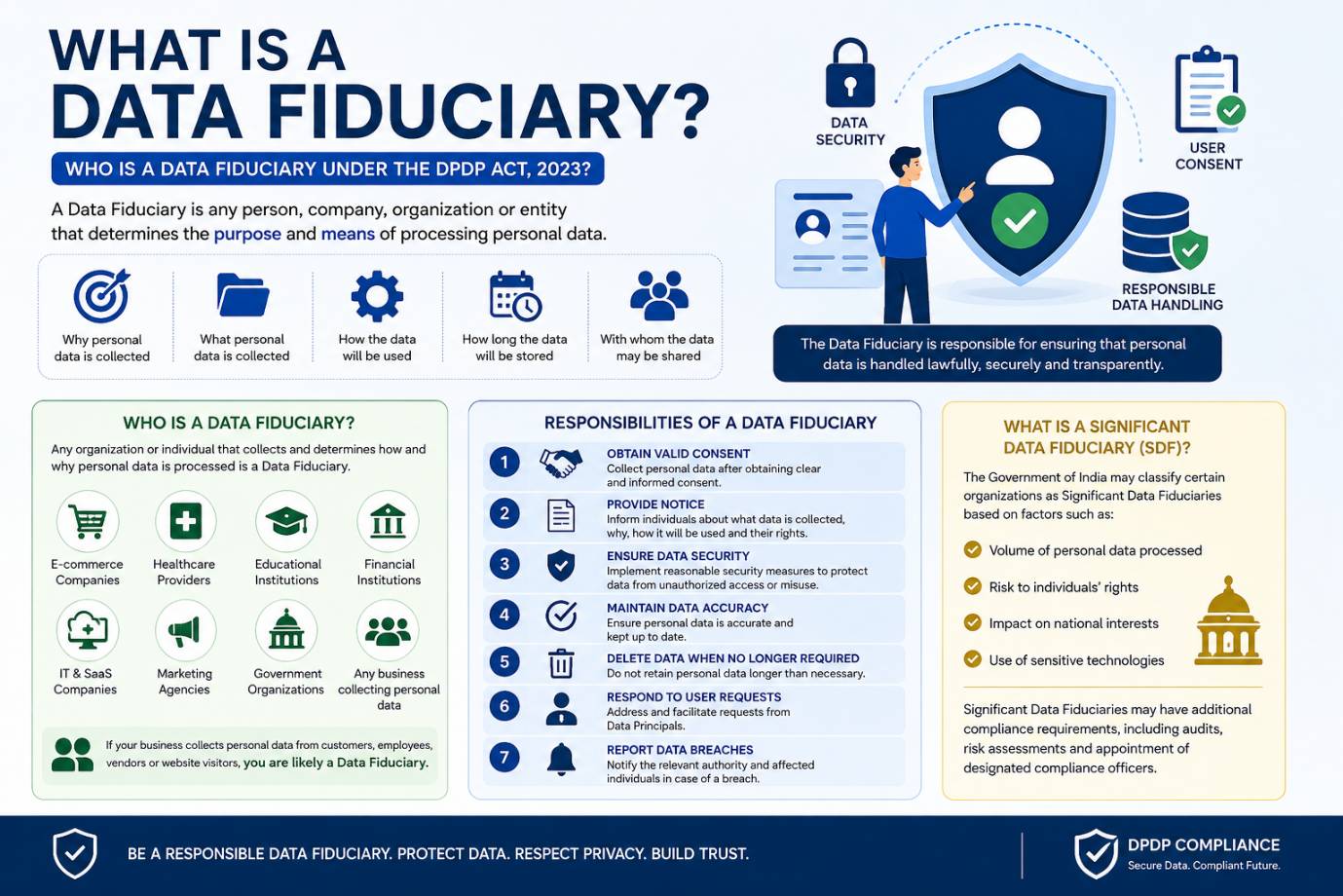
A Data Fiduciary is a person who, alone or in conjunction with others, determines the purpose and means of processing personal data.
Businesses such as hospitals, banks, e-commerce companies, educational institutions, and SaaS providers may act as Data Fiduciaries.
Their obligations depend on the nature of their personal data processing activities and the applicable provisions of the Act.
For example, consider an e-commerce company collecting consent for promotional messages.
The company may implement a CMP to record customer preferences, manage consent withdrawal, and communicate changes to its marketing systems.
This activity does not automatically make the company a statutory Consent Manager.
Similarly, purchasing a CMP does not require the business to register as a Consent Manager merely because the software contains consent-management functionality.
However, an organisation seeking to offer services in the statutory Consent Manager role must satisfy the applicable registration requirements.
5. Consent Manager Registration Requirements Under the DPDP Rules
The DPDP Rules, 2025, establish requirements for organisations seeking registration as Consent Managers.
Under Rule 4 and the First Schedule, applicants must meet specified eligibility and operational conditions.
These include requirements relating to:
Organisational Eligibility
The applicant must satisfy the prescribed organisational conditions, including incorporation requirements.
Financial Capacity
The framework specifies a minimum net worth requirement of ₹2 crore, alongside other eligibility conditions.
Technical Capability
Applicants must demonstrate appropriate technical and operational capabilities to perform the statutory Consent Manager function.
Governance and Accountability
Registered Consent Managers must meet the applicable governance and accountability requirements.
Security and Interoperability
The statutory framework includes requirements relevant to secure, transparent, and interoperable consent management.
Meeting one eligibility requirement does not automatically qualify an organisation for registration.
The applicant must satisfy the complete applicable framework and obtain registration from the Data Protection Board.
6. What Changes on 13 November 2026?
Under the phased commencement schedule notified in November 2025, the statutory Consent Manager-related provisions are scheduled to commence on 13 November 2026.
This milestone is important for organisations intending to operate as registered Consent Managers.
However, it should not be confused with the commencement of all major DPDP obligations for Indian businesses.
Important DPDP Implementation Dates
| Date | Major Milestone |
|---|---|
| 13 November 2025 | Initial provisions of the DPDP framework commence |
| 13 November 2026 | Statutory Consent Manager registration-related provisions scheduled to commence |
| 13 May 2027 | Major operational obligations for Data Fiduciaries scheduled to commence |
The 13 November 2026 milestone does not mean every Indian company must register as a Consent Manager.
Businesses should distinguish between the statutory registration framework and their broader responsibilities as Data Fiduciaries.
These dates reflect the notified phased schedule and should be checked against any subsequent official amendments.
7. Does Every Data Processing Activity Require Consent?
No.
This is another important consideration when evaluating consent-management solutions.
Under Section 4 of the DPDP Act, personal data processing may be based on consent or on applicable certain legitimate uses specified under Section 7.
Therefore, not every processing activity requires consent.
For example, certain processing activities may qualify under Section 7, depending on the circumstances and statutory conditions.
Organisations should identify the appropriate legal basis for each processing purpose rather than automatically collecting consent for every activity.
Where consent is relied upon, the organisation must satisfy the applicable requirements for valid consent and notice.
A CMP can help manage consent-based activities, but it should not replace the organisation's legal-basis assessment.
8. Why Do Indian Businesses Need a Consent Management Platform?
Managing consent across multiple systems can become complicated.
Consider a business operating:
- A corporate website.
- A mobile application.
- A CRM system.
- An email marketing platform.
- An SMS gateway.
- A WhatsApp communication system.
- An ERP or internal database.
A customer may initially provide consent through the website.
That consent information may then influence how multiple connected systems process personal data.
Now suppose the customer withdraws consent for promotional communications.
The business must identify the affected processing activities and ensure the withdrawal is appropriately implemented.
Without a centralised consent-management process, relevant systems may continue operating with outdated consent information.
A CMP helps organisations manage this operational challenge.
Example: Consent Withdrawal Across Business Systems
A customer withdraws consent for marketing communications.
An appropriately configured CMP may:
- Record the withdrawal request.
- Update the central consent status.
- Identify affected processing purposes.
- Notify relevant connected applications.
- Track whether those systems received the update.
- Record acknowledgements and completed actions.
- Preserve relevant evidence for compliance review.
This is an illustrative technical workflow, not a mandatory system architecture prescribed by the DPDP Act.
The objective is to ensure that consent changes are not confined to a single website or application.
9. Why Consent Audit Trails Matter Under the DPDP Act
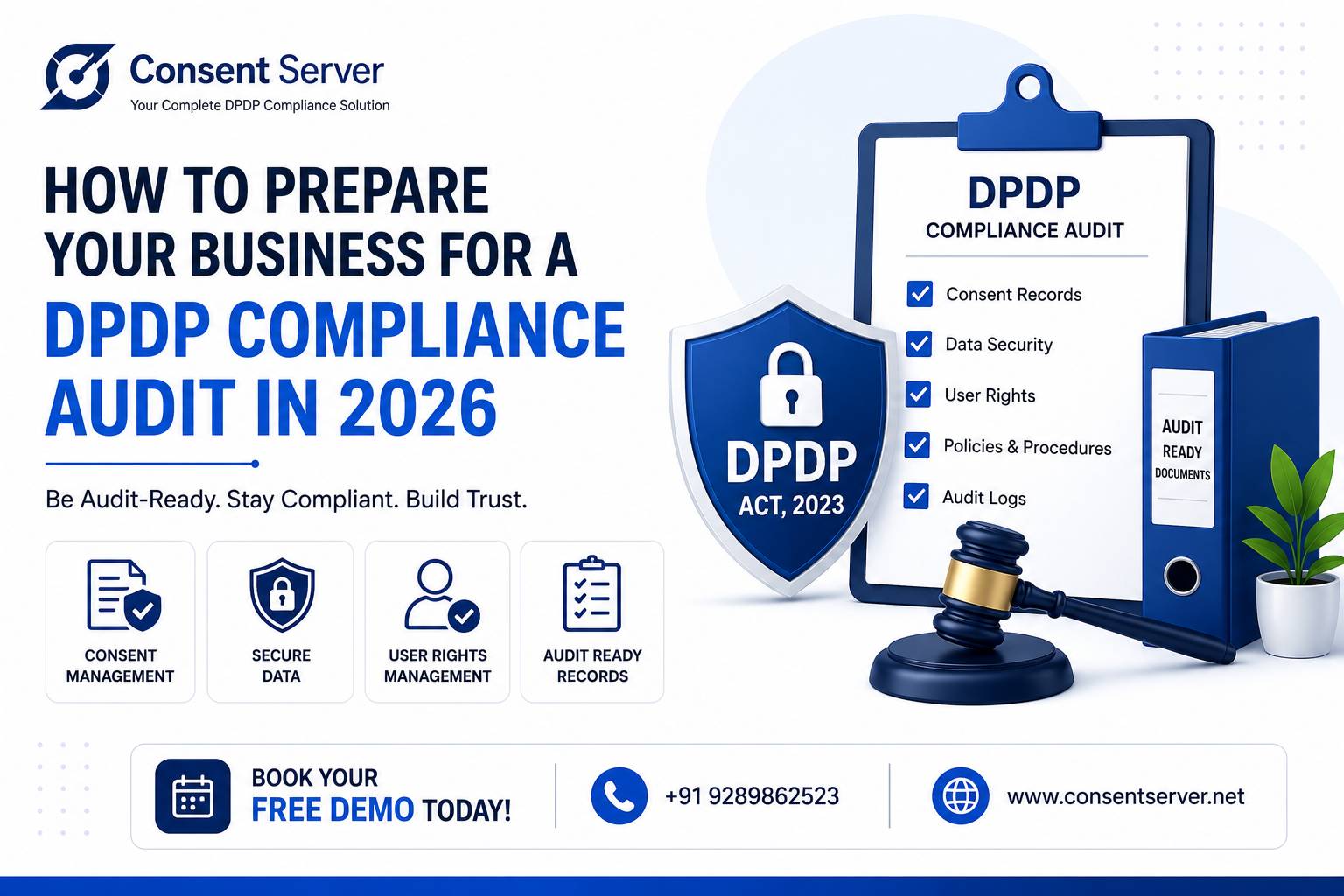
Under Section 6(10) of the DPDP Act, where consent is relied upon and questioned in a proceeding, the Data Fiduciary bears the burden of proving that the required notice was given and consent was obtained in accordance with the Act.
This makes reliable consent records important.
A simple checkbox may capture an affirmative choice, but it may not provide sufficient context to demonstrate what the individual agreed to.
Recommended Consent Evidence
A business may maintain records such as:
| Evidence | Purpose |
|---|---|
| Consent ID | Identifies a particular consent record |
| Data Principal Reference | Associates the record with the relevant individual |
| Consent Timestamp | Shows when consent was recorded |
| Processing Purpose | Identifies the activity covered by consent |
| Privacy Notice Version | Identifies the notice presented |
| Consent Form Version | Identifies the consent interface used |
| Affirmative Action | Helps demonstrate how consent was expressed |
| Consent Status History | Tracks changes over time |
| Withdrawal Record | Documents relevant withdrawal activity |
| Connected-System Evidence | Helps verify downstream implementation |
These are recommended technical evidence fields rather than a universally mandated database schema.
Organisations should determine appropriate evidence and retention practices based on their actual legal obligations.
10. Can a CMP Replace a Registered Consent Manager?
A CMP and a registered Consent Manager perform different functions, so the answer depends on what an organisation is trying to achieve.
If a business wants to manage its own consent forms, consent history, withdrawal workflows, and connected applications, a CMP may provide the required technical capabilities.
However, a commercial CMP does not automatically replace the statutory role of a registered Consent Manager.
Similarly, a registered Consent Manager does not necessarily replace every internal consent-management, recordkeeping, or system-integration capability a Data Fiduciary may need.
The two may coexist.
For example, a business may maintain its internal CMP while also supporting interactions with registered Consent Managers where relevant.
The appropriate architecture depends on the business's processing activities, integration requirements, and applicable legal obligations.
11. How Consent Server Helps Businesses Manage DPDP Consent Requirements
Consent Server is a DPDP Compliance Software and Consent Management Platform developed by Iconic Infotech Pvt. Ltd.
It is designed to help Indian organisations manage consent-related workflows through centralised records, lifecycle automation, and integration with existing applications.
Consent Server is a commercial CMP and should not be confused with a statutory registered Consent Manager.
Purpose-Based Consent Collection
Consent Server enables businesses to configure consent forms for specific processing purposes.
This helps organisations avoid relying entirely on broad, generic consent statements.
Centralised Consent Dashboard
Businesses can manage relevant consent records and lifecycle activities through a central interface.
Consent Lifecycle Management
The platform supports consent granting, updating, renewal, expiry, and withdrawal.
Privacy Notice and Purpose Versioning
Consent Server helps maintain relevant notice, purpose, and form versions associated with consent records.
Audit Trail and Integrity Controls
The platform maintains consent histories and supports hash-based integrity verification to help identify unauthorised modifications.
These technical controls support evidence management but do not independently guarantee legal compliance.
API and Webhook Integration
Consent Server can communicate relevant consent changes to CRM, ERP, marketing, and other connected systems.
Acknowledgement and Completion Tracking
The platform supports an operational workflow such as:
Consent Event --> Webhook/API Notification --> Delivered --> Acknowledged --> Action Completed --> Completion Evidence
This distinction matters because successful message delivery does not automatically prove that a connected system completed the required action.
Data Principal Rights Management
Consent Server supports workflows for access, correction, erasure, consent withdrawal, and grievances.
On-Premise Deployment
For organisations that prefer to retain greater control over their infrastructure, Consent Server offers on-premise deployment options.
Hosted deployment options are also available.
Integration With Existing Business Systems
Consent Server is designed to integrate with existing applications through APIs, webhooks, and related technical mechanisms, helping reduce the need for extensive system replacement.
12. Consent Manager vs CMP: Which One Does Your Business Need?
The correct choice depends on the organisation's intended role and operational requirements.
For many Data Fiduciaries, the immediate technology requirement is an effective internal consent-management system—not registration as a statutory Consent Manager.
However, a CMP is only one component of a broader DPDP compliance programme.
13. Common Misconceptions About Consent Managers and CMPs
Myth 1: Every Indian Business Must Register as a Consent Manager
Fact: Registration applies to entities seeking to operate in the statutory Consent Manager role. It is not a universal registration requirement for all Data Fiduciaries.
Myth 2: A Consent Management Platform Is Automatically a Registered Consent Manager
Fact: Providing consent-management software does not automatically confer statutory Consent Manager status.
Myth 3: Installing a CMP Guarantees DPDP Compliance
Fact: Software can support compliance workflows, but organisations must also address legal bases, notices, security safeguards, contractual arrangements, rights requests, retention, breach response, and other applicable requirements.
Myth 4: Consent Is Mandatory for Every Personal Data Processing Activity
Fact: The DPDP Act permits processing based on consent or applicable certain legitimate uses under Section 7.
Myth 5: A Consent Checkbox Is Enough to Demonstrate Compliance
Fact: A checkbox alone may not establish what notice was provided, which purpose was covered, or whether consent was validly obtained.
Myth 6: A Successful Webhook Means Consent Withdrawal Has Been Completed
Fact: Delivery, acknowledgement, and action completion are different operational events. Businesses should distinguish between them when maintaining evidence.
14. How to Choose the Right DPDP Consent Management Platform
When evaluating DPDP consent management software, businesses should assess both legal requirements and technical capabilities.
Purpose-Based Consent Management
Can the platform manage consent separately for different processing purposes?
Consent Lifecycle Tracking
Can it maintain relevant histories of consent granting, updates, withdrawal, renewal, and expiry?
Audit Evidence
Can the organisation retrieve records showing the notice, purpose, timestamp, and relevant consent action?
Integration Capabilities
Can the platform connect with existing CRM, ERP, marketing, and business applications?
Withdrawal Implementation
Can it help communicate consent withdrawal to affected systems and track implementation?
Data Principal Rights
Does it support appropriate request and grievance workflows?
Security Controls
Does the platform provide suitable access controls, integrity mechanisms, and operational safeguards?
Deployment Flexibility
Can the organisation choose an infrastructure model that meets its security and operational requirements?
Support and Maintenance
Does the vendor provide implementation assistance, technical support, and ongoing maintenance?
Businesses should evaluate these capabilities alongside their own compliance responsibilities and implementation budget.
15. Frequently Asked Questions
What is the main difference between a Consent Manager and a CMP?
A Consent Manager is a registered statutory entity under the DPDP Act. A CMP is software that helps organisations manage consent-related activities.
Is Consent Manager registration mandatory for every company in India?
No. It is required for entities seeking to operate in the statutory Consent Manager role, not automatically for every Data Fiduciary.
Is a CMP mandatory under the DPDP Act?
The Act does not generally mandate the purchase of a particular CMP product. Organisations must meet applicable legal requirements and may use suitable technical solutions to support compliance.
Can a business use Consent Server without registering as a Consent Manager?
Yes. Consent Server is a commercial CMP intended to help organisations manage their own consent-related workflows. Using it does not automatically require statutory Consent Manager registration.
Does a CMP handle consent withdrawal?
A CMP may provide withdrawal recording, lifecycle management, and connected-system notifications. Actual implementation depends on the platform's capabilities and the organisation's integrations.
Can Consent Server help with DPDP audit readiness?
Consent Server supports consent histories, notice versioning, audit records, integrity verification, and connected-system action tracking. These capabilities can support audit preparation.
When do major DPDP compliance obligations commence?
Under the notified phased schedule, major operational Data Fiduciary obligations are scheduled to commence on 13 May 2027, subject to any subsequent official changes.
16. Conclusion: Understand the Difference Before Choosing Your DPDP Compliance Solution
The terms Consent Manager and Consent Management Platform may sound similar, but they represent different roles within India's data protection ecosystem.
A registered Consent Manager operates under a specific statutory framework and helps Data Principals manage consent.
A CMP provides technical infrastructure that organisations can use to manage their own consent collection, records, withdrawal workflows, and integrations.
For Indian businesses preparing for DPDP compliance, understanding this distinction can prevent unnecessary confusion and help guide technology investments.
The priority should be to identify the organisation's actual processing activities, legal responsibilities, and operational requirements.
| Business Requirement | Appropriate Approach |
|---|---|
| Operate as a statutory Consent Manager | Obtain registration and meet the applicable statutory requirements |
| Collect consent through websites and applications | Implement suitable consent collection processes, potentially supported by a CMP |
| Maintain consent histories and notice versions | Use appropriate recordkeeping processes or CMP capabilities |
| Manage consent withdrawal across CRM and marketing systems | Establish integrated consent-management workflows |
| Handle Data Principal rights requests | Implement rights-management processes, potentially supported by compliance software |
| Support statutory Consent Manager interactions | Evaluate applicable interoperability and integration requirements |
| Maintain internal consent evidence | Implement appropriate audit records and controls |
| Achieve broader DPDP compliance | Establish a comprehensive legal, organisational, security, and technical compliance programme |
A well-designed consent-management platform can help organisations manage consent more consistently, maintain relevant evidence, and connect consent decisions with existing business systems.
Consent Server, developed by Iconic Infotech Pvt. Ltd., provides purpose-based consent management, lifecycle automation, audit-ready records, Data Principal rights workflows, and integration capabilities for Indian organisations.