DPDP Act 13 November 2026: What Changes in India?
What changes on 13 November 2026 under the DPDP Act? Understand Consent Manager registration, the May 2027 deadline and what Indian businesses should prepare.
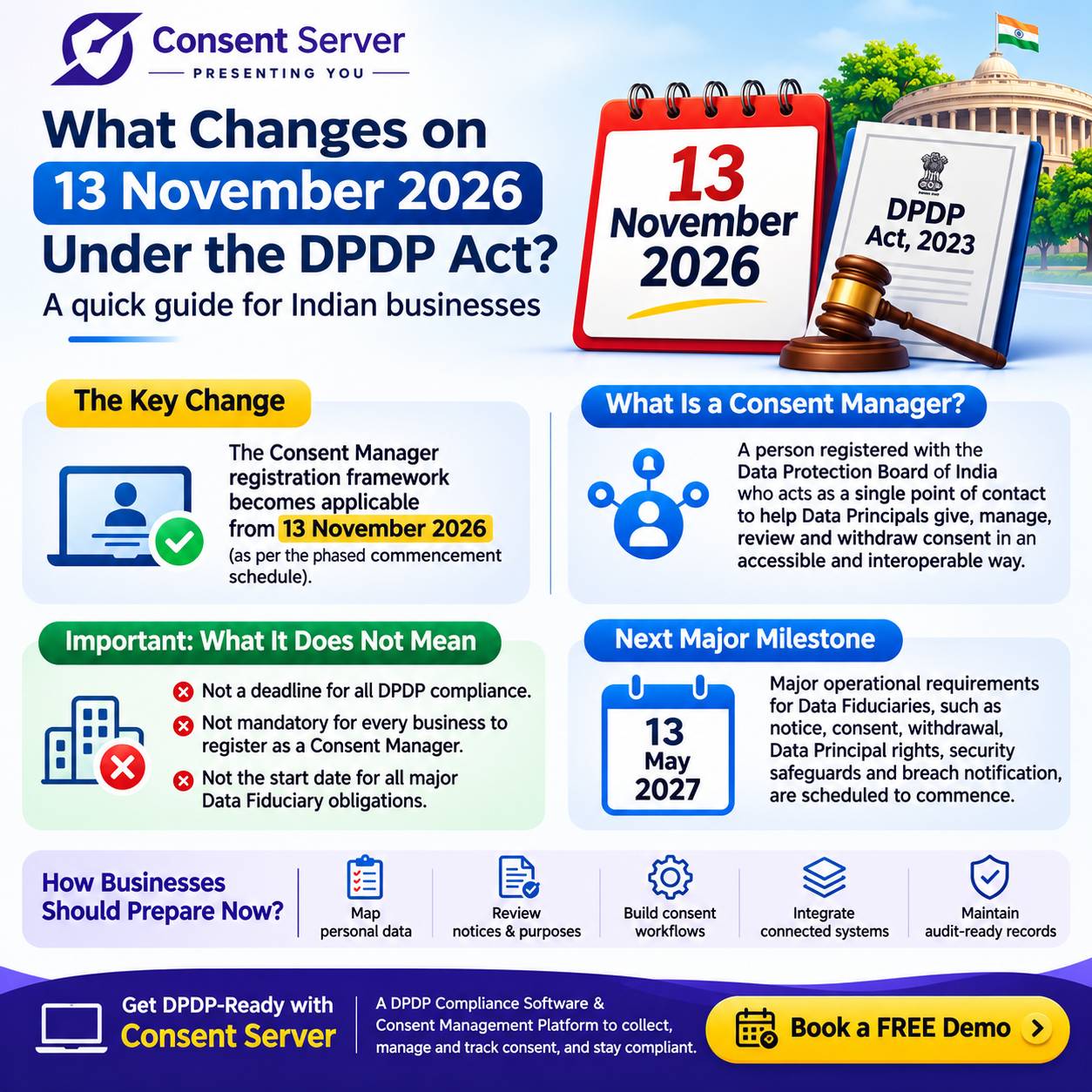
What Changes on 13 November 2026 Under the DPDP Act? A Complete Guide for Indian Businesses
Introduction: Why 13 November 2026 Matters for India's Data Privacy Framework
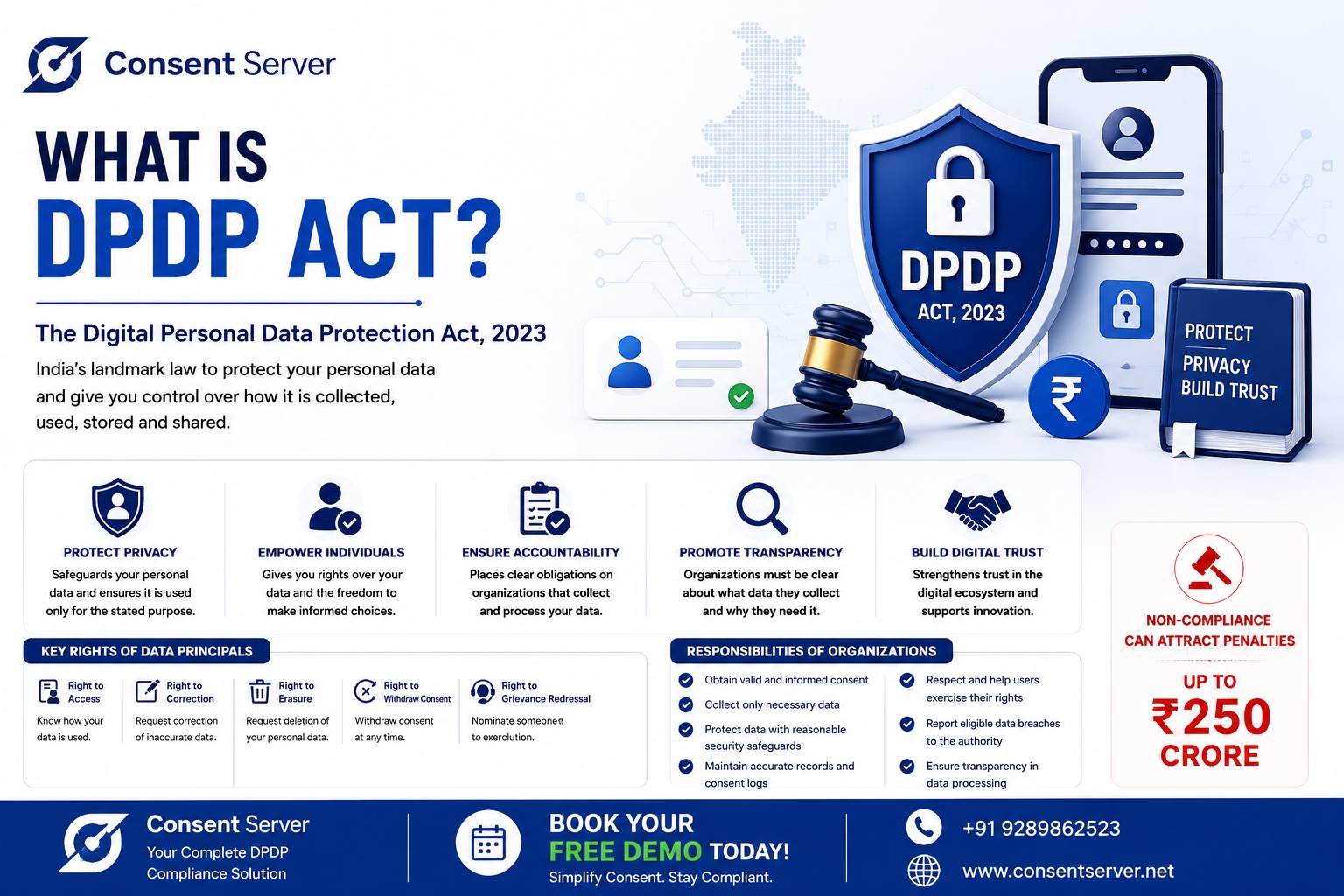
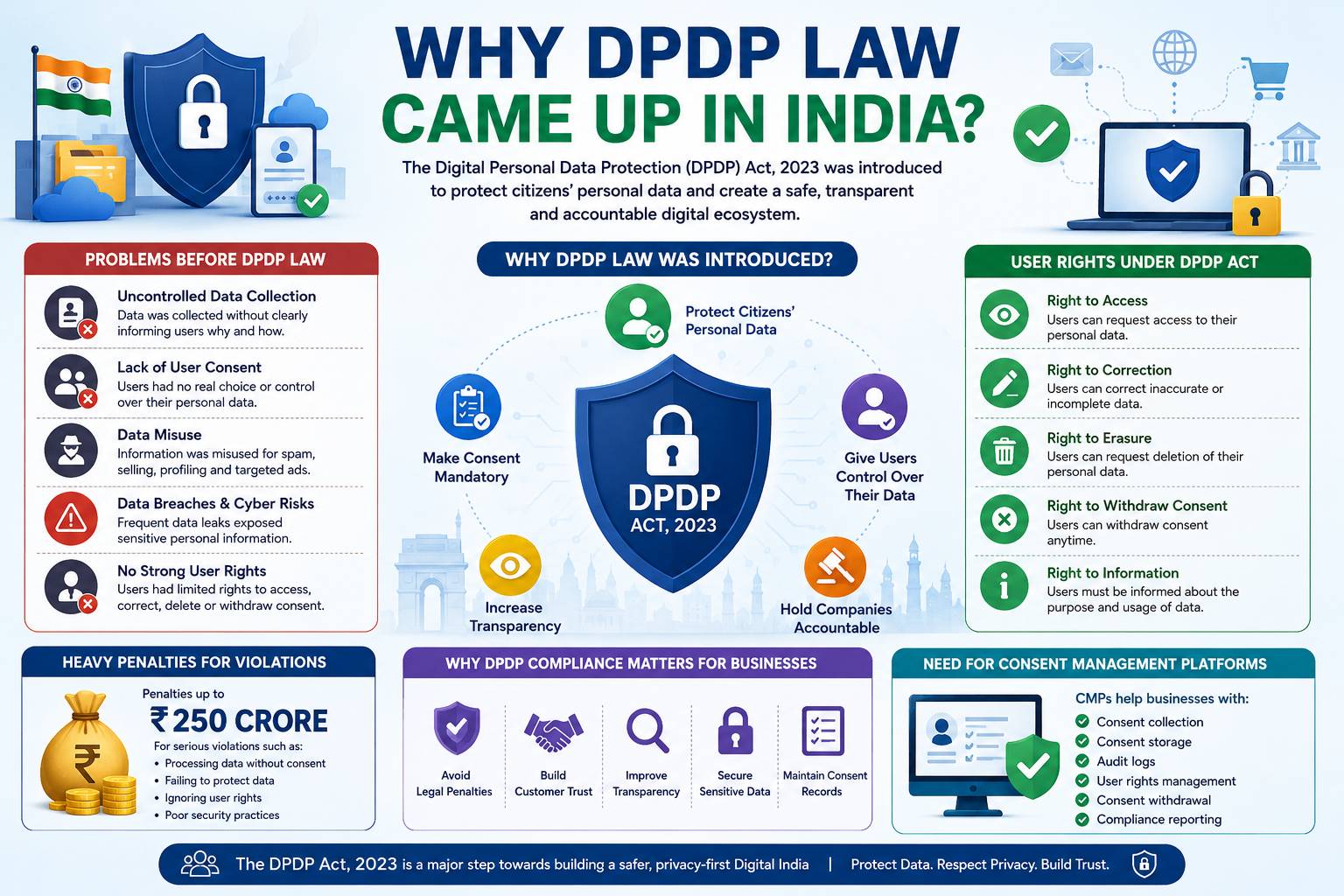
India's Digital Personal Data Protection (DPDP) Act, 2023 represents a major shift in how organisations collect, process, store, and manage personal data.
As businesses prepare for the implementation of the DPDP framework, one date is attracting particular attention:
13 November 2026.
But what exactly changes on this date?
Does every Indian business need to become DPDP compliant by 13 November 2026? Will penalties begin immediately? Is it mandatory for every company to appoint a registered Consent Manager?
These questions have created considerable confusion among Data Fiduciaries, compliance officers, IT teams, and business owners.
The important distinction is that 13 November 2026 is associated with the scheduled commencement of the statutory Consent Manager registration framework, not the general commencement of all operational DPDP obligations for Indian businesses.
Under the phased implementation schedule announced in November 2025, major operational requirements are scheduled for 13 May 2027.
This article explains what changes on 13 November 2026, what remains scheduled for 2027, and how businesses can use the intervening period to prepare their consent-management systems.
1. Understanding the DPDP Act Implementation Timeline
The DPDP Act and its accompanying Rules follow a phased commencement approach.
Different provisions become operational at different stages rather than all taking effect simultaneously.
The principal milestones are:
| Date | Implementation Milestone | Significance |
|---|---|---|
| 13 November 2025 | Initial provisions commence | Establishes parts of the institutional and regulatory framework |
| 13 November 2026 | Consent Manager-related provisions scheduled to commence | Introduces the statutory registration framework for Consent Managers |
| 13 May 2027 | Major operational provisions scheduled to commence | Brings key Data Fiduciary obligations into effect |
This phased approach is important because organisations must distinguish between the legal requirements applying to registered Consent Managers and those applying more broadly to Data Fiduciaries.
The DPDP Act does not impose one identical implementation deadline on every type of organisation or obligation.
2. What Exactly Changes on 13 November 2026?
The principal change scheduled for 13 November 2026 concerns the legal framework for Consent Managers under the DPDP Act.
A Consent Manager has a specific statutory meaning.
Under Section 6(9), a Consent Manager is a person registered with the Data Protection Board of India who acts as a single point of contact to enable a Data Principal to give, manage, review, and withdraw consent through an accessible, transparent, and interoperable platform.
The framework provides for registration and associated requirements under the DPDP Rules.
From the relevant commencement date, organisations seeking to operate in this statutory capacity must follow the applicable registration framework.
This is different from a business simply using software to collect and manage consent.
Key Implications
- The statutory Consent Manager registration framework becomes applicable according to the notified commencement schedule.
- Applicants seeking registration must satisfy the relevant eligibility and operational requirements.
- The Data Protection Board's role in registration becomes relevant.
- Registered Consent Managers must operate within the obligations applicable to that statutory role.
However, this does not mean that every company collecting customer data must register as a Consent Manager.
3. What Is a Registered Consent Manager Under the DPDP Act?
A registered Consent Manager is an intermediary operating under the statutory framework to help Data Principals manage consent across participating Data Fiduciaries.
Its role is different from that of an ordinary business managing consent for its own customers.
For example, an individual may interact with several digital services and wish to manage relevant consent choices through a registered Consent Manager.
The Consent Manager framework is intended to support accessible, transparent, and interoperable consent management.
Registration is subject to eligibility requirements and other conditions established by the applicable Rules.
Who May Seek Registration?
An organisation intending to operate as a statutory Consent Manager must evaluate the requirements under Rule 4 and the First Schedule of the DPDP Rules.
These include conditions concerning organisational eligibility, financial capacity, governance, technical capabilities, and operational responsibilities.
One specified eligibility condition concerns minimum net worth of ₹2 crore, alongside other applicable requirements.
Meeting a financial threshold alone does not guarantee registration.
Applicants must satisfy the complete applicable framework and obtain registration from the relevant authority.
4. Does Every Indian Business Need to Register as a Consent Manager?
No.
This is one of the most important distinctions under the DPDP Act.
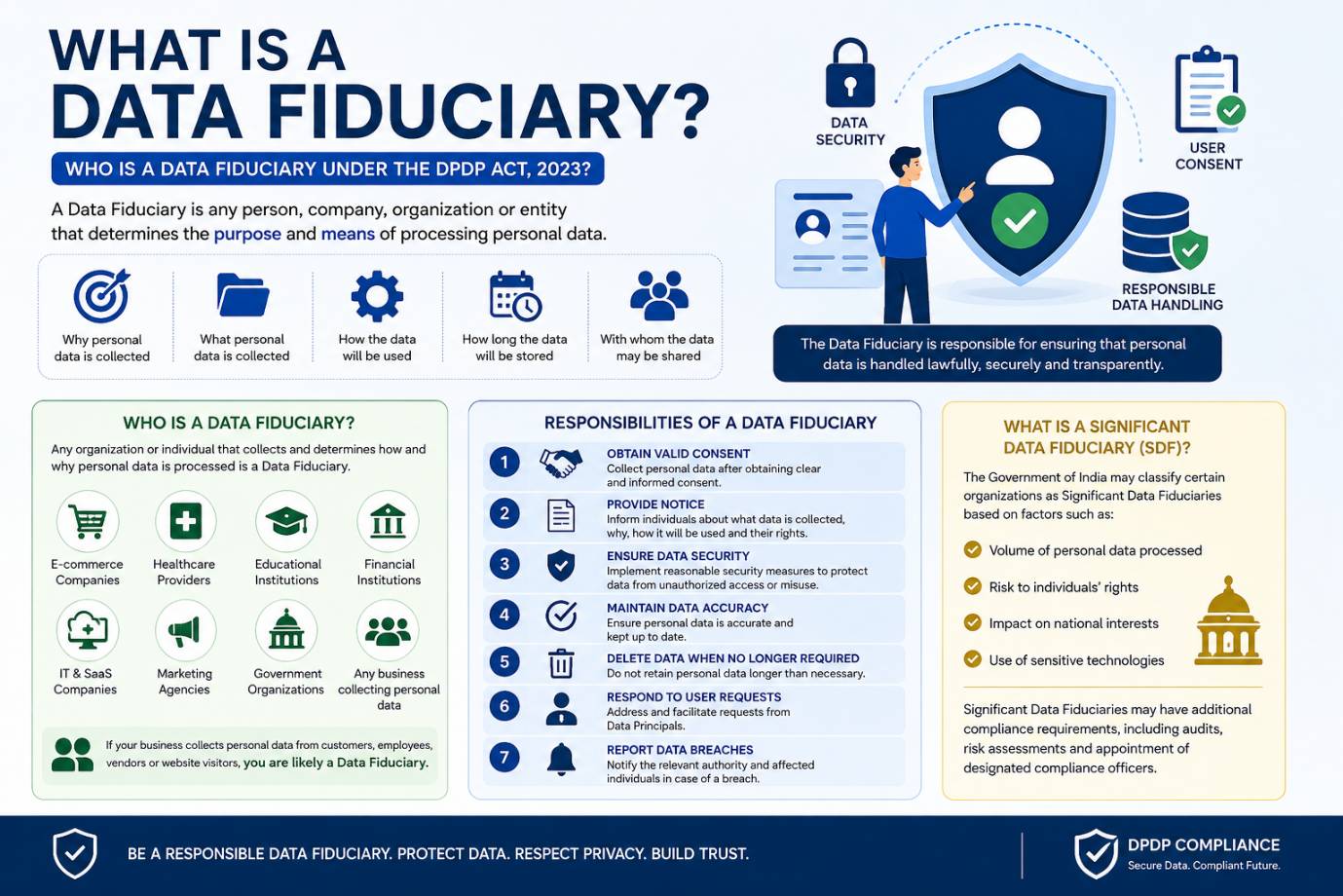
A Data Fiduciary is a person who, alone or in conjunction with others, determines the purpose and means of processing personal data.
An e-commerce company, hospital, educational institution, financial services provider, or SaaS business may act as a Data Fiduciary when it determines how and why personal data is processed.
A registered Consent Manager, on the other hand, performs a specific statutory function on behalf of Data Principals.
These are different roles.
For example, an e-commerce business collecting customer consent for promotional communications does not automatically become a statutory Consent Manager merely because it maintains a consent database.
Similarly, deploying a Consent Management Platform does not mean the business must register as a Consent Manager.
The business must comply with the legal obligations applicable to its actual role and processing activities.
5. Consent Manager vs Consent Management Platform: Understanding the Difference
Many businesses confuse the term Consent Manager with Consent Management Platform (CMP).
Although both involve consent management, they are not interchangeable.
| Comparison | Registered Consent Manager | Consent Management Platform (CMP) |
|---|---|---|
| Nature | Statutory role under the DPDP Act | Software platform used to manage consent |
| Registration | Registration required to operate in the statutory role | Software providers are not automatically required to register merely for offering a CMP |
| Primary Function | Helps Data Principals manage consent through the statutory framework | Helps organisations collect, record, update, and manage consent |
| Typical Users | Data Principals and participating Data Fiduciaries | Businesses, compliance teams, IT teams, and Data Fiduciaries |
| Main Focus | Accessible and interoperable consent management under statutory requirements | Consent collection, lifecycle management, records, and system integration |
| Legal Status | Subject to Consent Manager-specific provisions | Does not automatically have statutory Consent Manager status |
For Indian businesses, understanding this distinction is essential when evaluating DPDP compliance software.
A business may use a commercial CMP to support its own consent-management obligations without becoming a registered Consent Manager.
6. What Does Not Automatically Change on 13 November 2026?
The commencement of Consent Manager-related provisions should not be confused with the commencement of every major Data Fiduciary obligation.
Under the notified phased schedule, significant operational requirements are scheduled to commence on 13 May 2027.
These include key requirements concerning:
- Notices and valid consent.
- Consent withdrawal.
- Data Fiduciary responsibilities.
- Appropriate security safeguards.
- Personal data breach notification.
- Data Principal rights.
- Relevant erasure and retention obligations.
- Data Processor arrangements.
- Additional obligations concerning children's personal data.
- Applicable obligations for Significant Data Fiduciaries.
The exact applicability of individual requirements depends on the relevant statutory provisions, commencement notifications, exemptions, and organisational circumstances.
Businesses should therefore avoid interpreting 13 November 2026 as a universal deadline for all DPDP compliance activities.
7. Why Should Businesses Start Preparing Before May 2027?
Although major operational requirements are scheduled for May 2027, implementing an effective compliance programme can take significant time.
Consider a company operating multiple websites, CRM systems, mobile applications, marketing platforms, and internal databases.
The company may need to identify where personal data is collected, which processing purposes apply, and how consent changes are communicated across its systems.
This cannot always be achieved by adding a consent checkbox shortly before the compliance deadline.
Personal Data Mapping
Businesses need to understand what personal data they process, where it is stored, and which applications and service providers access it.
Purpose Identification
Organisations should distinguish processing based on consent from processing permitted under applicable certain legitimate uses.
Privacy Notice Review
Where consent is relied upon, businesses need to prepare notices that satisfy applicable requirements.
Consent Lifecycle Management
Businesses should establish processes for granting, updating, and withdrawing consent.
Connected-System Integration
Relevant consent changes must be reflected in the systems responsible for processing personal data.
Data Principal Rights
Organisations need appropriate processes for handling access, correction, erasure, and grievance-related requests.
Audit Evidence
Businesses relying on consent should be able to demonstrate that the required notice was provided and valid consent was obtained when questioned in a proceeding.
Starting these activities early can reduce implementation pressure and provide time for testing.
8. Why a Basic Consent Checkbox Is Not a Complete Compliance Strategy
A website checkbox may help capture a customer's consent choice.
However, it does not independently address the full operational requirements associated with consent management.
For example, a customer may provide consent through a website registration form.
That information may subsequently be used by a CRM, email marketing platform, SMS gateway, and WhatsApp integration.
If the customer later withdraws marketing consent, the organisation needs to identify the affected processing activities and ensure that relevant connected systems act accordingly.
A checkbox alone cannot establish whether those systems received or implemented the change.
Businesses should therefore consider the complete consent lifecycle:
Consent Collection --> Consent Record --> Purpose Mapping --> Consent Update or Withdrawal --> Connected-System Action --> Evidence
This is an illustrative implementation workflow, not a technical sequence prescribed by the Act.
9. The Importance of Audit-Ready Consent Records
Under Section 6(10) of the DPDP Act, where consent is relied upon and questioned in a proceeding, the Data Fiduciary bears the burden of proving that the required notice was given and consent was obtained in accordance with the Act.
This makes reliable consent evidence important.
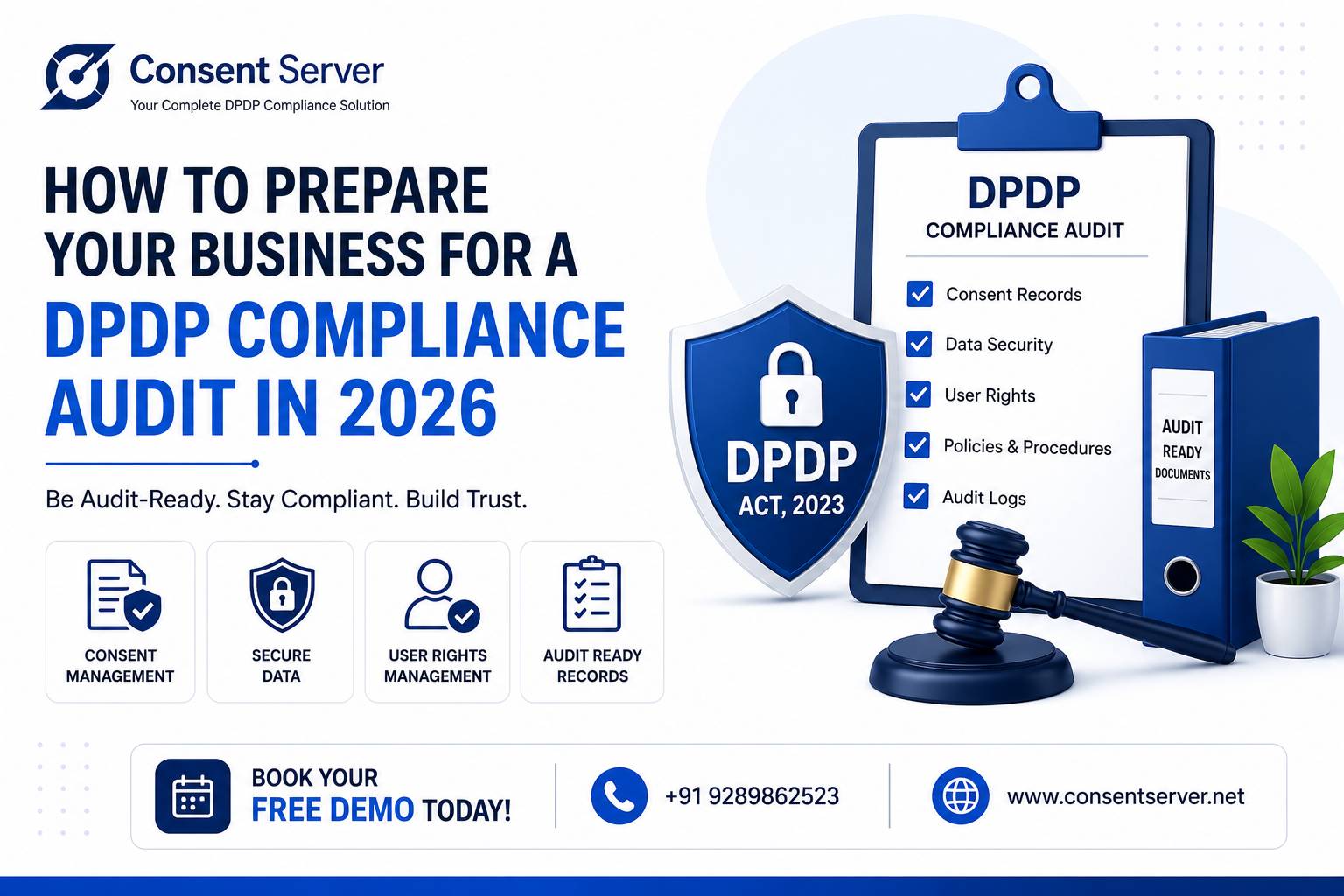
Recommended records may include:
- Unique consent reference.
- Relevant Data Principal reference.
- Consent collection timestamp.
- Processing purpose.
- Notice and consent form versions.
- Evidence of affirmative action.
- Consent status history.
- Withdrawal records.
- Relevant connected-system action records.
These are recommended evidence elements rather than a universal list of database fields expressly mandated by the Act.
An organisation should maintain records appropriate to its actual processing activities and applicable obligations.
10. How Consent Server Helps Indian Businesses Prepare for DPDP Compliance
Consent Server is a DPDP Compliance Software and Consent Management Platform developed by Iconic Infotech Pvt. Ltd.
The platform is designed to help Data Fiduciaries manage consent-related operations through centralised records, automated workflows, and integration with existing business applications.
Purpose-Based Consent Collection
Consent Server supports configurable consent forms linked to defined processing purposes.
Centralised Consent Management
Businesses can maintain consent-related records through a central management system rather than relying entirely on disconnected applications.
Consent Lifecycle Automation
The platform supports consent granting, updating, withdrawal, renewal, and expiry.
Notice and Purpose Versioning
Consent Server helps maintain relevant notice and purpose versions associated with consent records.
Audit-Ready Records
Consent histories, timestamps, and activity records support evidence retrieval and internal compliance reviews.
Hash-based integrity mechanisms support tamper detection.
API and Webhook Integration
Consent-related events can be communicated to CRM, ERP, marketing, and other connected systems.
Acknowledgement and Completion Tracking
Consent Server supports the following workflow:
Consent Event --> Webhook/API Notification --> Delivered --> Acknowledged --> Action Completed --> Completion Evidence
This helps organisations monitor the progress of relevant consent-related actions across connected systems.
Data Principal Rights Management
The platform supports workflows relating to access, correction, erasure, consent withdrawal, and grievances.
On-Premise and Hosted Deployment
Consent Server offers deployment flexibility for organisations with different infrastructure and operational requirements.
Consent Server is a commercial CMP, not automatically a statutory registered Consent Manager. The platform supports consent-related compliance processes, while each organisation remains responsible for its broader legal and operational obligations.
11. DPDP Compliance Preparation Roadmap: November 2026 to May 2027
Businesses should treat the period between November 2026 and May 2027 as an opportunity to complete implementation, test workflows, and address compliance gaps.
| Period | Recommended Activities |
|---|---|
| November–December 2026 | Map personal data, identify processing purposes, assess legal bases, and review existing privacy notices |
| January–February 2027 | Implement consent-management workflows, Data Principal rights processes, and relevant application integrations |
| March–April 2027 | Test consent withdrawal, downstream processing updates, audit records, security controls, and breach-response procedures |
| May 2027 | Complete readiness reviews and address outstanding requirements before the scheduled operational commencement |
This roadmap is illustrative. Organisations with complex processing operations, numerous vendors, or large customer databases may need more implementation time.
12. Which Indian Industries Should Pay Attention?
The DPDP framework is relevant across sectors that process digital personal data.
Healthcare
Hospitals, clinics, diagnostic centres, and healthcare technology providers should assess their handling of patient information, applicable legal bases, access controls, and Data Principal rights.
Education
Schools, colleges, universities, and EdTech platforms should review student information, parental consent requirements where applicable, and third-party processing arrangements.
Financial Services
Banks, fintech companies, insurance providers, and financial technology platforms should examine consent-based processing, customer communications, security controls, and applicable sector-specific obligations.
E-Commerce and Retail
Online retailers should distinguish order-related processing from promotional marketing, customer profiling, and other activities requiring separate legal-basis assessments.
SaaS and Technology Companies
Software providers should clarify their roles as Data Fiduciaries or Data Processors and establish appropriate contractual and technical arrangements.
Manufacturing and Corporate Enterprises
Organisations should assess employee data, vendor information, customer databases, and personal data shared across internal systems.
The practical compliance requirements depend on the organisation's role, processing activities, and applicable statutory provisions—not simply its industry classification.
13. Frequently Asked Questions
What happens on 13 November 2026 under the DPDP Act?
Under the notified phased schedule, Section 6(9), Section 27(1)(d), and Rule 4 are scheduled to commence. These provisions relate primarily to the statutory Consent Manager framework and the Board's relevant powers.
Is 13 November 2026 the DPDP compliance deadline for all businesses?
No. Major operational obligations for Data Fiduciaries are scheduled to commence on 13 May 2027 under the notified framework.
Does every business need to register as a Consent Manager?
No. Statutory Consent Manager registration applies to organisations seeking to operate in that specific role. Ordinary Data Fiduciaries do not automatically need to register as Consent Managers.
Can a business use a Consent Management Platform without becoming a registered Consent Manager?
Yes. A commercial CMP can help an organisation manage its own consent-related processes. Using such software does not automatically confer statutory Consent Manager status.
Will all DPDP penalties begin on 13 November 2026?
No. The Act follows phased commencement, and relevant enforcement provisions must be considered alongside the substantive obligations and powers that are in force. Businesses should not assume that every penalty-related provision becomes applicable on the same date.
What is the next major DPDP implementation date after November 2026?
Under the notified schedule, 13 May 2027 is the next major milestone for operational Data Fiduciary obligations.
Can Consent Server help businesses prepare for DPDP compliance?
Yes. Consent Server supports purpose-based consent collection, lifecycle management, notice versioning, audit-ready records, Data Principal rights workflows, and connected-system integrations.
14. Conclusion: 13 November 2026 Is an Important Milestone, Not the Final Compliance Deadline
The date 13 November 2026 marks an important scheduled stage in the implementation of India's Digital Personal Data Protection framework.
Its principal significance concerns the statutory Consent Manager registration framework.
However, it should not be confused with the broader operational obligations scheduled to commence on 13 May 2027.
For Indian businesses, the key takeaway is straightforward:
Do not confuse Consent Manager registration with Data Fiduciary compliance.
Organisations should use the remaining preparation period to identify their personal data processing activities, review their legal bases, improve privacy notices, establish consent lifecycle processes, and integrate relevant systems.
A well-designed consent-management infrastructure can help businesses prepare for these requirements and manage future changes more effectively.
Consent Server, developed by Iconic Infotech Pvt. Ltd., helps Indian organisations manage purpose-based consent, maintain audit-ready records, automate consent-related workflows, and connect consent decisions with existing business applications.
Prepare Your Business for DPDP Compliance With Consent Server
Simplify consent collection, management, withdrawal, and tracking with a platform designed for Indian Data Fiduciaries.