DPDP Data Audit Requirements for Significant Data Fiduciaries
Learn DPDP data audit requirements for Significant Data Fiduciaries under Section 10, including DPIA, independent auditors, Rule 13 and audit readiness.
India's Digital Personal Data Protection (DPDP) Act, 2023, is introducing a more structured approach to personal data protection, accountability, and compliance. For organizations handling large volumes of personal data or processing information that presents significant risks, understanding the additional obligations applicable to Significant Data Fiduciaries (SDFs) is especially important.
One of the key requirements under Section 10 of the DPDP Act is the conduct of periodic data audits.
The importance of this provision has been highlighted by the Digital Personal Data Protection (Removal of Difficulties) Order, 2026, issued in October 2026, which clarified the statutory wording from "periodic audit" to "periodic data audit."
This clarification draws attention to a critical question for Indian businesses:
Can your organization demonstrate that its personal data processing activities comply with the DPDP Act?
A data protection audit is not simply a review of IT infrastructure or cybersecurity policies. It involves evaluating how an organization handles personal data, implements applicable legal obligations, maintains appropriate controls, and demonstrates accountability.
This article explains the DPDP data audit requirements for Significant Data Fiduciaries, the role of independent data auditors, the importance of consent management, and how DPDP Compliance Software such as Consent Server can support audit preparation.
1. What Is a Significant Data Fiduciary Under the DPDP Act?
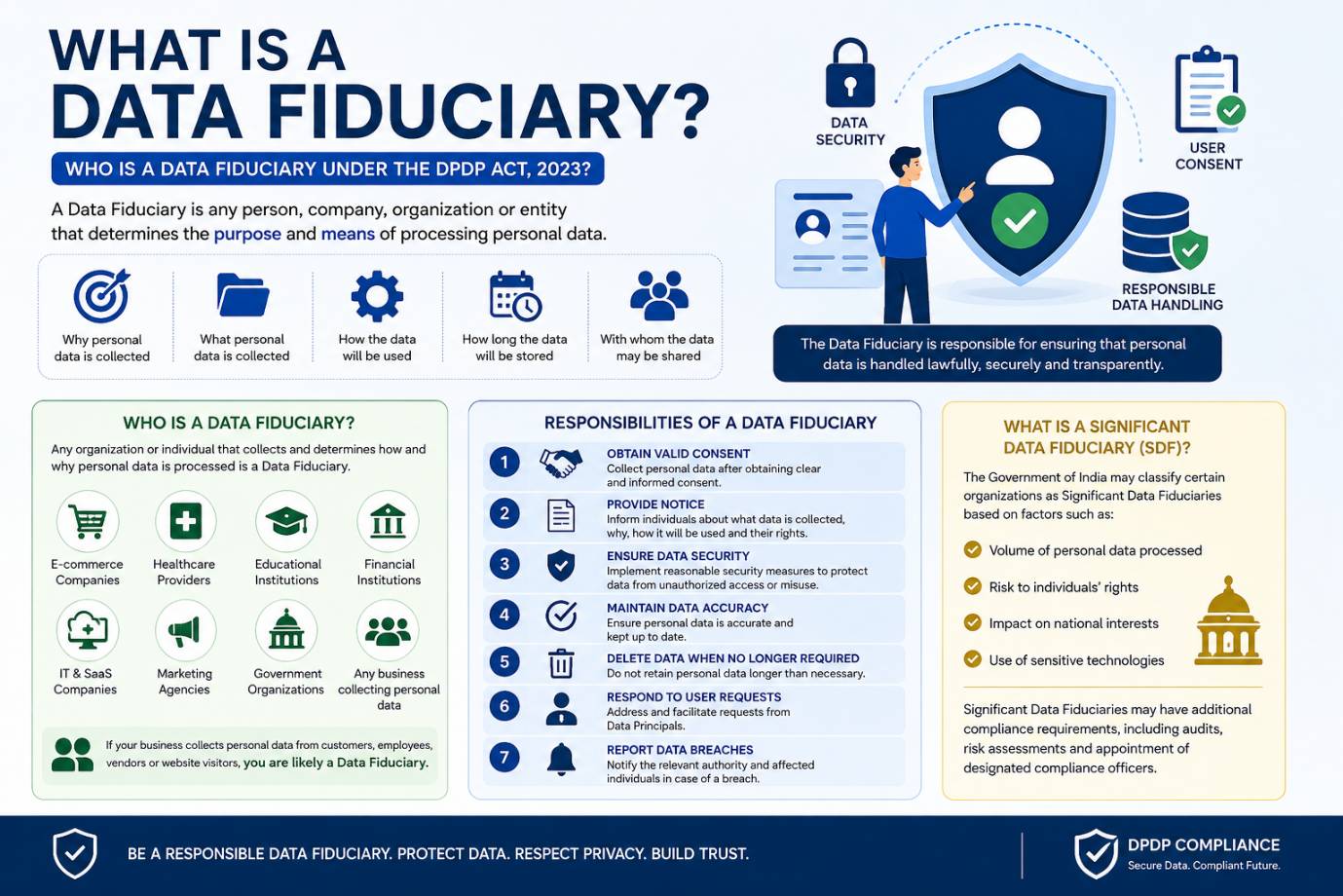
Under the DPDP Act, a Data Fiduciary is a person or organization that determines the purpose and means of processing personal data, either alone or together with others.
A Significant Data Fiduciary is a Data Fiduciary, or class of Data Fiduciaries, notified by the Central Government under Section 10.
The Government may consider several factors when making this designation, including:
- The volume and sensitivity of personal data processed.
- Risks to the rights of Data Principals.
- Potential impact on India's sovereignty and integrity.
- Risks to electoral democracy.
- Security of the State.
- Public order.
An organization does not automatically become a Significant Data Fiduciary merely because it is large, operates in a regulated industry, or processes a substantial number of customer records.
Formal designation by the Central Government is the determining factor.
However, organizations with complex personal data processing activities should understand these requirements in advance, particularly if they may fall within a future notified category.
2. What Does Section 10 Require from Significant Data Fiduciaries?
Section 10 establishes additional responsibilities beyond the general obligations applicable to Data Fiduciaries.
These include three important areas of accountability.
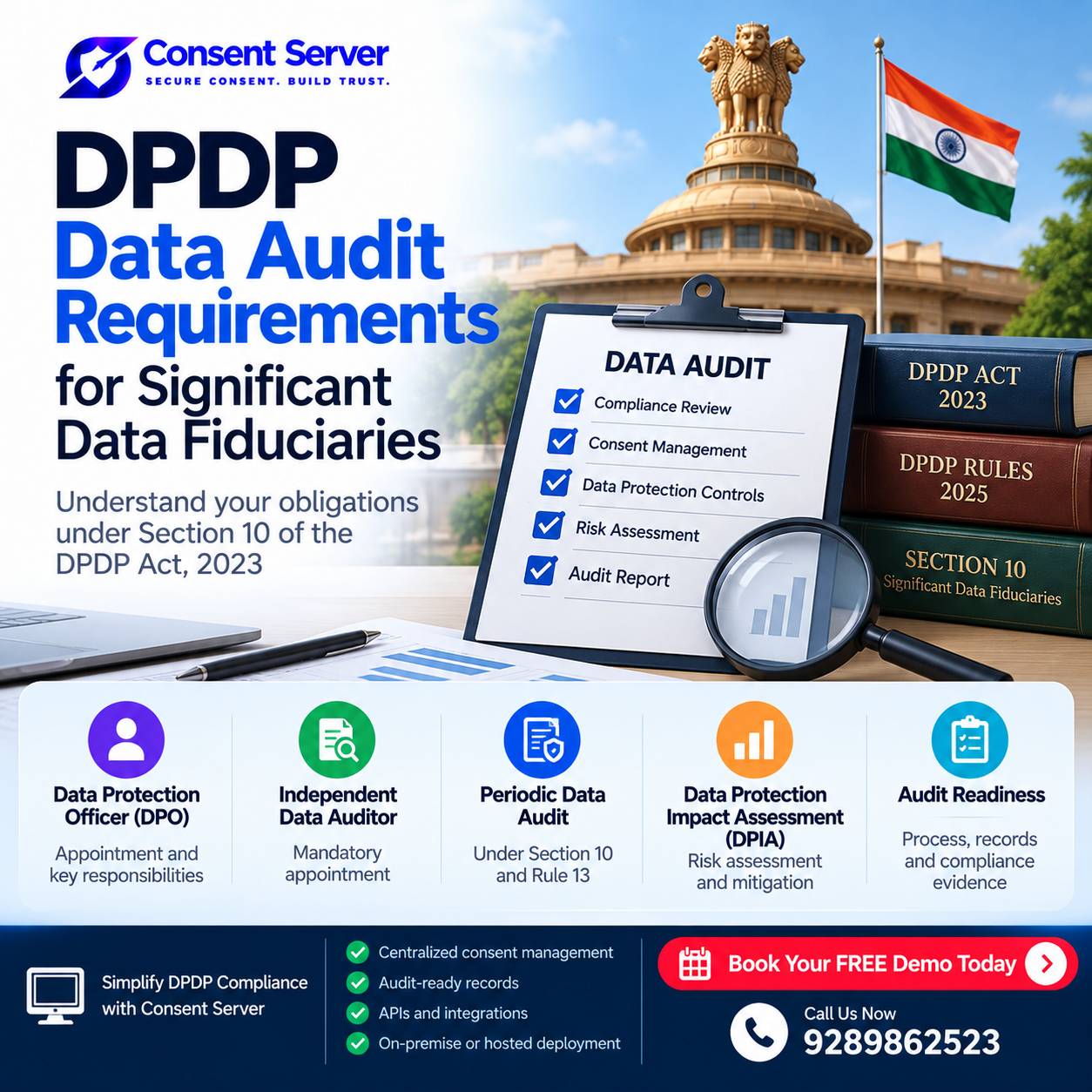
Appointment of a Data Protection Officer
A Significant Data Fiduciary must appoint a Data Protection Officer who:
- Is based in India.
- Is an individual responsible to the Board of Directors or similar governing body.
- Acts as the point of contact for the grievance redressal mechanism under the Act.
The Data Protection Officer plays an important role in coordinating data protection governance and organizational accountability.
Appointment of an Independent Data Auditor
Section 10 requires a Significant Data Fiduciary to appoint an independent data auditor.
The auditor is responsible for evaluating the Significant Data Fiduciary's compliance with the provisions of the DPDP Act.
Independence is important because the audit should provide an objective assessment rather than relying entirely on internal declarations.
Periodic Data Protection Impact Assessments and Data Audits
Section 10 also requires Significant Data Fiduciaries to undertake prescribed measures, including:
- Periodic Data Protection Impact Assessments (DPIAs).
- Periodic data audits.
- Other measures consistent with the provisions of the Act, as prescribed.
A DPIA and a data audit serve related but different purposes.
A DPIA examines the potential impact of processing personal data and the associated risks.
A data audit evaluates compliance with applicable data protection requirements.
Both contribute to an organization's ability to identify weaknesses and demonstrate accountability.
3. What Changed in the October 2026 Amendment?
On 5 October 2026, the Government issued the Digital Personal Data Protection (Removal of Difficulties) Order, 2026.
The Order clarified Section 10(2)(c)(ii) by replacing the expression "periodic audit" with "periodic data audit."
Earlier wording |
Revised wording |
|
Periodic audit |
Periodic data audit |
The clarification makes the subject of the audit more explicit.
It does not create a new obligation to conduct data audits, because periodic audits were already included in Section 10.
It also does not extend Section 10's additional obligations to every Data Fiduciary.
The underlying obligations remain applicable to organizations designated as Significant Data Fiduciaries, in accordance with the Act and relevant Rules.
For businesses, the key takeaway is that audit preparation should focus on data protection compliance rather than treating the requirement as an ordinary financial or general operational audit.
4. What Are the DPDP Rules for Data Audits?
The DPDP Rules, 2025 provide further detail on the obligations applicable to Significant Data Fiduciaries.
In particular, Rule 13 addresses additional obligations, including requirements relating to Data Protection Impact Assessments and audits.
Under Rule 13, a Significant Data Fiduciary must undertake a DPIA and an audit once in every twelve-month period from the date specified in the relevant notification, and provide the Data Protection Board with a report containing significant observations from those exercises.
The DPIA must include a description of the rights of Data Principals and the purposes of processing, along with an assessment and management of risks to those rights.
The Rules also address due diligence concerning technical measures, including algorithmic software used in certain personal data processing activities, and restrictions concerning specified personal data and traffic data where applicable government notifications prescribe them.
Organizations should therefore read Section 10 together with Rule 13 and any relevant designation or other notifications.
Important: The additional obligations under Section 10 are scheduled to commence on 13 May 2027 under the phased commencement notification issued in November 2025. The October 2026 textual clarification did not advance that date.
5. What Should a DPDP Data Audit Examine?
The exact scope of a statutory audit must be determined by the applicable Act, Rules, notifications, and the independent auditor's engagement.
Nevertheless, several areas are particularly relevant when evaluating an organization's data protection readiness.
Personal Data Collection and Processing
An organization should understand what personal data it collects, where it comes from, why it is processed, and which applications or departments use it.
For example, customer data may be collected through websites, mobile applications, onboarding systems, customer relationship management platforms, and offline channels.
Without a clear understanding of these processing activities, assessing compliance becomes difficult.
Privacy Notices and Consent Management
Where processing relies on consent, auditors may need to evaluate whether the organization has appropriate processes for providing notices, obtaining valid consent, and handling withdrawal.
Relevant evidence may include:
- The notice presented to the Data Principal.
- The purposes for which consent was requested.
- The consent decision and associated timestamp.
- The applicable notice version.
- Changes to consent preferences.
- Withdrawal records and related actions.
These records can help demonstrate how consent was managed over time.
However, consent records alone do not establish compliance with every requirement of the DPDP Act.
Consent Withdrawal and Connected Applications
Consent withdrawal creates operational challenges when personal data is processed across multiple systems.
For example, a customer may withdraw consent through a website while the same information is used by CRM, marketing, or customer support applications.
An audit-readiness review should examine whether relevant consent changes are communicated to connected systems and whether appropriate action is taken.
A successful webhook delivery is not necessarily evidence that downstream processing has stopped.
Organizations should distinguish between event delivery, acknowledgement, and completion of the required action.
Data Principal Rights Management
The DPDP Act provides rights to Data Principals, subject to applicable conditions.
These include rights relating to access to information, correction and erasure, grievance redressal, and nomination.
Organizations should establish procedures for receiving, reviewing, and responding to applicable requests.
Useful supporting evidence may include request histories, processing decisions, response records, and completion information.
Security Safeguards
Data protection audits should also consider the organization's applicable security obligations.
Relevant areas may include access controls, authentication, encryption, logging, monitoring, incident response, and safeguards applied to Data Processors.
The specific assessment should reflect the organization's systems, risks, and legal obligations.
Data Retention and Erasure
Organizations should evaluate how they determine when personal data must be retained and when erasure obligations apply.
This includes understanding legal retention requirements, processing purposes, and the systems in which personal data is stored.
Consent withdrawal does not automatically require the deletion of every record relating to a customer.
Businesses must distinguish between processing based on withdrawn consent and processing that may continue under an applicable legal basis or retention requirement.
Data Processor Management
Where personal data is processed by third-party service providers, organizations should assess their contractual arrangements, security controls, and operational coordination.
Data Fiduciaries remain responsible for applicable obligations under the DPDP Act when using Data Processors.
Appropriate records of processing arrangements and actions taken by connected service providers can support compliance reviews.
6. Why Audit-Ready Consent Records Are Important
One of the biggest practical challenges in DPDP compliance is the ability to demonstrate what happened during the consent lifecycle.
Consider an organization operating an e-commerce website, mobile application, CRM system, and marketing platform.
A customer initially agrees to receive promotional communications.
Later, the customer withdraws that consent.
The organization should be able to establish the relevant consent history and explain how the withdrawal was handled.
Important questions include:
- When was consent originally obtained?
- What notice and purpose were associated with it?
- When did the customer withdraw consent?
- Which connected systems received the withdrawal event?
- Did those systems acknowledge the event?
- Was the required action completed?
- What evidence supports that conclusion?
These questions illustrate why centralized consent management can be valuable for organizations preparing for data protection audits.
A structured DPDP Consent Management Platform can make relevant records easier to locate, review, and present.
7. Common Challenges Businesses Face During DPDP Audit Preparation
Many organizations already maintain customer databases, privacy policies, and cybersecurity controls.
However, these systems are not always connected.
One department may manage customer consent, another may operate marketing campaigns, and a third may maintain data retention procedures.
This fragmentation creates several challenges.
Inconsistent consent records: Different applications may hold conflicting versions of a customer's consent preferences.
Limited visibility: Compliance teams may struggle to identify where personal data is processed.
Incomplete withdrawal tracking: Organizations may record a withdrawal request without confirming whether connected systems acted upon it.
Missing historical evidence: Earlier notice versions, consent decisions, and processing changes may not be readily available.
Manual reporting: Preparing compliance evidence may require collecting information from several departments and systems.
Weak accountability: Organizations may have difficulty establishing who performed an action and when.
These problems are not necessarily evidence of a statutory violation in every case, but they can increase operational risk and make compliance reviews more difficult.
8. How Consent Server Helps Significant Data Fiduciaries Prepare for Data Audits
For organizations managing consent across multiple digital systems, Consent Server provides a centralized platform designed to support consent governance and related compliance workflows.
Developed by Iconic Infotech Pvt. Ltd., Consent Server is a DPDP Consent Management Platform built for Indian businesses, with particular emphasis on on-premise deployment, integration, and audit-ready consent records.
Centralized Consent Management
Consent Server enables organizations to manage consent information through a common platform rather than relying entirely on separate application databases.
This helps improve visibility into consent decisions and associated processing purposes.
Complete Consent Lifecycle Tracking
The platform supports consent grants, updates, withdrawals, renewals, and expiry.
Maintaining these lifecycle events helps organizations understand how consent preferences have changed over time.
Audit-Ready Consent History
Consent Server maintains supporting records such as timestamps, notice versions, purpose information, and consent activity history.
These records can assist compliance teams when preparing relevant evidence for reviews and audits.
API and Webhook Integration
Consent Server can communicate consent-related events to connected business applications through APIs and webhooks.
This allows organizations to coordinate consent changes across relevant systems.
Event Acknowledgement and Action Tracking
The platform supports event delivery monitoring, acknowledgements, retries, escalation, and action completion evidence where integrated receiving systems provide the necessary responses.
This helps organizations distinguish between sending an instruction and receiving evidence that the requested action was completed.
Data Principal Request Workflows
Consent Server provides a Data Principal portal supporting consent-related requests, grievance workflows, and request history.
These capabilities can help businesses organize relevant operational records.
On-Premise Deployment
Consent Server offers an on-premise deployment model for organizations that prefer to operate their consent-management infrastructure within their own environment.
This can be particularly relevant for enterprises with internal security policies, infrastructure requirements, or complex integration needs.
Consent Server supports consent-related audit preparation, but it does not replace the independent data auditor, DPIA, governance processes, or other statutory obligations applicable to Significant Data Fiduciaries.
9. DPDP Data Audit Readiness Checklist for Significant Data Fiduciaries
Organizations preparing for their additional obligations can use the following checklist to evaluate readiness.
| Audit Preparation Area | Key Question |
|---|---|
| SDF designation | Has the organization been formally designated as a Significant Data Fiduciary? |
| Data Protection Officer | Has an eligible DPO been appointed with the required reporting structure? |
| Independent data auditor | Is an independent data auditor appointed? |
| DPIA | Is there a process for conducting periodic Data Protection Impact Assessments? |
| Data audit | Can the organization complete the required audit within each applicable twelve-month period? |
| Board reporting | Is there a process for submitting significant observations to the Data Protection Board? |
| Data inventory | Are personal data processing activities appropriately documented? |
| Consent management | Can relevant consent decisions, notices, and changes be demonstrated? |
| Data Principal rights | Are requests and responses appropriately tracked? |
| Security safeguards | Are applicable security measures implemented and reviewed? |
| Technical due diligence | Are relevant technical measures, including algorithmic software, assessed for risks to Data Principal rights? |
| Data transfer restrictions | Can the organization comply with restrictions applicable to any personal data categories specifically notified by the Government? |
This checklist is a practical preparation tool, not an exhaustive statutory audit specification. The exact requirements depend on the applicable legislation, notifications, and organizational circumstances.
10. What Happens If a Significant Data Fiduciary Fails to Comply?
Failure to meet the additional obligations under Section 10 may expose a Significant Data Fiduciary to regulatory proceedings and financial penalties.
The Schedule to the DPDP Act provides for a monetary penalty of up to ₹150 crore for a breach of the additional obligations applicable to Significant Data Fiduciaries under Section 10.
This is a statutory maximum, not an automatic fine for every audit deficiency.
Any penalty depends on the applicable legal provisions, findings, and statutory assessment factors.
The potential consequences extend beyond financial penalties.
Organizations may also face increased remediation costs, operational disruption, and loss of customer or stakeholder confidence.
This makes proactive compliance preparation an important business priority.
11. When Do DPDP Data Audit Requirements Become Applicable?
Under the commencement notification issued on 13 November 2025, Section 10 and Rule 13 are scheduled to take effect on 13 May 2027.
For the periodic assessment and audit cycle, Rule 13 specifies a twelve-month period measured from the date an organization is notified as a Significant Data Fiduciary or included in a notified class.
Businesses should therefore distinguish between the commencement of the legal framework and the notification that triggers obligations for a particular organization.
The October 2026 wording clarification does not change these commencement arrangements. <Cite refs={["turn725285search10","turn725285search23"]}/>
12. How Should Businesses Start Preparing Today?
Organizations expecting to face additional DPDP obligations should begin with a practical assessment of their current data protection processes.
First, identify personal data processing activities across websites, applications, internal systems, and third-party service providers.
Second, review the legal basis for processing, including where consent is required.
Third, evaluate whether consent records, notices, withdrawal workflows, and Data Principal request histories can be retrieved reliably.
Fourth, assess existing security safeguards, governance responsibilities, and internal review procedures.
Finally, establish a structured plan for DPIAs, data audits, and remediation of identified weaknesses where those requirements apply.
Businesses should avoid treating audit readiness as a one-time documentation exercise.
Effective compliance depends on whether organizational processes and technical controls continue working as intended.
Conclusion: DPDP Data Audits Require More Than Documentation
The DPDP Act introduces additional accountability requirements for Significant Data Fiduciaries.
Section 10 establishes the independent data auditor and periodic assessment framework, while Rule 13 specifies important operational requirements, including the twelve-month DPIA and audit cycle.
The October 2026 amendment clarifies that the statutory reference concerns a periodic data audit, reinforcing the focus on data protection compliance. <Cite refs={["turn725285search5","turn725285search2"]}/>
For businesses, preparing for these obligations means understanding how personal data is collected, processed, secured, shared, and managed throughout its lifecycle.
Consent Server helps organizations strengthen the consent-management component of this preparation through centralized consent records, lifecycle management, integration capabilities, and audit-ready histories.
By combining appropriate governance processes with reliable technical systems, businesses can improve their readiness for India's evolving data protection requirements.