DPDP Compliance Checklist 2026–27 for Indian Businesses
Explore the DPDP compliance checklist for Indian businesses in 2026–27. Learn 15 essential steps for consent management, data privacy and audit readiness.

DPDP Compliance Checklist for Indian Businesses — 2026–27: A Complete Step-by-Step Guide
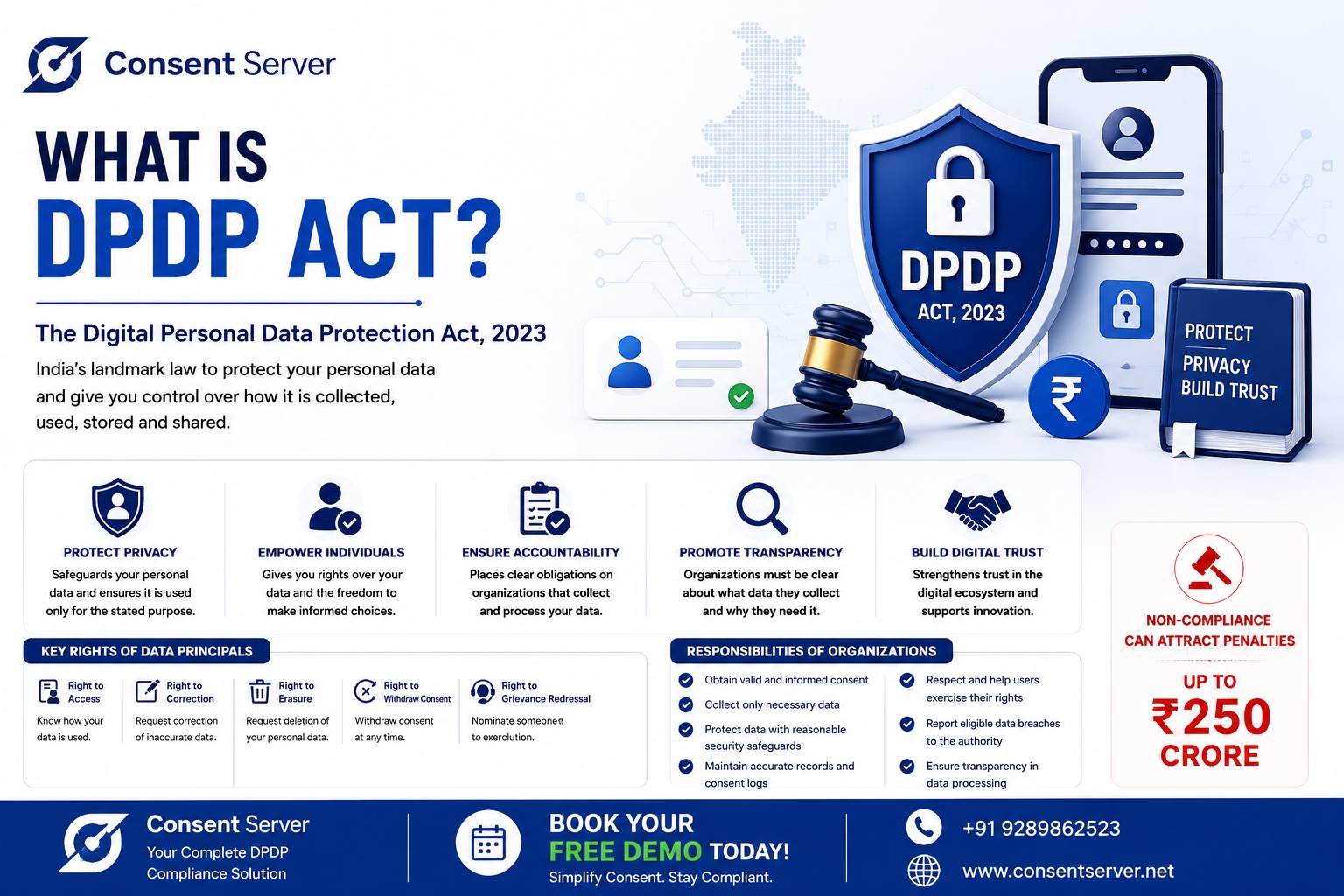
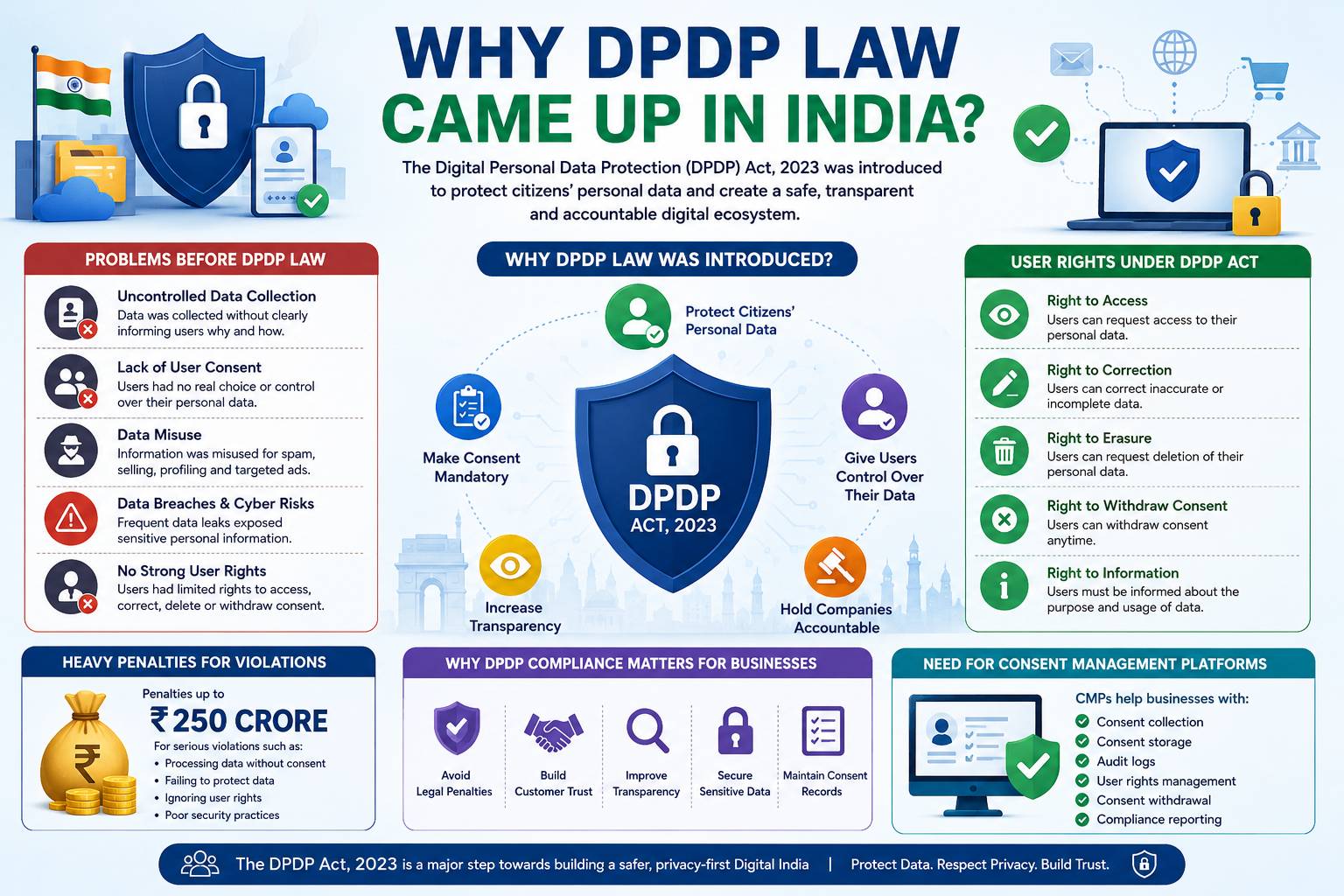
India's digital economy is growing rapidly, and businesses are collecting more personal data than ever before. From customer registrations and employee records to online payments, marketing campaigns, and mobile applications, personal information is now part of almost every business operation.
With the Digital Personal Data Protection (DPDP) Act, 2023 and the DPDP Rules, 2025, Indian organisations must prepare for a more structured approach to data privacy, consent management, security, and accountability.
For many organisations, the biggest challenge is understanding where to begin.
What personal data needs protection? How should consent be collected? What happens when customers withdraw consent? How should businesses handle data deletion requests? And what records should be maintained for compliance assessments?
This DPDP Compliance Checklist for Indian Businesses — 2026–27 explains 15 essential steps organisations should take to prepare for applicable requirements.
It also explores how DPDP Compliance Software, such as Consent Server, can help automate consent-related processes and strengthen compliance readiness.
Understanding the DPDP Compliance Timeline: 2026–27
The DPDP Act and Rules follow a phased implementation schedule.
| Date | Compliance Milestone |
|---|---|
| 13 November 2025 | Initial provisions, including establishment-related provisions for the Data Protection Board, commenced |
| 13 November 2026 | Provisions concerning registered Consent Managers and related requirements are scheduled to commence |
| 13 May 2027 | Major operational provisions covering consent, notices, Data Fiduciary obligations, security, and Data Principal rights are scheduled to commence |
For Indian businesses, 2026 is an important preparation period, while 2027 marks a major operational compliance milestone.
Organisations should avoid waiting until the last moment because compliance may require changes to software systems, contracts, security infrastructure, employee procedures, and customer-facing processes.
DPDP Compliance Checklist: 15 Essential Steps for Indian Businesses
1. Identify All Personal Data Collected by Your Business
The first step toward DPDP compliance is understanding what personal data your organisation collects and processes.
This may include customer names, mobile numbers, email addresses, employee records, delivery addresses, patient information, student records, and data collected through websites or mobile applications.
Businesses should identify where personal data originates, why it is collected, where it is stored, and which systems process it.
Key Actions:
- Identify personal data collection points across the organisation.
- Map relevant databases, websites, and applications.
- Document the purposes of personal data processing.
- Identify internal teams and external processors handling personal information.
This exercise provides the foundation for subsequent compliance activities.
2. Determine Your Organisation's Role Under the DPDP Act
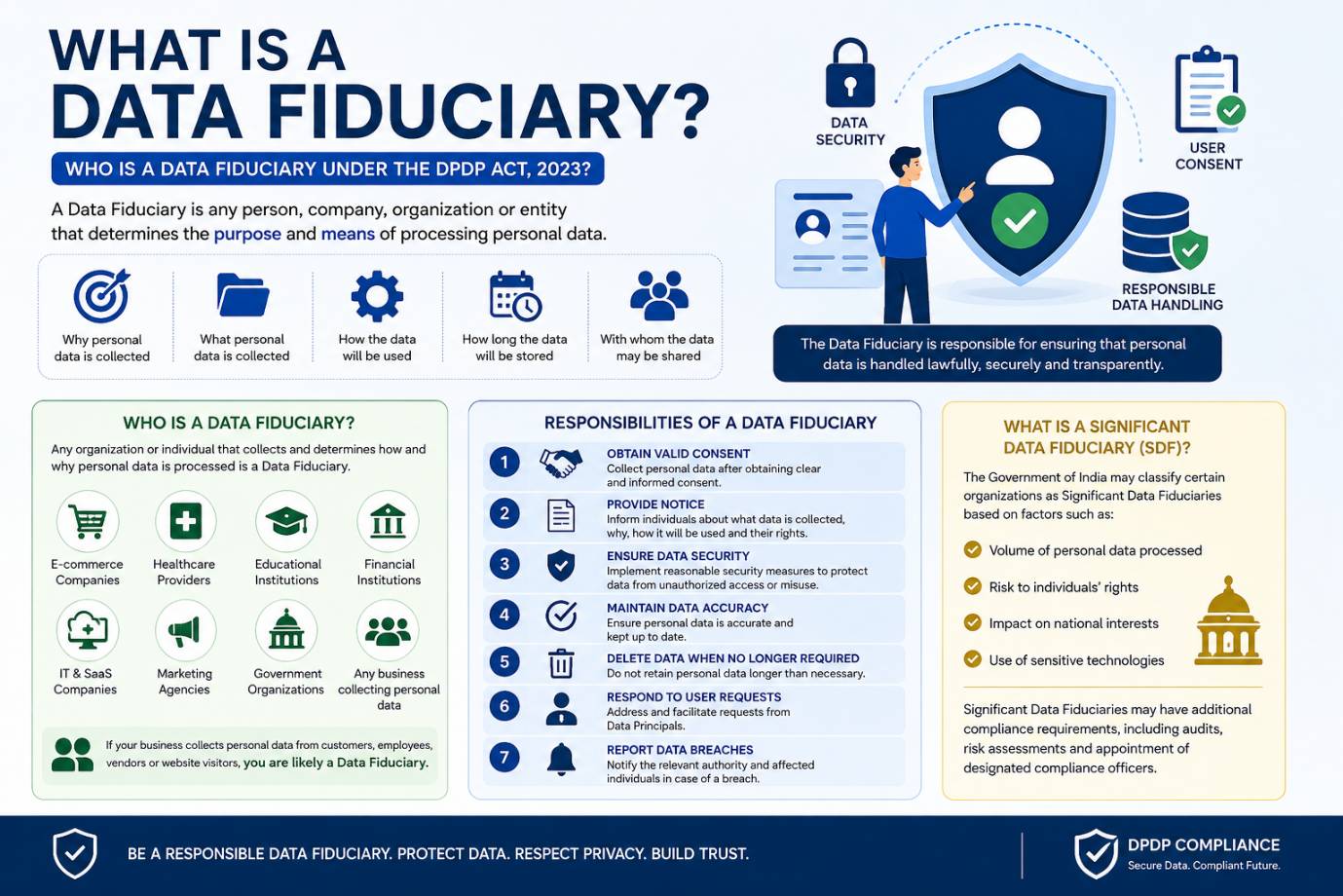
Businesses must understand whether they operate as a Data Fiduciary, Data Processor, or perform different roles for different processing activities.
A Data Fiduciary determines the purpose and means of processing personal data.
A Data Processor processes personal data on behalf of a Data Fiduciary.
Understanding these roles helps organisations identify their responsibilities, contractual arrangements, and compliance obligations.
Key Actions:
- Identify relevant Data Fiduciary and Data Processor relationships.
- Review vendor and processing agreements.
- Assign internal responsibility for privacy compliance.
3. Review the Legal Basis for Personal Data Processing
Not every processing activity necessarily requires consent.
Under the DPDP Act, personal data processing may be based on valid consent or certain specified legitimate uses permitted by law.
Organisations should evaluate the legal basis for each relevant activity.
For example, customer information used for order fulfilment, customer support, and promotional marketing may involve different processing purposes and legal considerations.
Key Actions:
- Identify the legal basis for each processing purpose.
- Distinguish consent-based processing from applicable legitimate uses.
- Review whether personal data collection is limited to appropriate purposes.
4. Update Privacy Notices and Consent Forms
Where consent is required, businesses must provide appropriate notices and obtain consent that satisfies the DPDP Act.
Consent must be free, specific, informed, unconditional, unambiguous, and expressed through clear affirmative action.
Notices should provide relevant information about the personal data being processed, specified purposes, and available mechanisms for exercising rights and withdrawing consent.
Key Actions:
- Review existing privacy notices.
- Explain relevant processing purposes clearly.
- Provide appropriate consent choices.
- Support applicable language and accessibility requirements.
- Maintain records of relevant notice versions.
A DPDP Consent Management Platform can help businesses manage configurable notices and purpose-based consent collection.
5. Implement Centralized Consent Management
Many businesses collect personal data through multiple channels, including websites, applications, CRM systems, and offline processes.
Without a centralized system, maintaining consistent consent information can become difficult.
A Consent Management Platform (CMP) helps organise consent records and preferences across relevant business applications.
Key Actions:
- Establish a centralized consent-management process.
- Maintain purpose-based consent preferences.
- Record consent collection and subsequent changes.
- Integrate relevant applications where necessary.
Consent Server supports centralized consent management through configurable forms, consent records, and integration capabilities.
6. Make Consent Withdrawal Easy and Effective
The DPDP Act requires withdrawal of consent to be as easy as giving consent.
Businesses should provide appropriate withdrawal mechanisms and ensure that processing based on withdrawn consent ceases within a reasonable time, subject to applicable legal exceptions.
For example, if a customer withdraws promotional consent, the business should ensure that relevant marketing systems respect that choice.
Key Actions:
- Provide an accessible consent-withdrawal mechanism.
- Update relevant consent records.
- Notify connected applications where required.
- Monitor whether affected processing has stopped.
- Maintain supporting withdrawal records.
A simple consent status update may not be sufficient when personal data is processed across multiple connected systems.
7. Establish Data Principal Rights Management
The DPDP Act provides rights relating to access to information, correction, erasure, grievance redressal, and nomination, subject to applicable conditions.
Businesses need suitable processes for receiving, reviewing, and responding to requests.
Key Actions:
- Provide mechanisms for submitting relevant requests.
- Establish appropriate identity-verification procedures.
- Assign responsibility for request handling.
- Track request progress and outcomes.
- Maintain relevant supporting records.
Consent Server provides Data Principal rights workflows to help businesses organise these activities.
8. Implement Reasonable Security Safeguards
Protecting personal data is a central responsibility under the DPDP framework.
The notified Rules specify safeguards including appropriate technical measures, access controls, monitoring, backups, contractual protections, and organisational controls.
Businesses should evaluate safeguards according to their processing activities and risks.
Key Actions:
- Protect relevant personal data through suitable security measures.
- Implement appropriate access controls.
- Monitor unauthorized access attempts.
- Maintain backups and recovery procedures.
- Review security vulnerabilities and updates.
- Establish suitable security responsibilities with Data Processors.
Security must be maintained continuously rather than treated as a one-time implementation task.
9. Prepare a Personal Data Breach Response Plan
Organisations should be prepared to detect, investigate, contain, and respond to personal data breaches.
Under the applicable DPDP Rules, affected Data Principals must be informed without delay, and the Data Protection Board must receive an initial intimation without delay, followed by prescribed additional information within 72 hours, unless a longer period is permitted.
Key Actions:
- Establish breach detection and reporting procedures.
- Assign incident-response responsibilities.
- Prepare notification templates.
- Maintain incident investigation records.
- Test the incident-response process.
Businesses should also consider other applicable incident-reporting obligations under Indian law.
10. Review Data Retention and Erasure Policies
Businesses should not retain personal data indefinitely without an appropriate basis.
The DPDP Act and Rules contain obligations concerning erasure, retention, and cessation of processing, subject to applicable legal requirements and exceptions.
Organisations should identify retention requirements for different categories of personal data.
Key Actions:
- Define appropriate retention periods.
- Identify data that must be erased when applicable conditions are met.
- Coordinate erasure with relevant processors.
- Document applicable retention exceptions.
- Maintain suitable records of completed actions.
A structured retention policy helps businesses reduce unnecessary data storage and associated risks.
11. Review Children's Personal Data Processing
Under the DPDP Act, a child is generally an individual below 18 years of age.
Where applicable, processing children's personal data requires verifiable parental consent, and the Act restricts certain forms of tracking, behavioural monitoring, and targeted advertising directed at children, subject to notified exemptions.
Key Actions:
- Identify services that process children's personal data.
- Assess applicable parental-consent requirements.
- Implement suitable verification procedures.
- Review restricted processing activities.
- Evaluate any applicable statutory exemptions.
Businesses should not assume that collecting a parent's name or using a basic OTP automatically satisfies every verifiable parental-consent requirement.
12. Review Third-Party Data Processors
Organisations frequently share personal data with external service providers, including CRM vendors, hosting providers, payment processors, and marketing platforms.
Data Fiduciaries remain responsible for applicable obligations concerning personal data processed on their behalf.
Key Actions:
- Identify relevant third-party processors.
- Review data-processing contracts.
- Evaluate security safeguards.
- Define consent-related integration responsibilities.
- Establish procedures for handling incidents and relevant requests.
13. Maintain Audit-Ready Records
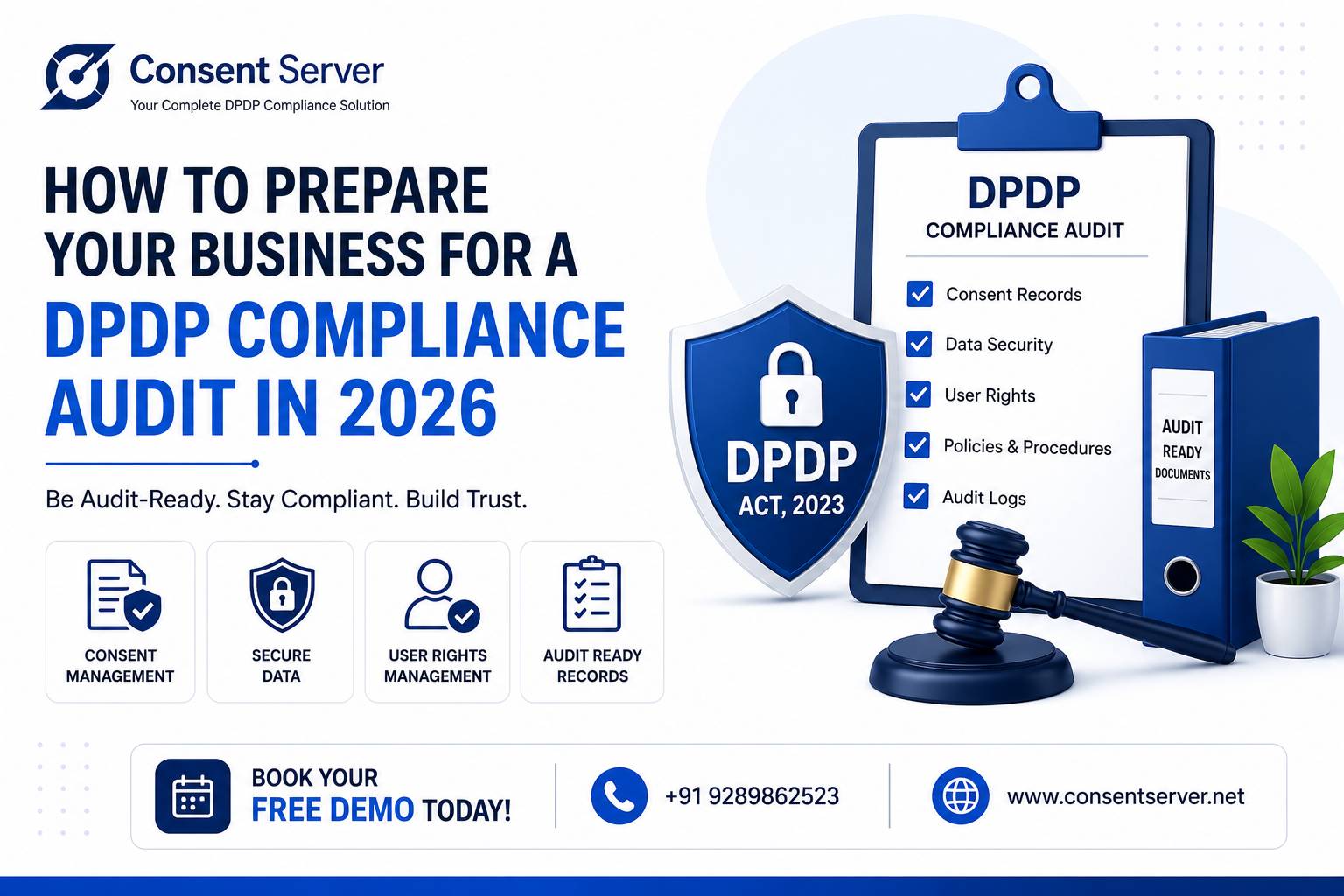
Maintaining reliable records can help businesses demonstrate how personal data and consent-related activities are managed.
Relevant evidence may include consent timestamps, notice versions, processing purposes, withdrawal histories, security logs, request records, and action-completion information.
Different categories of records may be subject to different statutory or operational retention requirements.
Key Actions:
- Maintain relevant consent histories.
- Record changes to notices and purposes.
- Protect logs against unauthorized modification.
- Maintain appropriate records of requests and responses.
- Establish procedures for retrieving evidence.
Audit readiness is not simply about storing data. It is about maintaining reliable, accessible, and meaningful evidence of relevant activities.
14. Train Employees and Assign Compliance Responsibilities
Technology alone cannot establish compliance.
Employees handling personal data should understand relevant privacy requirements, internal procedures, access restrictions, and incident-reporting responsibilities.
Key Actions:
- Assign appropriate compliance ownership.
- Train relevant employees.
- Establish internal operating procedures.
- Review administrative access permissions.
- Conduct periodic compliance assessments.
Organisations should also evaluate whether additional obligations apply to them, including requirements associated with Significant Data Fiduciary designation.
15. Select Suitable DPDP Compliance Software
Businesses operating multiple applications may find manual consent management increasingly difficult.
A suitable DPDP Compliance Software solution can help automate consent-related workflows, maintain records, and coordinate activities across systems.
When evaluating software, organisations should consider:
- Centralized consent collection and management.
- Consent withdrawal and lifecycle automation.
- Data Principal rights workflows.
- Audit-ready records and reporting.
- APIs and webhook integration.
- Security and access controls.
- On-premise or hosted deployment.
- Technical support and implementation requirements.
The best solution depends on the organisation's size, processing activities, existing infrastructure, and compliance needs.
How Consent Server Helps Businesses Prepare for DPDP Compliance
Consent Server is a DPDP Compliance Software and Consent Management Platform developed by Iconic Infotech Pvt. Ltd. for Indian businesses.
It is designed to help organisations move beyond basic consent collection toward structured consent-management operations.
Centralized Consent Management
Consent Server helps businesses collect, organise, and maintain purpose-based consent records across relevant websites and applications.
Consent Lifecycle Automation
The platform supports consent collection, updates, withdrawal, renewal, and expiry.
This helps organisations maintain more consistent consent-management processes.
Data Principal Rights Management
Consent Server provides workflows for access, correction, erasure, withdrawal, and grievance-related requests.
Audit-Ready Consent Records
The platform maintains relevant consent histories, timestamps, notice versions, and supporting activity records.
It also includes hash-based mechanisms designed to support record integrity and tamper detection.
APIs and Webhook Integration
Consent Server can communicate relevant consent events to connected CRM, ERP, SMS, WhatsApp, and other business applications.
Acknowledgement and Action Tracking
Consent Server supports a structured event workflow:
Consent Event → Webhook/API Notification → Delivered → Acknowledged → Action Completed → Completion Evidence
It also supports retry and escalation mechanisms for unresolved actions.
This helps organisations monitor whether connected systems have acknowledged and reported completion of consent-related instructions.
The actual processing changes must still be implemented by the receiving applications or responsible teams.
On-Premise and Hosted Deployment
Consent Server offers both on-premise and hosted deployment options, allowing businesses to select an infrastructure model aligned with their requirements.
By combining centralized consent management, lifecycle automation, Data Principal rights workflows, integrations, and supporting records, Consent Server helps businesses strengthen their DPDP compliance readiness.
However, software implementation must be accompanied by appropriate legal assessments, security controls, contracts, and organisational procedures.
DPDP Compliance Readiness: A Practical 2026–27 Action Plan
Businesses can organise their preparation into three phases.
| Phase | Recommended Activities |
|---|---|
| Phase 1: October–December 2026 | Data mapping, processing-purpose assessment, privacy notices, vendor review, compliance ownership |
| Phase 2: January–March 2027 | Consent-management implementation, application integration, security improvements, rights-management workflows |
| Phase 3: April–May 2027 | End-to-end testing, breach-response exercises, audit evidence review, employee training, remediation of gaps |
This is a suggested implementation plan, not a statutory timetable for individual tasks.
Businesses with complex systems should begin critical integration and security work as early as possible.
Common DPDP Compliance Mistakes Businesses Should Avoid
Mistake 1: Assuming a Privacy Policy Is Enough
A privacy policy does not replace appropriate consent processes, security safeguards, or Data Principal rights procedures.
Mistake 2: Treating Consent as a One-Time Checkbox
Consent may need to be updated or withdrawn, and relevant changes must be respected across applicable systems.
Mistake 3: Ignoring Third-Party Applications
A consent withdrawal recorded in one application may not automatically update CRM or marketing platforms.
Mistake 4: Maintaining No Supporting Records
Without reliable records, organisations may struggle to explain how consent-related activities were handled.
Mistake 5: Assuming DPDP Software Guarantees Compliance
Software can support compliance operations, but organisations remain responsible for meeting applicable legal obligations.
Mistake 6: Waiting Until the Enforcement Deadline
System integration, security testing, and operational changes can require substantial preparation time.
Why DPDP Compliance Matters Beyond Legal Requirements
DPDP compliance preparation can also encourage stronger information governance.
Businesses that establish clear consent-management processes, improve security, and respond effectively to customer requests may benefit from greater operational consistency and customer confidence.
A centralized Consent Management Platform can reduce fragmented consent records and improve visibility across connected applications.
For organisations processing personal data at scale, these improvements can be valuable beyond the immediate regulatory requirements.
Conclusion: Start Your DPDP Compliance Preparation Before 2027
The DPDP Compliance Checklist for Indian Businesses — 2026–27 highlights an important reality: compliance requires coordinated legal, technical, and organisational preparation.
Businesses should understand their personal data processing activities, review applicable legal bases, establish suitable consent procedures, implement security safeguards, prepare Data Principal rights workflows, and maintain supporting records.
For organisations using multiple websites, CRM systems, marketing platforms, and internal applications, centralized consent management can help simplify these activities.
Consent Server helps Indian businesses manage consent-related requirements through centralized consent management, lifecycle automation, audit-ready records, Data Principal rights workflows, APIs, webhooks, and flexible deployment options.
The right time to prepare is before the relevant obligations become enforceable.