DPDP Compliance Deadline 2026–27 What Businesses Must Know
Is 13 November 2026 the DPDP compliance deadline? Learn what changes in 2026, why 13 May 2027 matters, and how Indian businesses should prepare.
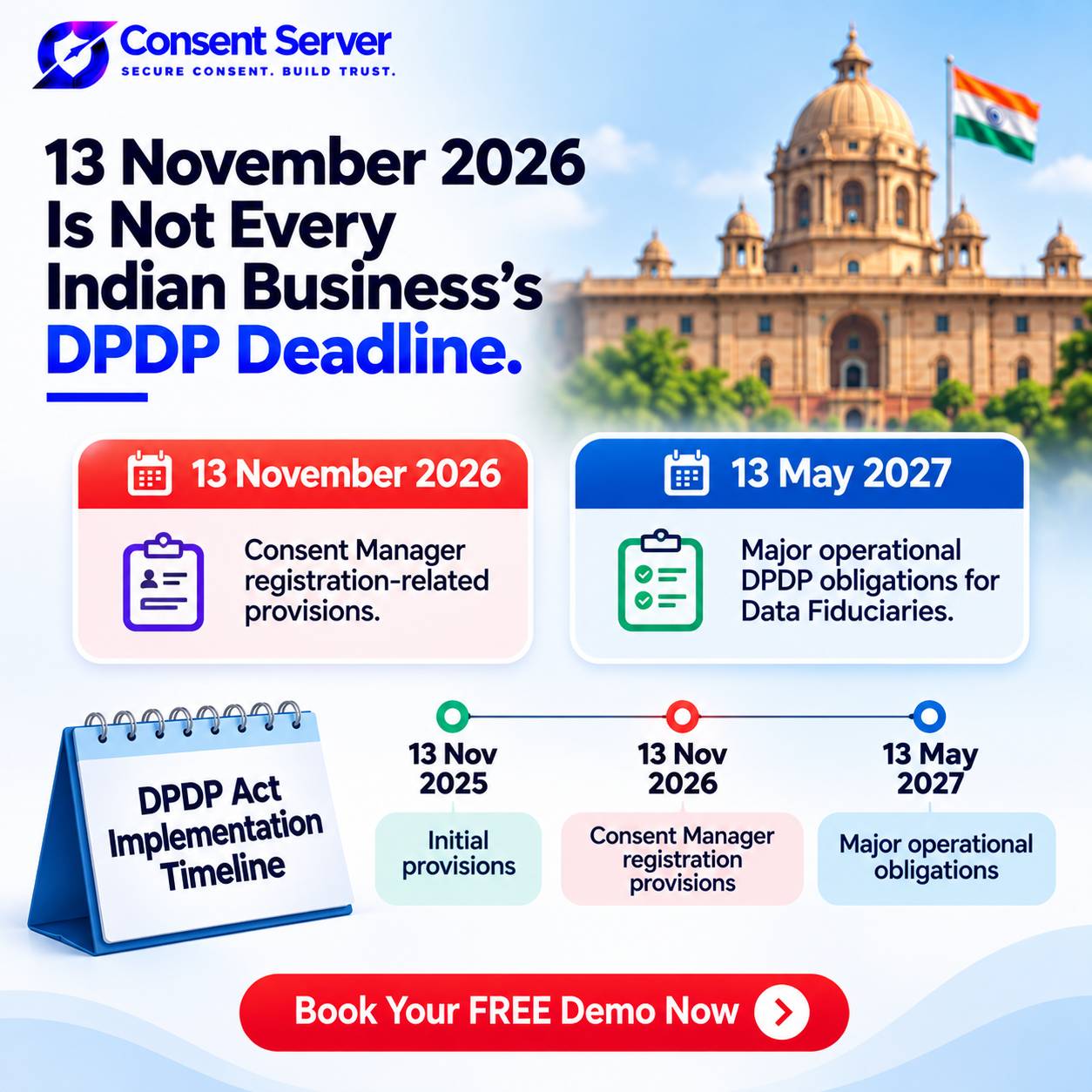
13 November 2026 Is Not Every Indian Business's DPDP Deadline: Here What You Need to Know
Introduction: The DPDP Deadline Confusion Indian Businesses Must Understand
As India moves closer to implementing the Digital Personal Data Protection (DPDP) Act, 2023, businesses are increasingly searching for answers about compliance deadlines.
One date attracting significant attention is 13 November 2026.
Many organisations believe that every Indian business collecting or processing personal data must become fully DPDP compliant by this date.
That interpretation is incorrect.
Under the phased commencement framework notified in November 2025, 13 November 2026 is primarily associated with the commencement of provisions governing the registration and obligations of statutory Consent Managers.
The major operational obligations for Data Fiduciaries are scheduled to commence on 13 May 2027.
However, this distinction does not mean businesses should postpone their compliance preparations.
Understanding the difference between these milestones is essential for organisations evaluating DPDP compliance software, consent management platforms, and data protection strategies.
1. Why Is There Confusion About 13 November 2026?
The DPDP Act was enacted in 2023, while its implementation has been structured through subsequent notifications and rules.
Because different provisions take effect at different times, it is easy to mistake one regulatory milestone for a universal compliance deadline.
The confusion generally comes from three assumptions:
- Every provision of the DPDP Act becomes operational on the same date.
- Every organisation managing consent must register as a statutory Consent Manager.
- Businesses must purchase or implement a registered Consent Manager service before November 2026.
These assumptions overlook the distinction between statutory Consent Managers and ordinary Data Fiduciaries.
A regulatory commencement date must always be understood in relation to the specific provisions becoming effective.
2. The Three Important DPDP Implementation Dates
The notified phased commencement framework identifies three major milestones.
| Date | Regulatory Milestone | Main Significance |
|---|---|---|
| 13 November 2025 | Initial provisions commenced | Establishment of the institutional and regulatory framework |
| 13 November 2026 | Consent Manager registration-related provisions scheduled to commence | Regulatory framework for entities seeking registration as statutory Consent Managers |
| 13 May 2027 | Major operational provisions scheduled to commence | Key Data Fiduciary obligations concerning personal data processing, consent, safeguards, and Data Principal rights |
These dates serve different purposes.
For most businesses processing personal data, the May 2027 milestone is especially significant because it relates to the commencement of major operational requirements.
Nevertheless, businesses must also comply with any other applicable laws and regulatory obligations already in force.
3. What Actually Happens on 13 November 2026?
The November 2026 milestone concerns the statutory Consent Manager framework under the DPDP Act and DPDP Rules, 2025.
Under Section 2(g) of the Act, a Consent Manager is a person registered with the Data Protection Board of India who acts as a single point of contact for Data Principals to give, manage, review, and withdraw consent through an accessible, transparent, and interoperable platform.
The relevant framework includes:
- Section 6(9), concerning registration of Consent Managers.
- Section 27(1)(d), concerning the Board's regulatory role in relation to registration conditions.
- Rule 4 of the DPDP Rules, 2025.
- The First Schedule, which specifies eligibility conditions and obligations.
These provisions establish a regulated pathway for organisations intending to operate as statutory Consent Managers.
However, commencement of these provisions does not automatically mean that every Data Fiduciary must register.
Nor does it necessarily mean that all application processes, technical standards, and certification mechanisms will become operational on that exact date.
Businesses should monitor official announcements from the Data Protection Board for implementation details.
4. Does Every Indian Business Need Consent Manager Registration?
No.
This is one of the most important points for Indian businesses to understand.
The DPDP Act distinguishes between different participants in the personal data processing ecosystem.
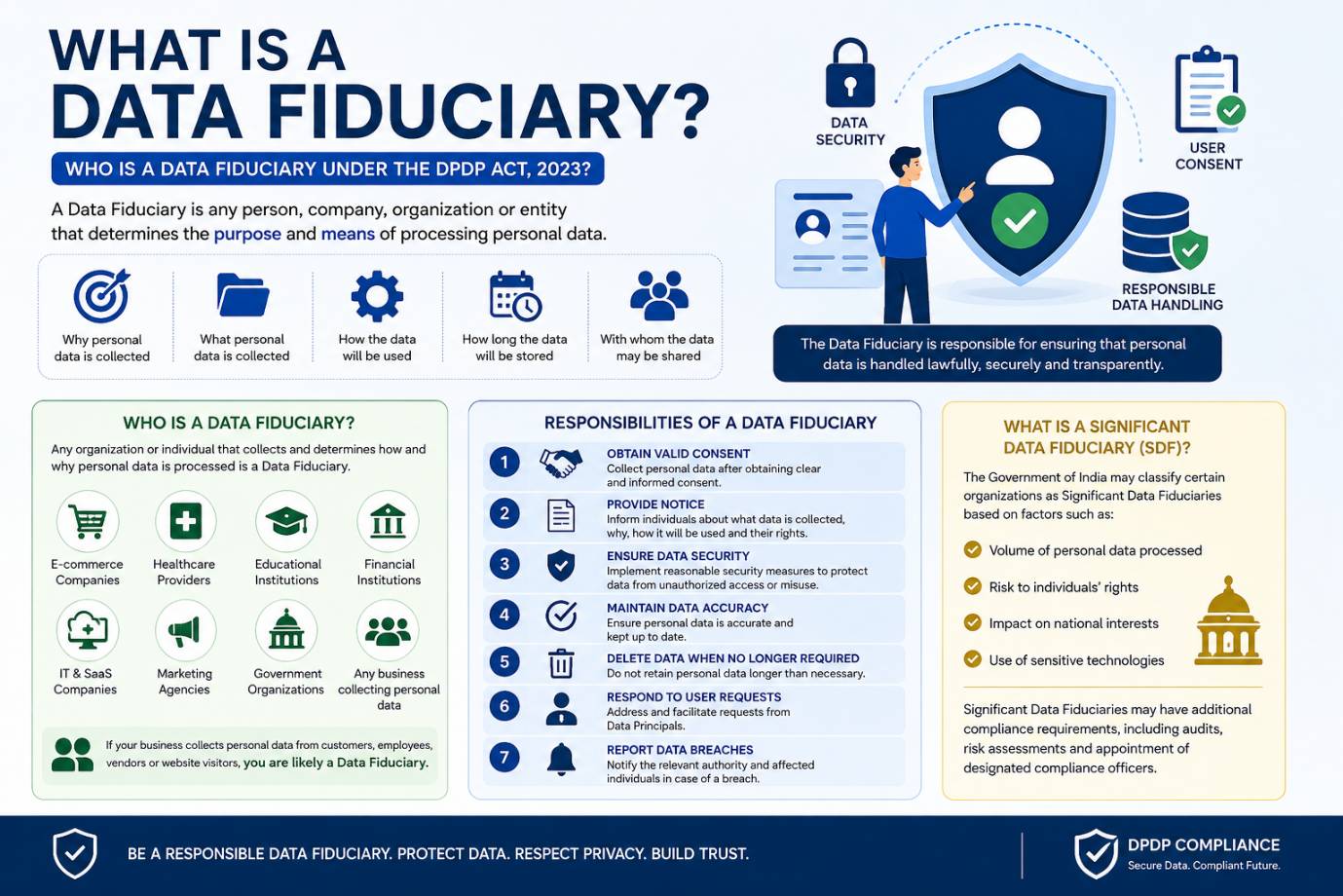
A Data Fiduciary determines the purpose and means of processing personal data, alone or in conjunction with others.
A Data Processor processes personal data on behalf of a Data Fiduciary.
A registered Consent Manager is a regulated entity that facilitates consent management on behalf of Data Principals through an interoperable platform.
An organisation collecting personal data from customers, employees, or website visitors does not automatically need statutory Consent Manager registration merely because it manages consent.
Instead, it must evaluate the legal requirements applicable to its own role and processing activities.
For example, an e-commerce company may need to manage customer consent, privacy notices, data security, and erasure requests without becoming a statutory Consent Manager.
Similarly, a hospital, educational institution, or SaaS company may use a commercial Consent Management Platform to support its own compliance operations.
Using consent management software and operating as a registered Consent Manager are legally different activities.
5. What Is the Difference Between a Registered Consent Manager and a CMP?
The terms Consent Manager and Consent Management Platform are frequently used interchangeably in marketing discussions, but they should not be confused.
| Factor | Registered Consent Manager | Consent Management Platform (CMP) |
|---|---|---|
| Legal status | Registered under the DPDP framework | Commercial technology solution |
| Primary function | Facilitates consent management on behalf of Data Principals | Helps organisations manage their consent-related processes |
| Registration requirement | Statutory registration required | No general statutory registration requirement merely for being a CMP |
| Platform model | Accessible, transparent, interoperable service | May operate within one business or across its connected applications |
| Main accountability | Obligations under the registered Consent Manager framework | Supports the purchasing organisation's compliance processes |
| Example | A Board-registered Consent Manager | Consent Server used by a Data Fiduciary |
This distinction matters when organisations evaluate DPDP software vendors.
A product may provide consent collection, withdrawal management, audit records, and system integrations without being a registered Consent Manager.
Likewise, purchasing a CMP does not automatically establish full legal compliance.
6. Why 13 May 2027 Matters More for Most Data Fiduciaries
Under the notified implementation schedule, several major operational provisions of the DPDP framework are scheduled to commence on 13 May 2027.
These include important obligations relating to the processing of personal data.
Privacy Notices and Lawful Processing
Businesses must assess whether their personal data processing has a valid legal basis and whether applicable notice requirements are satisfied.
Consent Collection
Where consent is required, it must meet the relevant statutory requirements.
Organisations should establish purpose-based consent collection and appropriate recordkeeping processes.
Consent Withdrawal
Data Principals must be able to withdraw consent in accordance with the Act.
Businesses must ensure that withdrawal is implemented appropriately across relevant processing operations.
Reasonable Security Safeguards
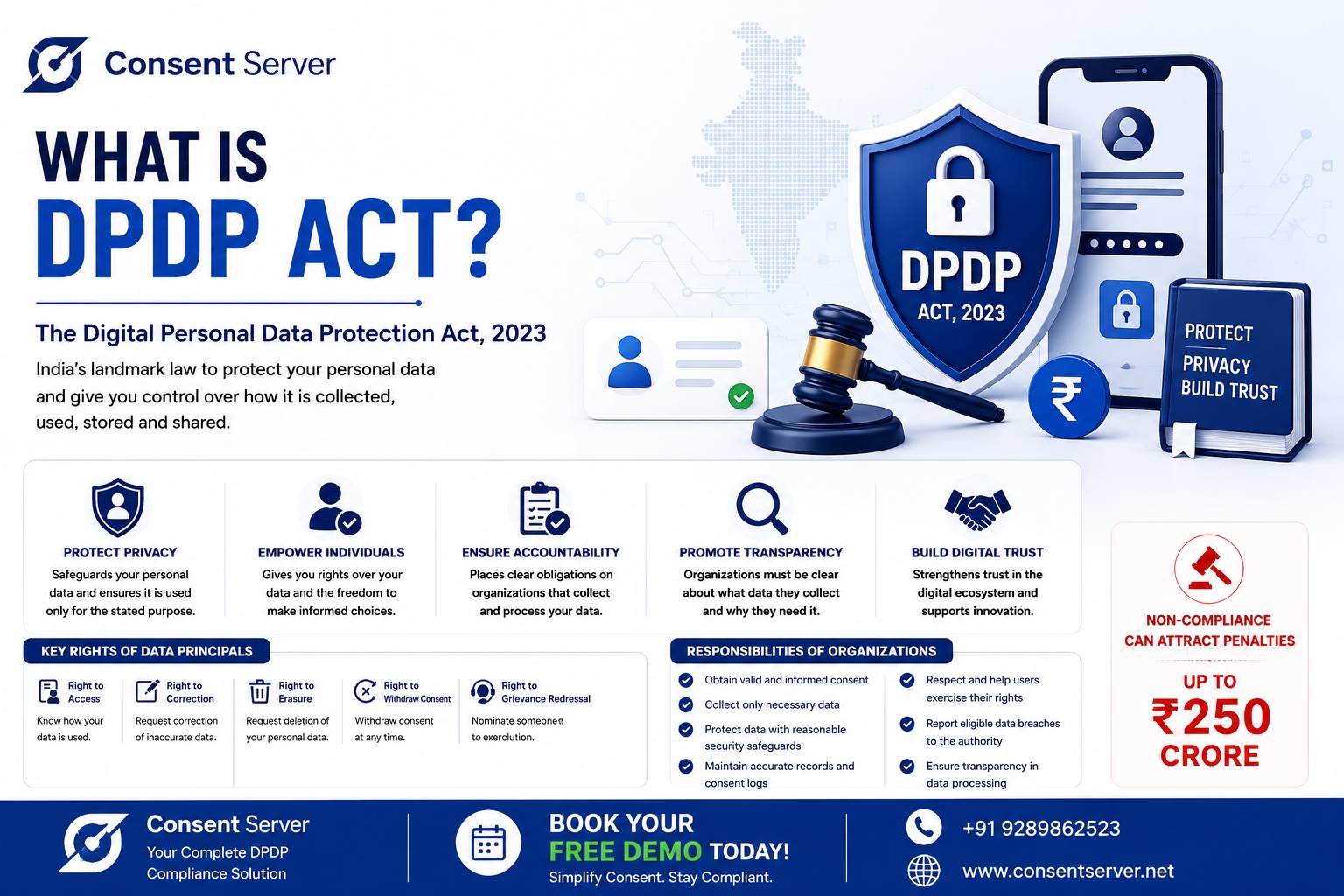
Data Fiduciaries must take reasonable security safeguards to protect personal data in their possession or under their control.
Personal Data Breach Notification
Applicable personal data breaches must be reported to the Board and affected Data Principals in the prescribed manner.
Data Principal Rights
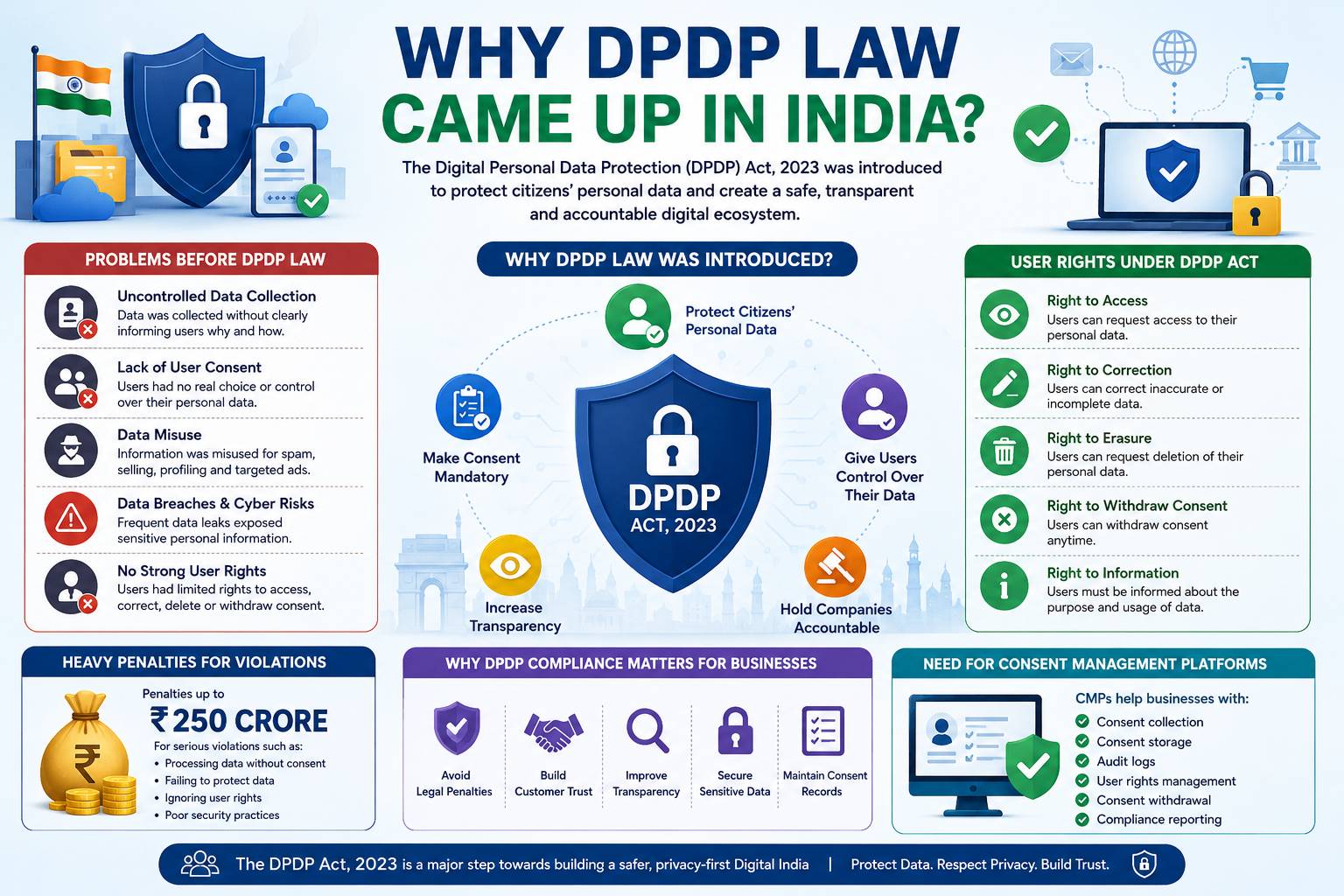
Organisations must prepare processes for applicable rights concerning access, correction, erasure, and grievance redressal.
Data Retention and Erasure
Personal data must be erased when required under the applicable provisions, subject to relevant legal exceptions and retention obligations.
These requirements often involve changes across websites, applications, databases, CRM systems, communication tools, and internal business workflows.
That is why DPDP compliance should be approached as an operational programme rather than a one-time policy update.
7. Does the November 2026 Deadline Apply to Your Industry?
The DPDP Act is not limited to large technology companies or multinational organisations.
Its applicability depends on factors such as the nature of digital personal data processing, the organisation's role, and the territorial scope of the Act.
Businesses across different industries should assess their responsibilities.
Healthcare
Hospitals, clinics, diagnostic centres, and health technology companies should review patient information processing, notices, access controls, retention practices, and applicable consent requirements.
Education
Schools, universities, coaching institutes, and EdTech platforms should examine student and parent information, including requirements concerning children's personal data.
Banking and Financial Services
Banks, NBFCs, FinTech companies, and insurance businesses should review DPDP obligations alongside existing financial-sector regulations.
E-Commerce and Retail
Online retailers should assess customer data collection, order processing, marketing communications, and data-sharing arrangements.
HR and Recruitment
Employers and recruitment platforms should review employee and applicant information, including the lawful grounds applicable to different employment-related processing activities.
SaaS and Technology
Software providers should determine whether they act as Data Fiduciaries, Data Processors, or both for different activities.
The November 2026 milestone does not automatically impose a universal registration deadline on these industries. Their DPDP responsibilities must be assessed according to the provisions applicable to their activities.
8. Why Waiting Until May 2027 Is a Risky Strategy
Although major operational requirements are scheduled for May 2027, compliance implementation can require substantial preparation.
Consider a business operating multiple websites, CRM systems, mobile applications, and marketing tools.
To prepare for DPDP compliance, it may need to:
- Identify where personal data is collected and stored.
- Map purposes and lawful processing grounds.
- Update privacy notices and consent forms.
- Implement appropriate consent records.
- Establish consent withdrawal processes.
- Connect consent updates with existing applications.
- Develop Data Principal rights workflows.
- Strengthen security safeguards.
- Review processor contracts and responsibilities.
- Train employees and test compliance procedures.
These activities cannot always be completed simply by installing a software product.
For example, if a customer withdraws consent for marketing, the organisation may need to ensure that relevant CRM, SMS, WhatsApp, and email marketing systems implement that change.
A consent withdrawal recorded on a website is not necessarily sufficient if connected applications continue processing personal data inconsistently with the withdrawal.
Businesses should therefore use the preparation period to build and test their operational processes.
9. How Consent Server Helps Indian Businesses Prepare for DPDP Compliance
Consent Server is a DPDP Compliance Software and Consent Management Platform designed to help Data Fiduciaries manage consent-related operations.
Developed by Iconic Infotech Pvt. Ltd., Consent Server helps organisations centralise consent records, automate consent lifecycle processes, and integrate consent-related events with existing business systems.
Centralised Consent Management
Collect and manage purpose-based consent through configurable forms and centralised records.
Consent Lifecycle Automation
Manage consent granting, updating, withdrawal, renewal, and expiry through defined workflows.
Data Principal Rights Management
Support requests relating to access, correction, erasure, withdrawal, and grievances.
Audit-Ready Consent Records
Maintain relevant consent histories, timestamps, notice versions, and activity records.
Hash-based integrity mechanisms help detect unauthorised modification of relevant records.
APIs and Webhooks
Communicate consent events to connected CRM, ERP, marketing, and other business applications.
Acknowledgement and Completion Tracking
Consent Server supports the following workflow:
Consent Event --> Webhook/API Notification --> Delivered --> Acknowledged --> Action Completed --> Completion Evidence
Retries and escalation mechanisms help identify unresolved processing actions.
Connected applications must still execute the necessary changes.
On-Premise and Hosted Deployment
Organisations can choose deployment options according to their infrastructure, security, and operational requirements.
Consent Server is a commercial Consent Management Platform for businesses. It should not be confused with a statutory Consent Manager registered with the Data Protection Board of India.
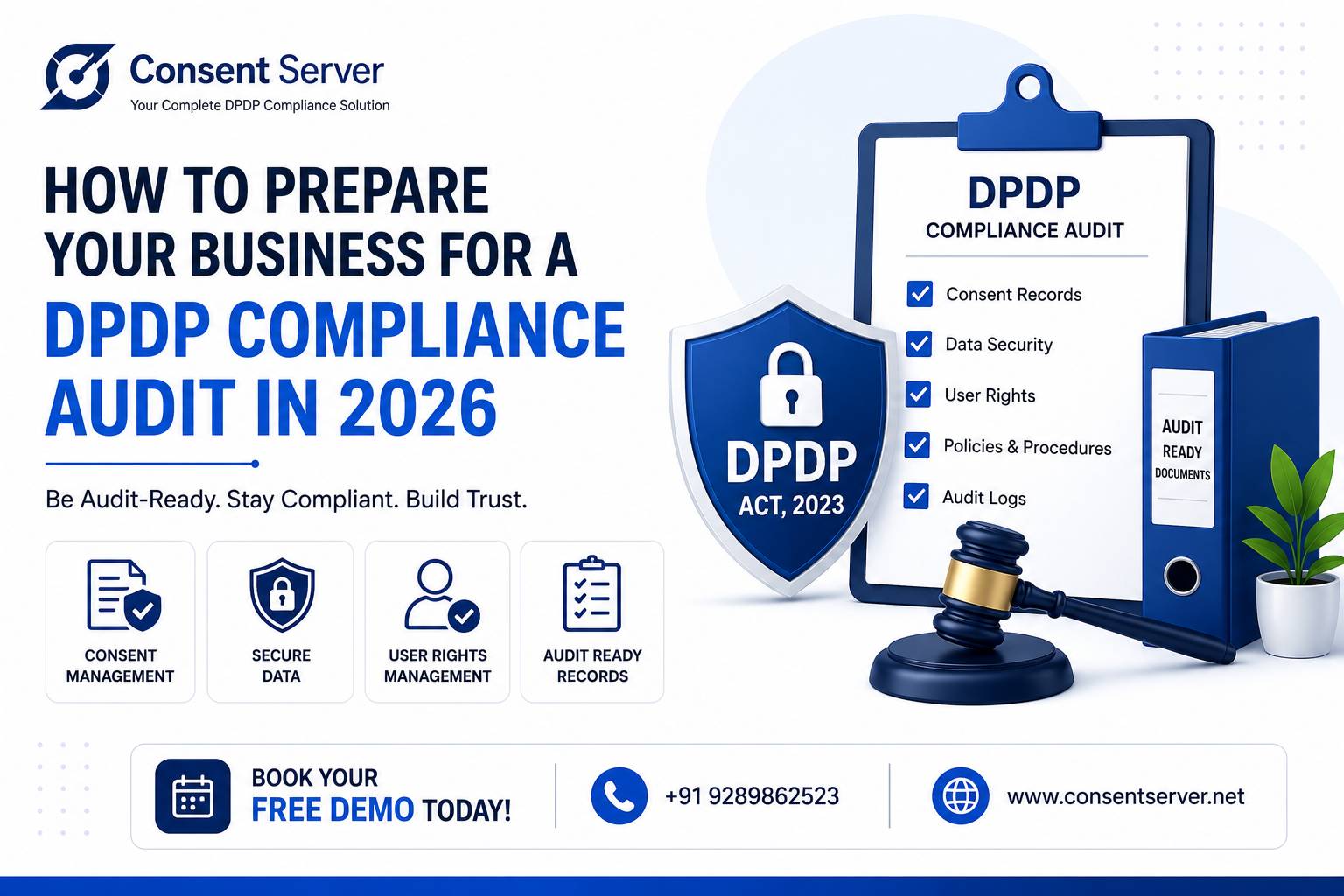
10. What Should Indian Businesses Do Before 13 May 2027?
Businesses can prepare through a phased implementation strategy.
Phase 1: November–December 2026 — Assess Your Current Position
Identify personal data processing activities, review legal grounds, examine existing notices, and assess security and consent-management gaps.
Phase 2: January–March 2027 — Implement Compliance Processes
Develop appropriate consent-management workflows, Data Principal rights procedures, retention controls, security safeguards, and integration mechanisms.
Phase 3: April–May 2027 — Test and Validate
Test consent collection and withdrawal, verify downstream application updates, review incident response readiness, train employees, and address outstanding gaps.
This is an illustrative preparation roadmap, not a government-prescribed implementation schedule.
Organisations with complex systems or significant processing activities may need to begin earlier.
11. Frequently Asked Questions
Is 13 November 2026 the DPDP compliance deadline for every Indian business?
No. Under the notified phased commencement framework, this date primarily concerns statutory Consent Manager registration provisions.
What is the main DPDP compliance date for Data Fiduciaries?
Major operational provisions are scheduled to commence on 13 May 2027, subject to any subsequent amendments or notifications.
Does every business need to register as a Consent Manager?
No. Registration applies to organisations seeking to operate as statutory Consent Managers, not automatically to every business managing its own customer consent.
Is using a Consent Management Platform mandatory?
The DPDP Act does not impose a universal requirement to purchase a particular CMP product. Businesses must satisfy their applicable legal obligations, and appropriate software can help them implement relevant processes.
Can a company use Consent Server without registering as a Consent Manager?
Yes. Consent Server is designed to support Data Fiduciaries' consent-management operations. Using a commercial CMP does not, by itself, require the customer to register as a statutory Consent Manager.
Can businesses wait until May 2027 to start preparing?
That would be risky. Data mapping, application integration, security improvements, and operational testing may require considerable time. Other applicable legal obligations may already be in force.
Conclusion: Understand the Deadline Before Making Compliance Decisions
13 November 2026 is not every Indian business's DPDP compliance deadline.
It is a significant milestone for the statutory Consent Manager framework.
For most Data Fiduciaries, the major operational requirements are scheduled to commence on 13 May 2027.
The distinction matters because businesses should not confuse Consent Manager registration with their own responsibilities for personal data processing.
However, the additional preparation period should not be mistaken for a reason to delay action.
DPDP compliance requires coordinated processes involving legal assessment, privacy notices, consent management, security safeguards, Data Principal rights, and appropriate recordkeeping.
Consent Server helps Indian businesses prepare through centralised consent management, automated workflows, audit-ready records, and integration with existing applications.
Prepare for DPDP Compliance Before the Deadline
Strengthen your consent-management infrastructure and simplify compliance-related operations with Consent Server.