DPDP Consent Audit Trail: Records and Evidence Guide
Learn what consent records and evidence Indian businesses should maintain under the DPDP Act, 2023, including audit trails, withdrawal logs and notice versions.
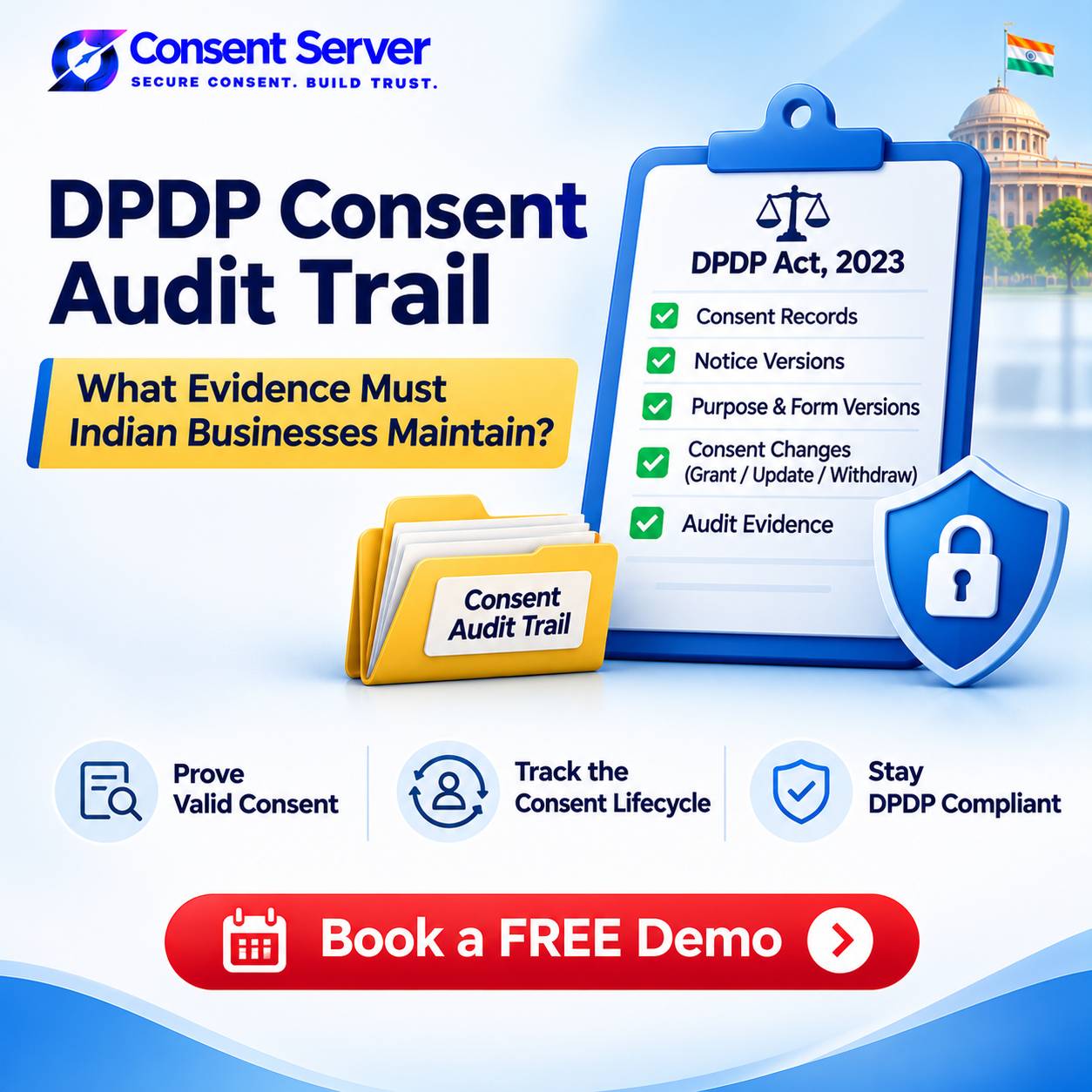
DPDP Consent Audit Trail: What Evidence Must Indian Businesses Maintain?
Introduction: Collecting Consent Is Only the Beginning
Imagine a customer visits your website, fills out a registration form, and agrees to receive promotional communications.
Six months later, the customer complains that your company is using their personal data without permission.
Your organisation responds, “The customer gave consent.”
But can you demonstrate it?
Can you identify when consent was collected, which processing purpose was presented, what information the customer received, and whether that consent was subsequently withdrawn?
These questions highlight one of the most important operational challenges under India's Digital Personal Data Protection (DPDP) Act, 2023: maintaining reliable evidence of consent.
Many Indian businesses still depend on website checkboxes, CRM fields, spreadsheets, or basic database records to manage customer permissions.
While these methods may capture an initial consent choice, they may not provide sufficient information to demonstrate that the consent satisfied the applicable legal requirements.
Under Section 6(10) of the DPDP Act, where consent is relied upon as the basis for processing and a proceeding questions that consent, the Data Fiduciary must prove that the Data Principal received the required notice and gave consent in accordance with the Act.
This makes DPDP consent audit trails particularly important for organisations preparing for compliance.
In this article, we explain what consent evidence businesses should maintain, how audit trails support DPDP compliance, and how a DPDP Consent Management Platform can help automate consent records and related workflows.
1. What Is a Consent Audit Trail?
A consent audit trail is a chronological record of relevant events and evidence associated with a Data Principal's consent.
It helps an organisation understand how consent was collected, what it covered, and how the consent status changed over time.
For example, a consent audit trail may record:
- When consent was granted.
- Which processing purpose was selected.
- Which privacy notice was presented.
- Which consent form version was used.
- When consent was updated or withdrawn.
- Which connected applications received the change.
- Whether the required downstream actions were completed.
A reliable audit trail should help reconstruct the history of consent-related decisions without relying entirely on manually maintained records.
However, the DPDP Act does not prescribe one universal audit-log format or require every organisation to use a particular software product.
The objective is to maintain appropriate evidence that can support the organisation's legal obligations and operational accountability.
2. Why Is Consent Evidence Important Under the DPDP Act?
Section 6 of the DPDP Act establishes requirements for valid consent.
Consent must be free, specific, informed, unconditional, and unambiguous, expressed through clear affirmative action.
It must also relate to the specified purpose and be limited to the personal data necessary for that purpose.
Importantly, Section 6(10) places the burden of proving valid notice and consent on the Data Fiduciary when consent is questioned in a proceeding.
This creates an important distinction between obtaining consent and being able to demonstrate that it was validly obtained.
Example: A Consent Dispute
Suppose an online retailer sends promotional WhatsApp messages to a customer.
The customer disputes having agreed to receive marketing communications.
The business has a CRM field showing:
Marketing Consent: Yes
But this field alone may not establish:
- Whether the customer actively selected the option.
- What information was displayed at the time.
- Whether the marketing purpose was clearly explained.
- When the consent was obtained.
- Whether the customer subsequently withdrew consent.
A more complete consent record can help the business establish what occurred.
A consent status is useful, but the supporting evidence is what makes the record meaningful during a dispute.
3. What Consent Evidence Should Indian Businesses Maintain?
The Act requires proof of compliant notice and consent where consent is questioned, but it does not prescribe every individual database field listed below.
The following records are recommended components of a practical consent-evidence framework.
A. Consent Identification and Data Principal Reference
Each consent record should be associated with an appropriate identifier.
This may include:
- Unique consent ID.
- Data Principal reference ID.
- Relevant customer or account reference.
- Consent record creation timestamp.
A unique consent ID makes it easier to locate and correlate relevant events across connected systems.
Organisations should avoid storing unnecessary personal data merely for audit purposes.
B. Consent Collection Date and Time
The organisation should be able to establish when the consent was obtained.
Useful records may include:
- Consent submission timestamp.
- Relevant time zone.
- Consent collection channel.
- Event sequence information.
For example, a business may need to demonstrate that valid consent was obtained before a consent-dependent marketing activity began.
Accurate timestamps can help establish that sequence.
C. Processing Purpose
Consent must be connected to the specified purpose.
An audit record should therefore identify the purpose for which consent was obtained.
For example:
Purpose: Promotional WhatsApp Communications
This is more meaningful than a generic field such as:
Consent: Accepted
A customer may agree to receive order notifications without agreeing to unrelated promotional communications.
Purpose-specific records help businesses distinguish between these activities.
D. Privacy Notice Version
The DPDP Act requires applicable notice information to be provided in accordance with its provisions.
Where consent is relied upon, businesses should retain evidence of the notice presented to the Data Principal.
Recommended records include:
- Notice identifier.
- Notice version.
- Relevant notice content or a securely retained copy.
- Language of the notice, where applicable.
- Date the notice version became effective.
This can help establish which information was available when consent was collected.
E. Consent Form Version
Businesses frequently update website forms, mobile application interfaces, and consent collection processes.
A record of the form version can help establish how the consent request appeared at the relevant time.
Recommended information may include:
- Form identifier.
- Form version.
- Purpose selection configuration.
- Consent collection mechanism.
Where practical, businesses may also retain appropriate evidence of the user-facing consent interface.
F. Affirmative Consent Action
Valid consent must involve clear affirmative action.
A business should therefore retain appropriate evidence of how the consent was expressed.
For example:
- Selection of an optional consent control.
- Submission of a consent form.
- Confirmation through an applicable verification process.
- Another clearly documented affirmative action.
The organisation should ensure that its consent collection mechanism satisfies the Act's requirements.
A record of a checkbox being selected does not automatically establish that the overall consent was valid.
G. Consent Status and Lifecycle History
Consent can change over time.
Businesses should preserve relevant lifecycle events, such as:
- Consent granted.
- Consent updated.
- Consent withdrawn.
- Consent renewed.
- Consent expired.
Rather than simply replacing the previous status, a chronological event history can help explain how the current status was reached.
H. Withdrawal Records
Section 6(4) provides Data Principals with the right to withdraw consent.
When consent is withdrawn, the Data Fiduciary must cease the relevant processing within a reasonable time and cause its Data Processors to cease, unless continued processing without consent is required or authorised under the Act or another applicable law.
Recommended withdrawal evidence includes:
- Withdrawal request timestamp.
- Relevant consent ID.
- Processing purpose affected.
- Withdrawal channel.
- Updated consent status.
- Downstream processing actions initiated.
- Completion or exception information, where applicable.
This information can help organisations investigate whether a withdrawal was implemented appropriately.
4. Consent Evidence Checklist for Indian Businesses
The following table distinguishes recommended records from the legal obligations they help support.
| Evidence Type | Why It Matters | Recommended Practice |
|---|---|---|
| Consent ID | Identifies a consent record | Generate a unique reference |
| Data Principal reference | Associates the record with the relevant individual | Use an appropriate internal identifier |
| Consent timestamp | Establishes when consent was obtained | Record reliable date and time |
| Processing purpose | Identifies what consent covers | Maintain purpose-specific records |
| Notice version | Supports proof of information provided | Preserve the relevant notice version |
| Consent form version | Helps reconstruct the collection process | Track material form changes |
| Affirmative action evidence | Supports proof of the consent decision | Record the applicable action |
| Consent lifecycle history | Shows how consent changed | Maintain chronological events |
| Withdrawal record | Supports withdrawal handling | Record request and action timestamps |
| Downstream action evidence | Supports operational accountability | Track relevant notifications and completion |
| Integrity evidence | Helps identify unauthorised record changes | Apply suitable integrity controls |
Important: This is a recommended implementation framework, not an exhaustive statutory list of mandatory audit-log fields.
The appropriate evidence and retention approach will depend on the processing activity, applicable law, and the organisation's compliance obligations.
5. Why a Basic Consent Checkbox May Not Be Enough
Many websites use a checkbox alongside a statement such as:
“I agree to receive promotional communications.”
When the customer submits the form, the website saves a Boolean value in its database.
For example:
marketing_consent = true
This record may be useful, but it does not independently establish all the circumstances surrounding the consent.
It may not identify the notice version, the specific purpose description, or the history of subsequent changes.
Now consider a business that updates its privacy notice after six months.
If the company only stores the current notice, it may struggle to establish what the customer originally saw.
Similarly, if a consent status is overwritten after withdrawal, the original grant event may no longer be visible.
A stronger approach is to preserve relevant consent events and supporting context rather than relying exclusively on the latest consent value.
6. Why Consent Audit Trails Must Cover More Than Collection
Consent management is not limited to the moment a customer submits a form.
The consent lifecycle can involve multiple events and connected applications.
For example, a customer may:
- Grant consent for promotional messages.
- Update their communication preferences.
- Withdraw consent for WhatsApp marketing.
- Continue receiving essential service communications under an independently applicable legal basis.
Each event can affect how the business is permitted to process personal data.
A useful audit trail should help the organisation identify the relevant event, the affected purpose, and the resulting operational action.
This becomes particularly important when personal data is processed across multiple applications.
7. The Hidden Challenge: Proving Consent Withdrawal Across CRM, SMS, and WhatsApp
Consider an e-commerce company using the following systems:
- Website for consent collection.
- CRM for customer records.
- SMS gateway for promotional campaigns.
- WhatsApp integration for marketing.
- ERP for order processing.
A customer withdraws consent for promotional communications through the website.
The website updates its database.
However, the CRM still shows the customer as subscribed.
The SMS gateway continues sending marketing messages.
The WhatsApp platform has not received the updated consent status.
In this situation, the website may have evidence that the customer withdrew consent, but the organisation still needs to address the relevant downstream processing.
An effective consent-management workflow should therefore consider whether connected systems received and implemented the change.
A Practical Consent Withdrawal Workflow
Consent Withdrawn --> Event Created --> Connected System Notified --> Delivery Confirmed --> Action Acknowledged --> Processing Updated --> Completion Recorded
This workflow is a recommended operational design, not a sequence expressly prescribed by the DPDP Act.
It can help organisations identify where a consent-related instruction was delayed, rejected, or left incomplete.
8. Is a Webhook Delivery Log Enough for DPDP Compliance?
No.
A webhook delivery log may establish that a notification was sent to another application.
It does not necessarily prove that the receiving application implemented the required processing change.
For example, a CRM may successfully receive a consent withdrawal event but fail to update the customer's marketing preferences because of an internal error.
The sending system may record:
Webhook Delivered: Success
But the underlying processing action may remain incomplete.
A more comprehensive operational record can distinguish between:
Delivered: The receiving system received the notification.
Acknowledged: The receiving system confirmed acceptance or processing of the instruction.
Completed: The required downstream action was performed.
Evidence Recorded: Relevant information about completion was retained.
This distinction can improve accountability and help organisations identify unresolved actions.
9. How Tamper Detection Can Strengthen Consent Audit Records
Consent records may become important evidence during complaints, investigations, or internal compliance reviews.
Organisations should therefore protect those records against unauthorised modification.
A practical technical approach may include cryptographic hashing.
For example, a system can calculate a SHA-256 hash over defined record content.
If the protected content changes, the recomputed hash will ordinarily differ from the previously stored hash.
This can help identify potential record modifications.
However, hashing alone does not make an audit trail tamper-proof.
If an attacker can alter both a record and its stored hash, a basic hash comparison may not reveal the change.
Stronger integrity designs may combine:
- Cryptographic hashes.
- Appropriate access controls.
- Protected audit storage.
- Secure timestamps.
- Independent verification or authenticated integrity mechanisms.
- Monitoring of privileged modifications.
The objective is to make unauthorised changes detectable and ensure that audit records remain reliable.
10. How Long Should Consent Audit Records Be Retained?
There is no single universal retention period that applies to every consent audit record under all circumstances.
Retention decisions must consider the DPDP Act, applicable Rules, other legal obligations, and the nature of the processing activity.
Section 8 addresses erasure obligations, including circumstances where the specified purpose is no longer served or consent is withdrawn, subject to applicable legal requirements.
The notified DPDP Rules also contain provisions relevant to retention of certain personal data, associated traffic data, and processing logs, including a minimum one-year period for specified security-related retention obligations, unless another applicable law requires otherwise.
That requirement should not be interpreted as a universal instruction to retain every consent record indefinitely.
Businesses should establish documented retention schedules that distinguish between:
- Personal data processed for the original business purpose.
- Consent evidence necessary for applicable legal obligations.
- Security and processing logs covered by relevant rules.
- Records required for disputes, investigations, or other lawful purposes.
They should also define secure deletion procedures when retention is no longer required or authorised.
An audit trail should support compliance without becoming an unnecessary repository of personal data.
11. Common Consent Audit Trail Mistakes Businesses Should Avoid
Storing Only a Yes or No Value
A single consent status may not preserve enough information about the original consent.
Failing to Preserve Notice Versions
If a notice changes, businesses may lose the ability to establish what information was previously presented.
Overwriting Consent History
Replacing historical events with the latest status can make it difficult to reconstruct the consent lifecycle.
Using One Consent Status for Every Purpose
A customer may permit one activity while declining another.
Ignoring Connected Applications
Updating the consent database does not automatically mean every relevant processor or application has implemented the change.
Treating Webhook Delivery as Completion
Successful notification delivery should not be confused with successful downstream execution.
Maintaining Unprotected Audit Records
Records that can be silently modified or deleted may provide weaker evidence.
Retaining Everything Indefinitely
Unnecessary retention can create additional security, privacy, and compliance risks.
Addressing these issues early can reduce operational complexity as consent volumes increase.
12. How Consent Server Helps Businesses Maintain Consent Audit Trails
Consent Server is a DPDP Compliance Software and Consent Management Platform developed to help Indian Data Fiduciaries manage consent-related operations.
The platform supports centralised consent records, lifecycle workflows, integrity controls, and integration with existing business applications.
Centralised Consent Records
Consent Server helps businesses maintain consent-related information within a central management system.
This reduces dependence on disconnected spreadsheets and isolated application records.
Purpose-Based Consent Management
Consent can be associated with defined processing purposes, helping organisations manage relevant consent choices separately.
Notice and Purpose Versioning
Consent Server supports notice and purpose versioning, helping organisations preserve the context associated with consent records.
Consent Lifecycle History
The platform supports events relating to consent granting, updating, withdrawal, renewal, and expiry.
These events help establish a chronological history of relevant consent decisions.
Hash-Based Integrity Verification
Consent Server incorporates hash-based mechanisms to support record integrity verification and tamper detection.
API and Webhook Integration
Consent-related events can be communicated to connected CRM, ERP, marketing, and other business applications.
Acknowledgement and Completion Tracking
Consent Server supports the following operational workflow:
Consent Event --> Webhook/API Notification --> Delivered --> Acknowledged --> Action Completed --> Completion Evidence
This helps businesses track the progress of relevant consent-related instructions.
Retry and Escalation Mechanisms
Where connected systems fail to acknowledge or complete an action, retry and escalation workflows can help bring unresolved activities to the attention of responsible personnel.
Data Principal Rights Management
Consent Server also supports workflows for access, correction, erasure, withdrawal, and grievances.
On-Premise and Hosted Deployment
The platform offers deployment flexibility for organisations with different infrastructure, security, and operational requirements.
Consent Server supports consent-related compliance processes, but organisations remain responsible for their overall DPDP obligations, including legal-basis assessment, retention decisions, and effective implementation across connected systems.
13. How Indian Businesses Can Build an Audit-Ready Consent Management Process
Businesses preparing for the major operational DPDP provisions scheduled to commence on 13 May 2027 should consider the following implementation roadmap.
Step 1: Identify Consent-Based Processing Activities
Map the personal data processing activities that rely on consent.
Distinguish them from processing supported by applicable certain legitimate uses or other legal provisions.
Step 2: Define Processing Purposes
Create clear purpose descriptions and identify the personal data required for each purpose.
Step 3: Review Consent Collection Interfaces
Ensure consent mechanisms meet the relevant statutory requirements.
Step 4: Establish Notice Versioning
Preserve relevant versions of the notices provided to Data Principals.
Step 5: Create a Consent Event History
Record consent grants, updates, withdrawals, and other relevant lifecycle events.
Step 6: Map Connected Systems
Identify which applications process personal data for each consent-based purpose.
Step 7: Implement Withdrawal Workflows
Ensure relevant connected applications receive and implement consent withdrawal instructions.
Step 8: Protect Audit Records
Apply suitable security, access control, and integrity verification measures.
Step 9: Define Retention and Deletion Rules
Determine appropriate retention periods based on applicable legal requirements and documented purposes.
Step 10: Test Audit Evidence Retrieval
Conduct internal exercises to determine whether the organisation can retrieve relevant consent evidence when required.
These steps can help businesses move from basic consent collection toward more reliable consent lifecycle management.
14. Frequently Asked Questions
Is maintaining a consent audit trail mandatory under the DPDP Act?
The Act requires the Data Fiduciary to prove compliant notice and consent when consent is questioned in a proceeding. It does not prescribe one universal audit-trail format. Appropriate records can help organisations meet that burden.
Is a consent checkbox sufficient evidence?
A checkbox record may contribute to evidence, but its sufficiency depends on the surrounding circumstances, including the notice, purpose, affirmative action, and applicable legal requirements.
Should businesses store consent timestamps?
Recording reliable timestamps is a recommended practice because it can help establish when consent was obtained, changed, or withdrawn.
Is privacy notice versioning required?
The Act does not expressly prescribe a particular version-control database design. Preserving relevant notice versions is a practical way to support proof of the notice provided.
Can a CRM maintain consent records?
A CRM can store consent information, but businesses should evaluate whether it can preserve appropriate evidence, manage purpose-specific choices, and support withdrawal across relevant connected systems.
Does successful webhook delivery prove consent withdrawal was implemented?
No. Delivery confirms notification transmission or receipt, depending on the system design. It does not necessarily establish that the required downstream action was completed.
Can Consent Server help maintain consent audit records?
Yes. Consent Server supports centralised consent management, lifecycle history, notice and purpose versioning, hash-based integrity mechanisms, and connected-system event tracking.
Conclusion: Consent Evidence Matters as Much as Consent Collection
The DPDP Act is not simply about displaying a privacy notice or collecting a customer's agreement.
For processing based on consent, businesses must be able to establish that the relevant legal requirements were satisfied.
Section 6(10) makes this particularly important by placing the burden of proving compliant notice and consent on the Data Fiduciary when consent is questioned in a proceeding.
A well-designed DPDP consent audit trail can help organisations preserve the relevant history of consent collection, changes, withdrawal, and related operational actions.
For businesses operating multiple applications, the challenge extends beyond recording consent in one database.
They must also ensure that relevant consent changes are communicated and implemented across the systems that process personal data.
Consent Server helps Indian businesses simplify this process through purpose-based consent management, centralised records, automated lifecycle workflows, integrity verification, and integration with connected business applications.
As the DPDP compliance framework moves toward its major operational implementation phase, businesses should prioritise reliable consent evidence and effective processing controls.