DPDP Consent Withdrawal: CRM, SMS & WhatsApp | Consent Server
Learn how to enforce consent withdrawal across CRM, SMS and WhatsApp under the DPDP Act. Discover how Consent Server helps automate workflows and track compliance.
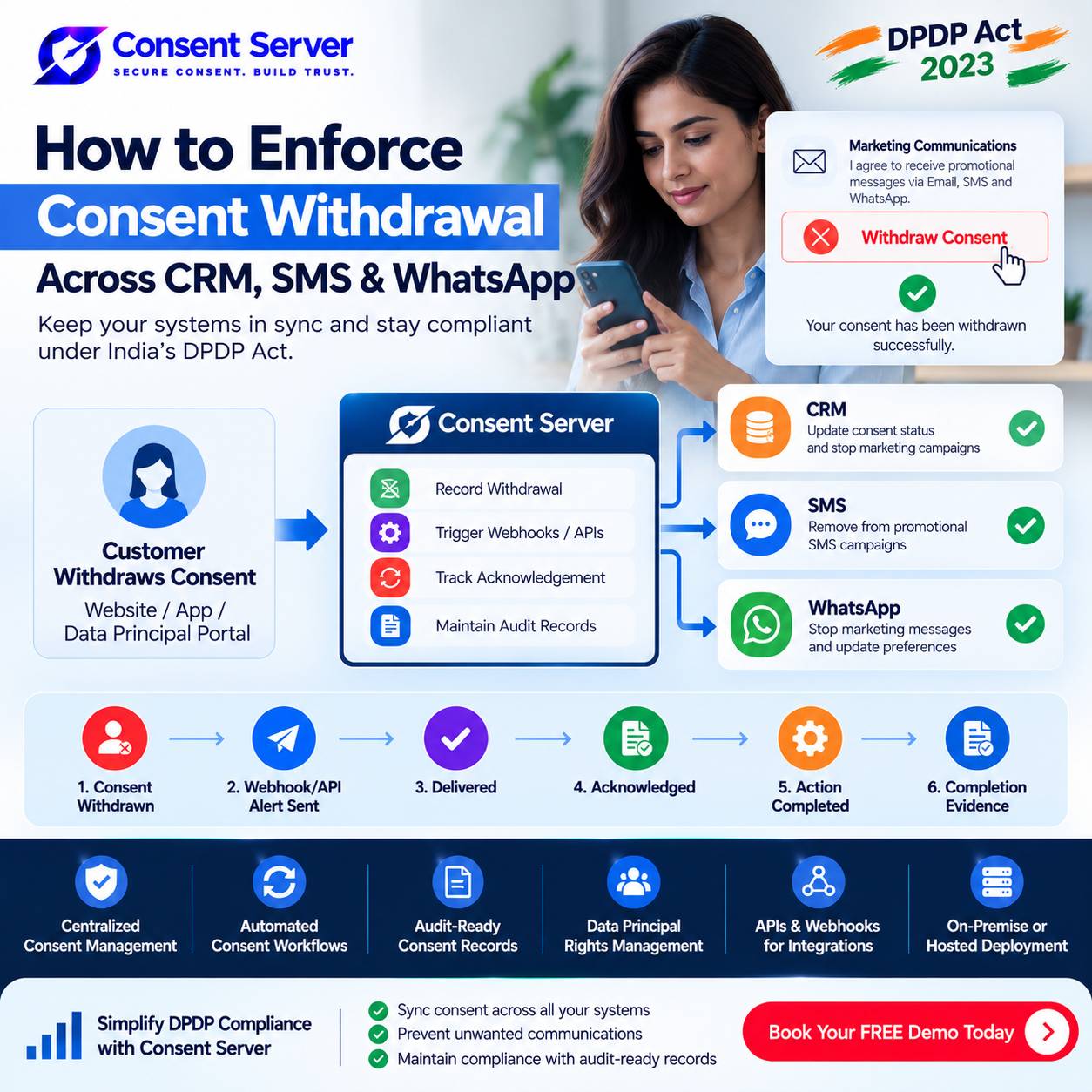
How to Enforce Consent Withdrawal Across CRM, SMS & WhatsApp Under the DPDP Act
Under India's Digital Personal Data Protection (DPDP) Act, 2023, obtaining customer consent is only one part of responsible personal data processing. Businesses must also ensure that consent can be withdrawn and that the withdrawal is appropriately implemented across relevant systems.
Today, organizations collect customer information through websites, mobile applications, CRM platforms, SMS gateways, and WhatsApp marketing tools.
But what happens when a customer withdraws consent?
Does withdrawing consent from your website automatically stop marketing messages from your CRM, SMS gateway, and WhatsApp campaigns?
In many organizations, the answer is no.
This creates an important operational challenge for businesses preparing for DPDP compliance.
A centralized DPDP Consent Management Platform, such as Consent Server, can help organizations manage consent withdrawal, communicate changes to connected applications, and maintain supporting compliance records.
1. What Does the DPDP Act Say About Consent Withdrawal?
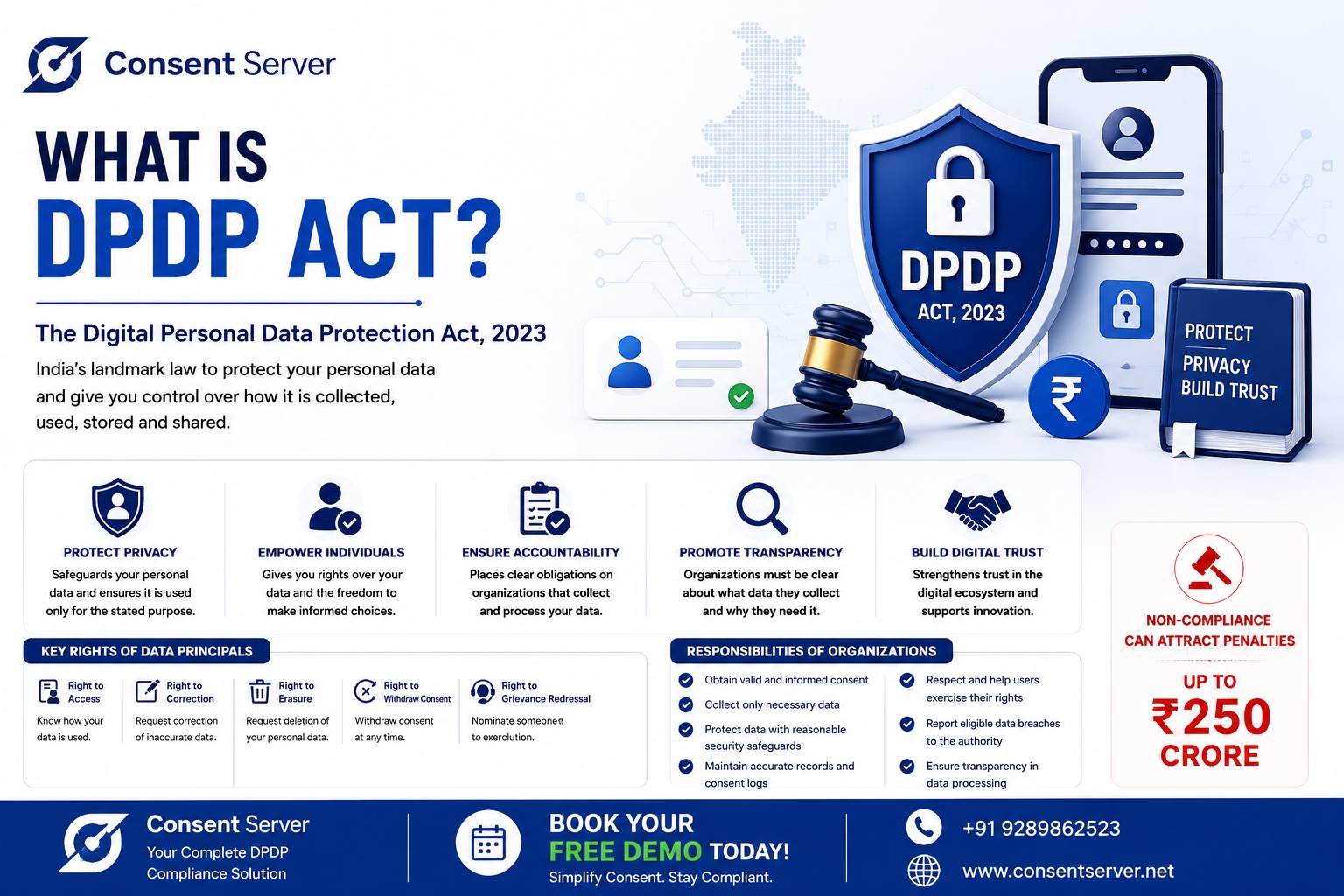
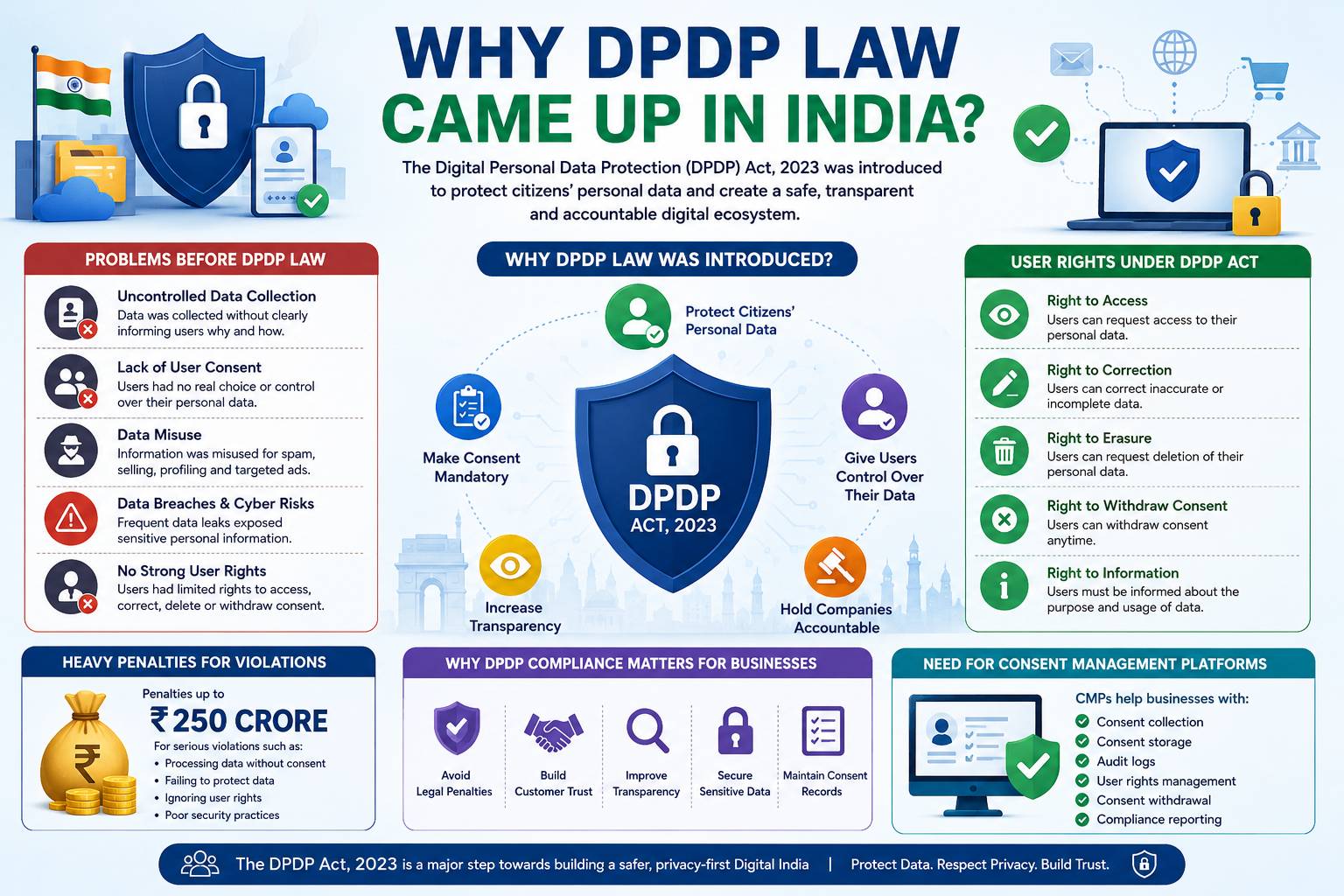
Section 6 of the DPDP Act gives Data Principals the right to withdraw consent at any time.
The Act also requires that withdrawing consent should be as easy as giving it.
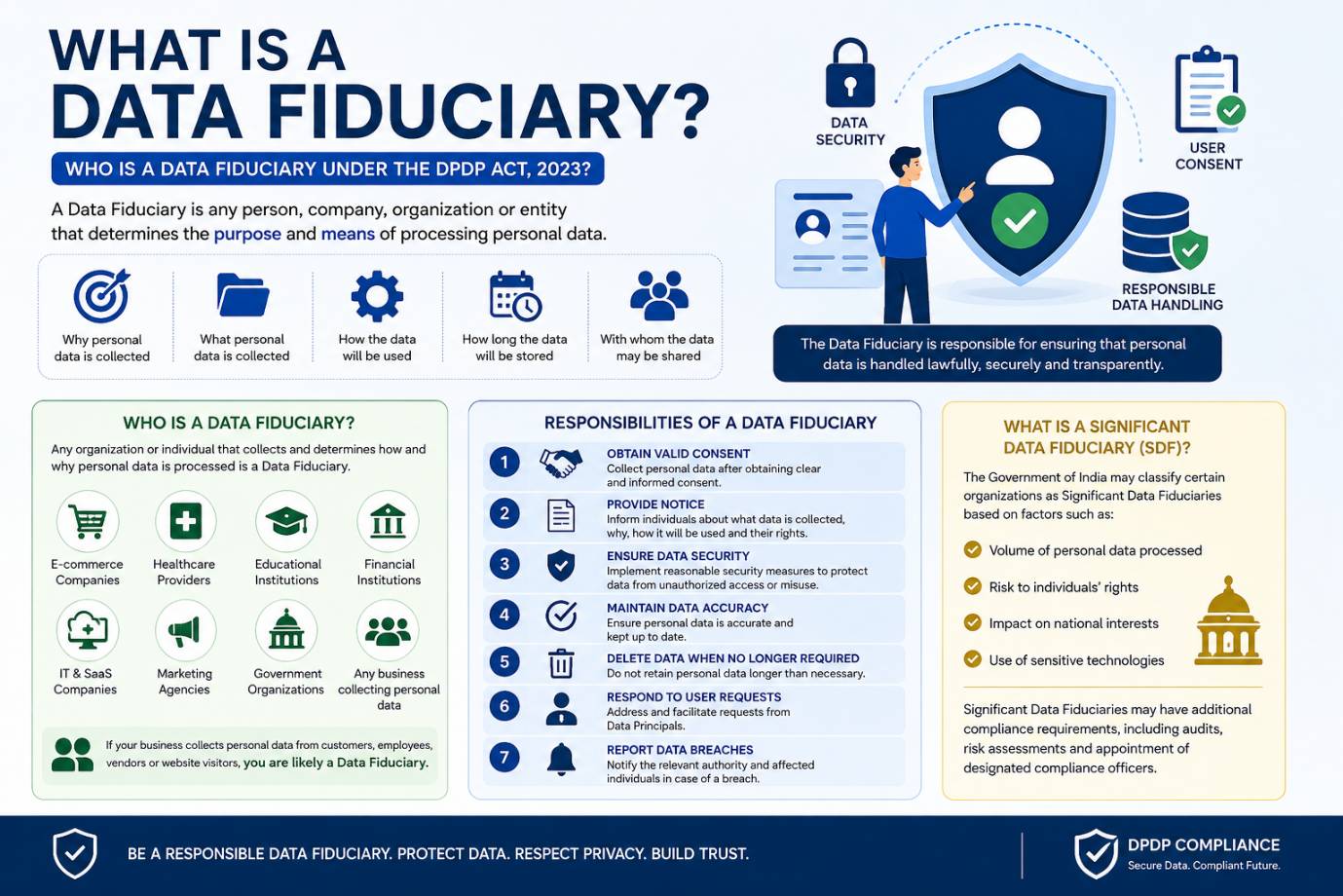
Following withdrawal, the Data Fiduciary must stop the processing of personal data that depends on the withdrawn consent within a reasonable time and cause relevant Data Processors to stop such processing, unless continued processing is permitted or required under another applicable legal ground.
For example, if a customer withdraws consent for promotional communications, the business should ensure that the affected consent-based marketing activities are stopped.
However, withdrawal does not automatically require deletion of every customer record or prohibit all processing. Other processing may continue where legally permitted.
The challenge is ensuring that consent withdrawal is implemented wherever the affected personal data is being processed.
2. Why Consent Withdrawal Becomes Complicated Across Business Systems
Consider a company using multiple applications to manage customer relationships.
Its website collects consent, the CRM stores customer information, an SMS gateway sends promotional messages, and a WhatsApp Business integration manages marketing campaigns.
A customer initially agrees to receive promotional communications.
Later, the customer withdraws marketing consent through the website.
The website updates the customer's preference, but the CRM may still show the customer as subscribed. The SMS gateway may retain the number in an active campaign, and WhatsApp marketing automation may continue sending promotional messages.
This happens because different applications maintain separate consent information.
A basic checkbox or standalone consent form cannot necessarily coordinate withdrawal across these systems.
For effective DPDP compliance, organizations need a reliable mechanism to communicate consent changes and verify that relevant actions have been completed.
3. How to Enforce Consent Withdrawal Across CRM, SMS and WhatsApp
Consent withdrawal should be treated as a coordinated business process rather than a simple database update.
Step 1: Capture and Record the Withdrawal
When a customer withdraws consent through a website, mobile application, or Data Principal portal, the system should record the request.
Relevant information may include the customer's identifier, affected processing purposes, withdrawal timestamp, and associated consent record.
A Consent Management Platform can help maintain this information centrally.
Step 2: Update the CRM Consent Status
The CRM should receive the relevant consent change and update the customer's preferences.
For example, if marketing consent has been withdrawn, the CRM should no longer treat the customer as eligible for consent-based promotional campaigns covered by that withdrawal.
This helps prevent future campaigns from using outdated consent information.
Step 3: Stop Affected SMS Campaigns
The SMS gateway or marketing automation platform should receive the withdrawal instruction.
The business should ensure that affected promotional messages are suppressed and that the customer's number is removed from or excluded from relevant campaign audiences.
Transactional or service-related communications may require separate consideration depending on their purpose and applicable legal basis.
Step 4: Update WhatsApp Marketing Preferences
WhatsApp marketing platforms may maintain their own contact lists, campaign audiences, and messaging preferences.
When a customer withdraws the relevant consent, the organization should update these systems and prevent affected consent-based marketing messages from continuing.
Businesses must also consider applicable WhatsApp Business messaging policies and opt-out requirements.
Step 5: Verify That the Actions Were Completed
Sending a notification to another application does not necessarily mean the application completed the required action.
For example, a webhook may be delivered successfully while the receiving system fails to update the customer's marketing preferences.
Businesses should therefore distinguish between:
- Withdrawal recorded.
- Instruction delivered.
- Instruction acknowledged.
- Required action completed.
- Completion evidence recorded.
This distinction is critical for building reliable consent-withdrawal processes.
4. Why Basic Consent Management Tools May Not Be Enough
Many consent tools focus primarily on displaying consent banners and recording initial user preferences.
However, organizations operating multiple business applications may need additional capabilities.
A comprehensive DPDP CMP should help businesses manage the consent lifecycle and coordinate relevant consent changes across connected systems.
For example, when a customer withdraws consent, the platform should support communication with relevant applications and provide visibility into delivery or processing failures.
Without appropriate monitoring, organizations may not know whether a withdrawal instruction was successfully implemented.
This is why businesses evaluating DPDP Software should look beyond consent collection and assess integration, tracking, and evidence-management capabilities.
5. How Consent Server Helps Businesses Enforce Consent Withdrawal
Consent Server is a comprehensive DPDP Compliance Software and Consent Management Platform designed to help Indian businesses manage consent-related requirements under the DPDP Act.
Unlike solutions focused only on collecting consent, Consent Server supports the complete consent lifecycle and provides integration capabilities for coordinating consent-related actions across business applications.
Centralized Consent Management
Consent Server helps organizations manage consent across multiple websites, applications, and business systems through a centralized platform.
This reduces dependence on disconnected consent records and helps businesses maintain consistent consent information.
Automated Consent Withdrawal Workflows
When a customer withdraws consent, Consent Server can record the change and generate relevant events for connected applications.
These events can be used to initiate appropriate actions in CRM, SMS, WhatsApp, and other integrated systems.
APIs and Webhook Integration
Consent Server provides APIs and webhooks to communicate consent-related events to connected applications.
For example, a marketing consent withdrawal can trigger instructions to update the CRM and suppress affected promotional communications.
The receiving systems must be configured to implement those instructions.
Acknowledgement and Action Tracking
One of Consent Server's important capabilities is its consent-event tracking architecture.
The platform supports a workflow such as:
Consent Withdrawn --> Webhook/API Alert --> Delivered --> Acknowledged --> Action Completed --> Completion Evidence
This helps organizations monitor whether relevant systems have received and processed consent-related instructions.
Retry and Escalation Management
If an integrated application fails to receive or process a withdrawal instruction, Consent Server supports retry and escalation mechanisms.
This helps businesses identify unresolved actions rather than assuming that every notification was successful.
Audit-Ready Consent Records
Consent Server maintains consent histories, timestamps, notice versions, purpose selections, and relevant activity records.
These records can help businesses demonstrate how consent-related events were managed and what responses were received from connected applications.
Data Principal Rights Management
Consent Server also provides a Data Principal portal supporting consent withdrawal, access, correction, erasure, and grievance-related requests.
On-Premise and Hosted Deployment
Consent Server offers on-premise and hosted deployment options, allowing organizations to choose an infrastructure model aligned with their operational and security requirements.
By combining centralized consent management, automated event communication, acknowledgement tracking, retries, escalation, and supporting evidence, Consent Server helps businesses move beyond basic consent collection toward more reliable consent-withdrawal operations.
Actual enforcement within CRM, SMS, and WhatsApp systems depends on the relevant integrations and the receiving applications carrying out the required actions.
6. Example: Consent Withdrawal Across Three Business Systems
Imagine a retail company using a CRM, an SMS marketing gateway, and a WhatsApp marketing platform.
A customer withdraws consent for promotional communications through the company's website.
With an appropriately configured DPDP Consent Management Platform, the following process can take place:
1. Customer Withdrawal: The customer withdraws promotional consent through the website.
2. Consent Server: The withdrawal is recorded, and relevant consent events are generated.
3. CRM: The customer's marketing consent status is updated.
4. SMS Gateway: The customer is suppressed from affected promotional SMS campaigns.
5. WhatsApp Platform: The customer's relevant marketing preferences and campaign eligibility are updated.
6. Verification: Connected systems acknowledge the instructions and report completion where supported.
7. Audit Evidence: Consent Server maintains relevant event histories and reported completion information.
If a connected system fails to respond, the platform can support retries and escalation.
This provides businesses with greater visibility into the withdrawal process and helps identify actions requiring attention.
7. How to Choose the Best CMP for Consent Withdrawal Management
When selecting a DPDP Consent Management Platform, businesses should evaluate whether the solution supports their actual operational requirements.
Important capabilities include centralized consent records, purpose-based consent management, withdrawal workflows, APIs, webhooks, acknowledgement tracking, retry mechanisms, audit histories, and Data Principal rights management.
For organizations operating multiple marketing and customer-management applications, integration capabilities are particularly important.
Consent Server brings these capabilities together in a platform designed for Indian businesses preparing for DPDP compliance.
Its combination of consent lifecycle management, integration workflows, action tracking, audit-ready records, and on-premise deployment makes it a strong option for organizations seeking more than a basic consent collection tool.
However, no CMP alone guarantees complete legal compliance. Businesses must also implement appropriate governance, security, legal, and operational controls.
Conclusion: Consent Withdrawal Must Work Beyond Your Website
Under the DPDP Act, consent withdrawal is not simply about providing a withdrawal button.
Businesses must ensure that processing based on withdrawn consent is appropriately stopped across relevant applications and Data Processors, subject to applicable legal exceptions.
For organizations using CRM, SMS, WhatsApp, and other connected systems, this requires coordinated workflows, reliable integrations, and supporting records.
Consent Server helps Indian businesses strengthen their DPDP compliance readiness by centralizing consent management, communicating withdrawal events, tracking acknowledgements, supporting retries and escalation, and maintaining relevant evidence.
The goal is simple: Don't just record consent withdrawal. Make sure the affected business systems act on it.