Excel vs Consent Management Platform for DPDP Compliance
Excel vs Consent Management Platform: discover which is better for DPDP compliance, consent lifecycle management, audit-ready records, and Data Principal requests under the DPDP Act.
Excel vs Consent Management Platform: Which Is Better for DPDP Compliance?
As businesses prepare for the DPDP Act , many organizations still manage customer consent using Excel sheets, spreadsheets, emails, or manually maintained records.
Excel may work for basic record keeping, but DPDP Compliance requires much more than storing a customer's name and consent status.
Businesses need to manage the entire consent lifecycle, including collection, purpose, withdrawal, history, Data Principal requests, and reliable compliance records.
This is where a dedicated Consent Management Platform becomes important.
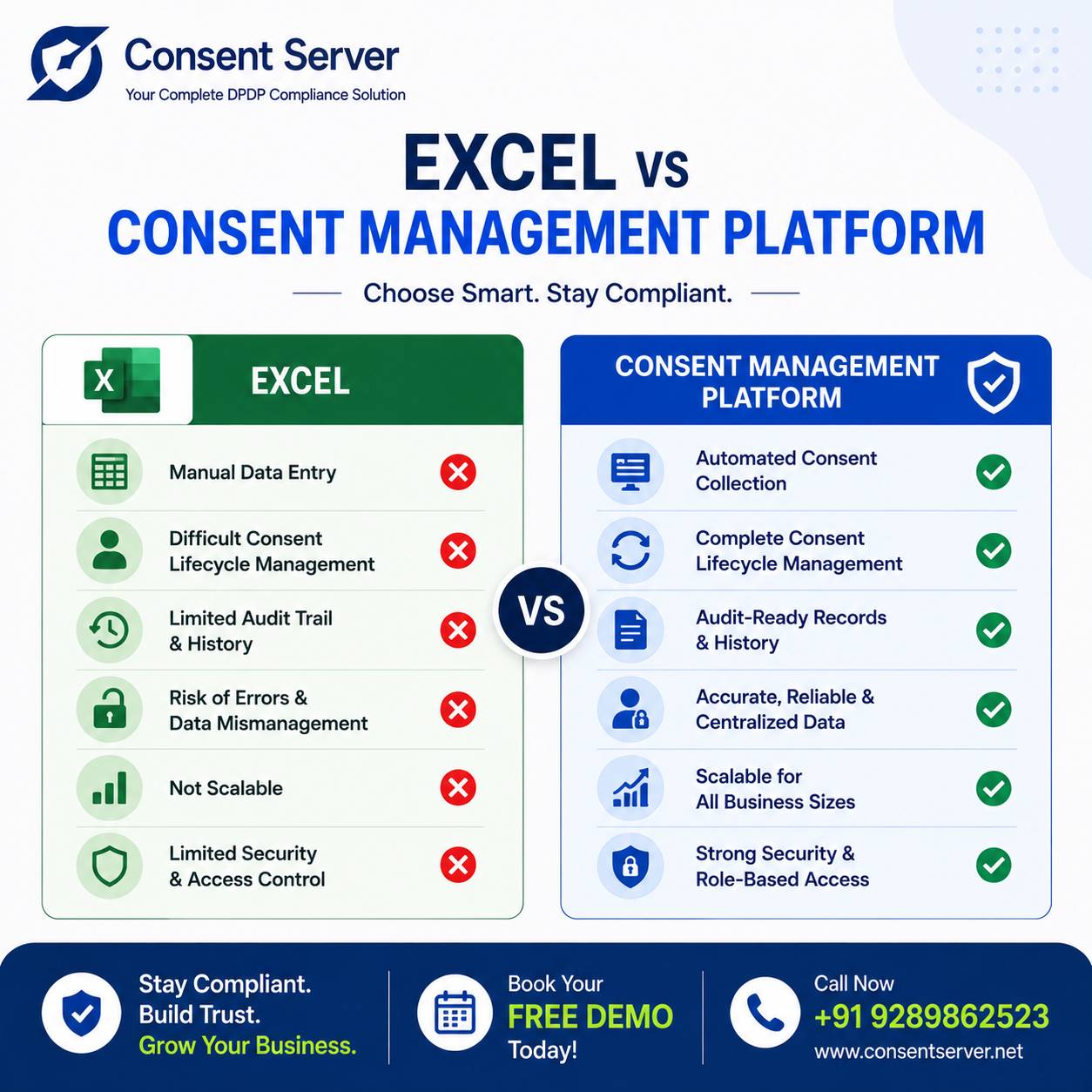
Excel vs Consent Management Platform
1. Consent Collection
Excel: Consent information usually needs to be entered or imported manually.
Consent Management Platform: Consent can be collected digitally through websites, applications, forms, APIs, and other integrated channels.
2. Consent Lifecycle Management
Consent is not necessarily permanent. Users may change or withdraw their consent.
With Excel, tracking every change across thousands of records can quickly become complicated.
A Consent Management Platform can maintain the lifecycle of consent, including its current status and historical changes.
3. Audit-Ready Records
Imagine being asked:
"Show us when this customer gave consent, what they agreed to, and whether that consent is still active."
With spreadsheets, finding and verifying this information can require manual effort.
A dedicated platform can maintain structured consent histories and audit trails, making compliance evidence easier to retrieve.
4. Consent Withdrawal
Under the DPDP Act, where processing is based on consent, a Data Principal can withdraw that consent.
An Excel sheet does not automatically communicate that withdrawal to your website, CRM, marketing platform, or other business systems.
A Consent Management Platform can provide centralized consent status and integrate consent changes with connected systems.
5. Data Principal Requests
Businesses also need processes for handling Data Principal rights and grievances.
Managing requests through separate emails and spreadsheets can result in missed requests, poor visibility, and inconsistent records.
A DPDP Compliance Platform can provide structured workflows for managing and tracking these activities.
6. Security and Access Control
Excel files can be copied, downloaded, shared, or modified.
While spreadsheets can certainly be secured, managing granular access and maintaining reliable histories becomes increasingly difficult as teams grow.
A purpose-built platform can provide features such as role-based access control, activity logs, and centralized governance.
7. Scalability
Managing 100 consent records in Excel may be simple.
Managing 10,000, 100,000, or millions of consent records while tracking purposes, withdrawals, histories, and user requests is a completely different challenge.
A Consent Management Platform is designed to handle these processes at scale.
Excel Stores Data. A CMP Manages Consent.
This is the biggest difference.
Excel is primarily a spreadsheet and record-management tool.
A Consent Management Platform is specifically designed to manage consent as an ongoing process.
For businesses working toward DPDP Compliance, the goal should not simply be to prove that a spreadsheet exists. The organization should be able to demonstrate how consent is collected, managed, changed, withdrawn, and connected to relevant purposes and processing activities.
How Consent Server Helps
Consent Server is a comprehensive Consent Management Platform in India designed to help businesses simplify DPDP Compliance.
Instead of managing consent across spreadsheets, emails, and disconnected systems, Consent Server provides a centralized platform for:
- Consent Collection
- Consent Lifecycle Management
- Consent Withdrawal
- Purpose-Based Consent
- Data Principal Requests
- Grievance Management
- Audit Logs
- Compliance Reporting
- Role-Based Access
- APIs & Webhooks
- Centralized Consent Dashboard
This allows organizations to move from manual consent tracking to structured consent management.
Is Excel Enough for DPDP Compliance?
Excel can remain useful for internal analysis, exports, reporting, and basic data management.
But businesses should be cautious about treating an Excel sheet as a complete DPDP Compliance solution.
As consent volumes and compliance responsibilities increase, manual processes become harder to control and demonstrate.
A dedicated DPDP Compliance Platform provides the automation, governance, auditability, and scalability businesses need for modern consent management.
Conclusion
The question isn't really:
"Can we store consent in Excel?"
Of course you can.
The better question is:
"Can Excel efficiently manage the complete consent lifecycle and provide reliable compliance evidence at scale?"
For businesses processing significant amounts of personal data, moving from spreadsheets to a dedicated Consent Management Platform can significantly improve efficiency, accountability, and compliance readiness.
Consent Server helps businesses replace fragmented manual consent processes with a centralized solution designed around the requirements of the DPDP Act.
Excel Stores Consent Records. Consent Server Manages the Consent Lifecycle.
Ready to Move Beyond Spreadsheets?
Book Your FREE Consent Server Demo Today
Contact: +91 9289862523
Consent Server: consentserver.net