Can a Developer Build a DPDP Consent System for 10,000-15,000?
Can 10,000–15,000 consent form ensure DPDP compliance? Learn the difference between a basic consent form and a complete DPDP Consent Management Platform.
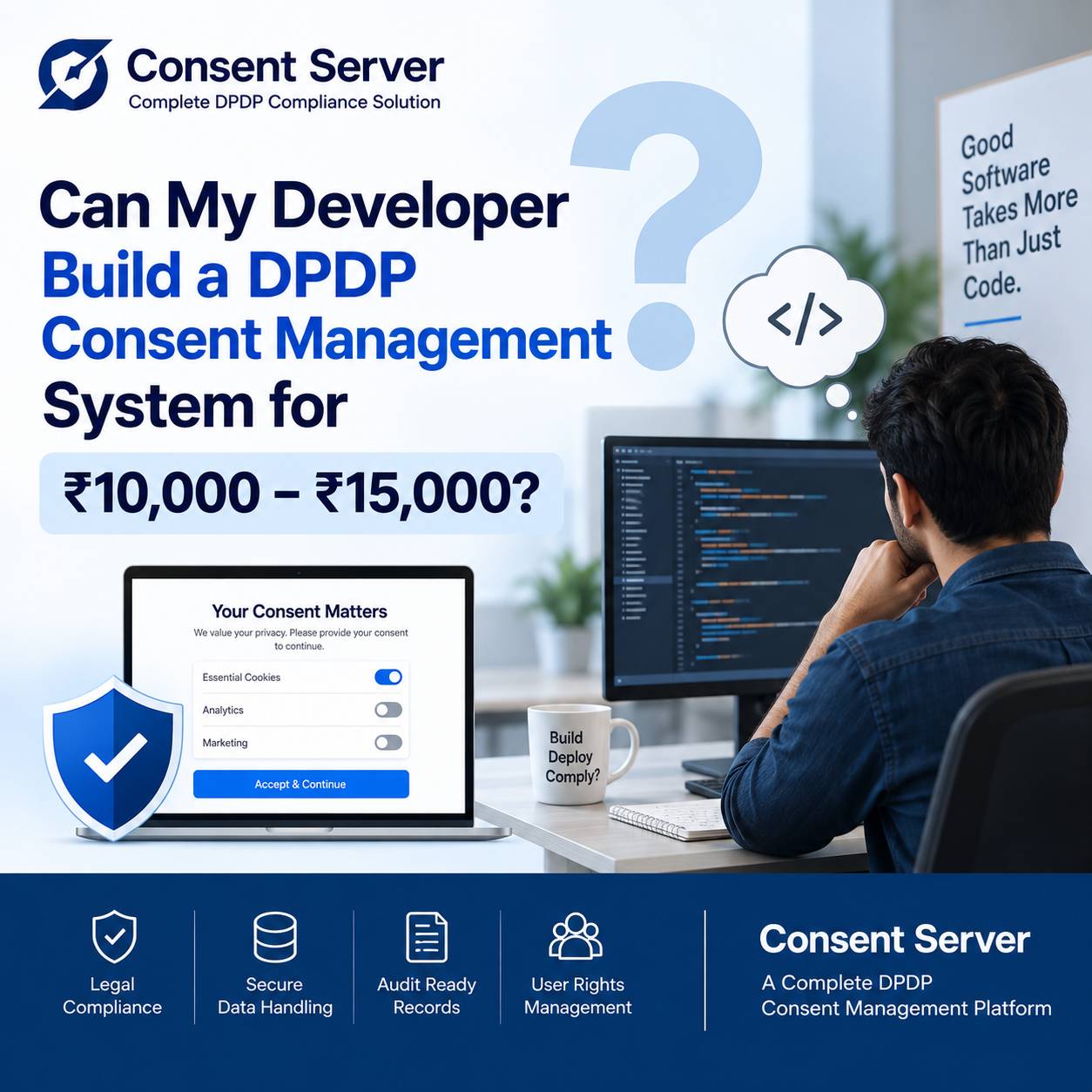
Can My Developer Build a DPDP Consent Management System for ₹10,000–₹15,000?
As Indian businesses prepare for the Digital Personal Data Protection Act, 2023 and the Digital Personal Data Protection Rules, 2025, a common question is beginning to emerge:
“Why should I buy a DPDP consent management platform? Can’t my developer simply build a consent form for ₹10,000–₹15,000?”
The short answer is:
Yes, your developer can probably build a consent form for ₹10,000–₹15,000.
A developer can create a webpage containing a few fields, purposes, checkboxes and a submit button, then store the submitted information in a database.
But there is an important distinction:
A consent form is not the same thing as a complete consent management system.
The real challenge under the DPDP framework is not simply collecting a “Yes” from the user. It is managing the entire consent lifecycle across the organisation and being able to demonstrate what happened when required.
Let us understand the difference.
What Can a Developer Build for ₹10,000–₹15,000?
Suppose your company has a website where users submit their name, mobile number and email address.
A developer can easily create something like:
Name
Mobile Number
Email Address
“I agree to receive promotional communication.”
Submit
When the user submits the form, the developer can save information such as:
- Name
- Mobile number
- Checkbox status
- Date and time
- IP address
For a small website with a very simple requirement, this may be completely reasonable.
The technical implementation itself is not particularly complicated.
The mistake happens when a business assumes that because it has stored a checkbox value, it has created a complete DPDP consent management system.
That is where the discussion becomes much broader.
DPDP Consent Is More Than a Checkbox
Section 6 of the DPDP Act states that consent should be free, specific, informed, unconditional and unambiguous, with a clear affirmative action, and should relate to the personal data necessary for the specified purpose.
Consider an e-commerce company collecting a customer's:
- Name
- Mobile number
- Email address
- Delivery address
- Purchase history
The organisation may process this data for several different purposes.
For example:
Order fulfilment: Required
Delivery updates: Required
Product recommendations: Optional
Promotional SMS: Optional
Marketing emails: Optional
A single checkbox saying:
“I agree to the Privacy Policy and Terms & Conditions.”
does not automatically solve every consent-management requirement.
A mature system needs to understand what consent was collected, for which purpose, under which notice and what happened to that consent later.
The Question Is Not “Can You Collect Consent?”
The more useful question is:
“Can your organisation manage and prove the complete consent lifecycle?”
Imagine a customer gives marketing consent today.
Three months later, the company modifies the wording of its consent notice.
Six months later, the customer withdraws consent for promotional SMS but continues to allow order-related communication.
A year later, the customer raises a grievance about receiving a marketing message.
Your organisation may now need to determine:
When was the original consent given?
What notice was presented at that time?
Which version of the notice was used?
For what purposes did the customer consent?
Which purposes were declined?
Was the consent subsequently updated?
When was marketing consent withdrawn?
Which systems were informed about that withdrawal?
What is the customer's current consent status?
Can the organisation produce reliable evidence of this history?
This is very different from simply querying:
marketing_consent = yes
from a MySQL table.
Withdrawal Is Especially Important
The DPDP Act gives a Data Principal the right to withdraw consent at any time, and the ease of withdrawal should be comparable to the ease with which consent was given. When consent is withdrawn, the Data Fiduciary is required, within a reasonable time, to cease and cause its Data Processors to cease processing based on that consent unless processing is otherwise required or authorised by law.
That creates an operational problem.
Suppose consent was collected from the company's website, but the customer's information is also present in:
CRM
Email marketing software
SMS platform
Mobile application
Customer support system
Sales software
The checkbox exists on the website.
But when the customer withdraws marketing consent, what happens to all the other systems?
This is where APIs, webhooks and centralised consent status become important.
A Consent Form and a Consent Management Platform Solve Different Problems
The difference can be understood simply:
Basic Custom Consent Form |
DPDP Consent Management Platform |
|
Collects checkbox response |
Manages consent lifecycle |
|
Stores Yes or No |
Maintains purpose-wise consent state |
|
Basic timestamp |
Detailed consent event history |
|
Usually website-specific |
Can integrate with websites, apps and enterprise systems |
|
Basic database record |
Centralised consent repository |
|
Limited notice tracking |
Notice and consent version management |
|
Withdrawal may require custom development |
Structured consent withdrawal workflow |
|
Limited user access |
Data Principal self-service capabilities |
|
Basic admin panel |
Role-based administration |
|
Usually limited audit history |
Audit-ready consent history |
|
Manual integrations |
APIs and webhooks |
|
Developer-maintained project |
Productised and supported platform |
Therefore, both solutions can be useful, but they are built for very different requirements.
Proof of Consent Matters
One of the most important provisions for businesses appears in Section 6(10) of the DPDP Act.
Where consent is the basis of processing and a question arises in a proceeding, the Data Fiduciary is obliged to prove that notice was given and that consent was obtained in accordance with the Act and Rules.
This changes the conversation considerably.
The important question is no longer:
“Did we save a checkbox?”
It becomes:
“Can we demonstrate what the user was shown, what they agreed to, when they agreed, what subsequently changed and what the current status is?”
For organisations handling large numbers of Data Principals, this can become a significant data-management problem.
What Happens When Your Business Has 10,000 or 10 Lakh Users?
For 50 customers, a spreadsheet or a small database application might appear sufficient.
Now imagine an organisation has:
500,000 Data Principals
20 different consent forms
15 processing purposes
Multiple branches
Website and mobile application
CRM integration
Several administrators
Thousands of consent updates and withdrawals
A user may give consent through the mobile app and later withdraw it from the website.
Another user might modify only one out of five purposes.
A third may request correction or erasure of personal data.
An administrator may need to identify the latest valid consent state while still preserving previous events for audit purposes.
At this level, consent becomes infrastructure rather than a webpage feature.
This Is Also Why the Government Has Looked at Modular Consent Systems
The distinction between a checkbox and a broader system is not merely a software vendor's argument.
MeitY Startup Hub launched the “Code for Consent: The DPDP Innovation Challenge”, aimed at developing a modular Consent Management System capable of integrating with existing platforms and applications used by Data Fiduciaries and addressing technical, functional and operational requirements.
That itself illustrates that consent management can extend well beyond placing a checkbox on a webpage.
Can Your Developer Build All of This?
Absolutely.
There is nothing magical about a commercial consent management platform.
A sufficiently capable development team can build purpose management, notice versioning, consent history, withdrawal workflows, APIs, webhooks, dashboards, access controls, security mechanisms and audit capabilities.
The more relevant questions are:
How long will it take?
How much will it actually cost?
Who will maintain it when requirements change?
Who will handle security updates?
Who will maintain integrations?
Who will test withdrawal and consent-update workflows?
Who will build reporting and audit capabilities?
Who will support the system over the next several years?
A ₹10,000–₹15,000 consent form and a production-ready enterprise consent platform should therefore not be compared solely on development cost.
They are different scopes of software.
Build vs Buy: Which One Should Your Organisation Choose?
Building internally may make sense when your requirement is small, your workflows are simple, your organisation has a capable technical team and you are prepared to maintain the system continuously.
A dedicated DPDP consent management platform becomes more valuable when you need multiple consent purposes, large numbers of Data Principals, multiple forms, version history, withdrawal management, audit trails, Data Principal workflows, multiple applications, API integrations, access controls and centralised consent governance.
The decision should therefore be based on requirements and total cost of ownership, not simply the price of creating a checkbox.
Where Consent Server Fits
Consent Server is designed as a DPDP consent management platform for organisations that need more than basic website consent collection.
It is designed to support capabilities such as purpose-wise consent, consent forms, verification options, consent updates and revocation, consent history, Data Principal self-service workflows, audit trails, APIs, webhooks, role-based access, reporting, lifecycle automation and self-hosted or on-premise deployment options.
The objective is not to replace a ₹10,000 website form.
It is to solve a different problem:
₹10–15k custom form/plugin |
Consent Server |
|
Checkbox |
Purpose-wise consent |
|
Submit button |
Consent lifecycle |
|
DB me Yes/No |
Detailed consent record |
|
Basic timestamp |
Audit trail |
|
One website |
Multiple forms/use cases |
|
Usually, no version history |
Consent/version history |
|
No proper withdrawal workflow |
Revoke/withdraw consent |
|
No Data Principal portal |
Self-service Data Principal portal |
|
No correction/erasure workflow |
Rights-management workflow |
|
Basic database |
SQLite Cipher encrypted storage |
|
Developer can modify records |
Hash-based tamper detection |
|
No evidence package |
Audit-ready records/PDF/export |
|
Usually, no re-consent |
Expiry/re-consent lifecycle |
|
No verification |
Mobile/Email/Aadhaar OTP options |
|
Website-specific |
APIs + Webhooks + JS SDK |
|
No enterprise access model |
RBAC |
|
Cloud/plugin dependent |
Self-hosted/on-premise option |
|
No centralized grievance workflow |
Complaint/grievance handling |
|
Developer maintains it |
Productized platform + support |
Managing consent as an organisation-wide compliance process.
Final Answer
So, can your developer build a DPDP consent system for ₹10,000–₹15,000?
Yes, if by “consent system” you mean a basic website form that captures consent and stores it in a database.
But if your requirement includes:
Collect --> Inform --> Record --> Manage --> Update --> Withdraw --> Integrate --> Audit --> Prove
then you are no longer talking about a simple checkbox.
You are talking about a Consent Management Platform.
Before deciding whether to build or buy, organisations should therefore prepare a complete list of their consent-management requirements and compare solutions on functionality, security, lifecycle management, integrations, scalability, auditability, maintenance and long-term cost.
Because under DPDP, collecting a consent response may be the easy part.
Managing that consent throughout its lifecycle is the real challenge.
Want to see how Consent Server manages the complete consent lifecycle? Book a free demo and evaluate it against your organisation's actual DPDP requirements.