Manage Consent Across Multiple Websites | DPDP Act
Learn how to manage consent across multiple websites and apps using Consent Server, a DPDP Consent Management Platform with APIs, webhooks and audit records.
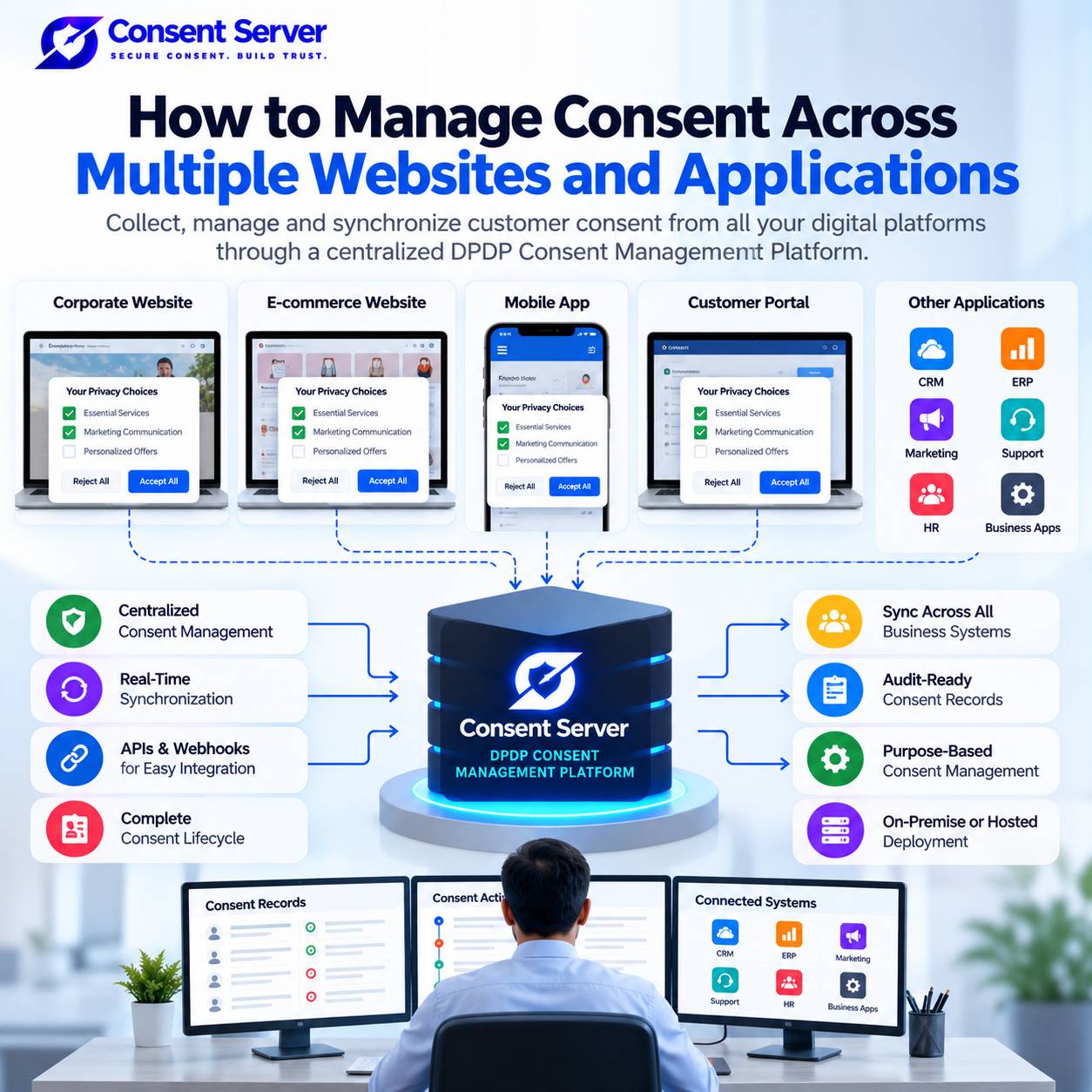
How to Manage Consent Across Multiple Websites and Applications Under DPDP Act
Today, businesses rarely operate through a single website or application. A company may have a corporate website, an e-commerce platform, a customer portal, a mobile application, and several internal business systems.
Each platform may collect or process personal data for different purposes.
But what happens when a customer provides consent on one website and later withdraws it through another application?
How can businesses ensure that consent preferences remain consistent across their entire digital ecosystem?
This is an important challenge for organizations preparing for DPDP compliance under India's Digital Personal Data Protection Act, 2023 (DPDP Act).
Managing consent independently across multiple websites and applications can create duplicate records, inconsistent preferences, delayed withdrawals, and difficulties in maintaining audit-ready evidence.
A centralized DPDP Consent Management Platform can help businesses overcome these challenges by managing consent from a common system and coordinating relevant changes across connected applications.
Consent Server, a comprehensive DPDP Compliance Software solution, helps organizations centralize consent collection, manage the complete consent lifecycle, integrate multiple applications, and maintain detailed consent records.
Why Managing Consent Across Multiple Applications Is Challenging
Consider a company operating several digital platforms:
- Corporate website for inquiries and lead generation
- E-commerce website for online purchases
- Mobile application for customer engagement
- Customer portal for account management
- CRM for sales and marketing activities
- ERP for operational processes
- Email and SMS marketing platforms
A single customer may interact with multiple platforms using the same mobile number or email address.
For example, the customer may consent to marketing communication on the corporate website but later withdraw that consent through the mobile application.
If each platform maintains independent consent records, the company's systems may show conflicting preferences.
The website may record consent as withdrawn, while the CRM continues treating it as active.
This can lead to unauthorized consent-dependent processing, operational confusion, and increased compliance risk.
The solution is not simply adding a consent checkbox to every website. Businesses need a coordinated consent-management architecture.
What Does the DPDP Act Require?
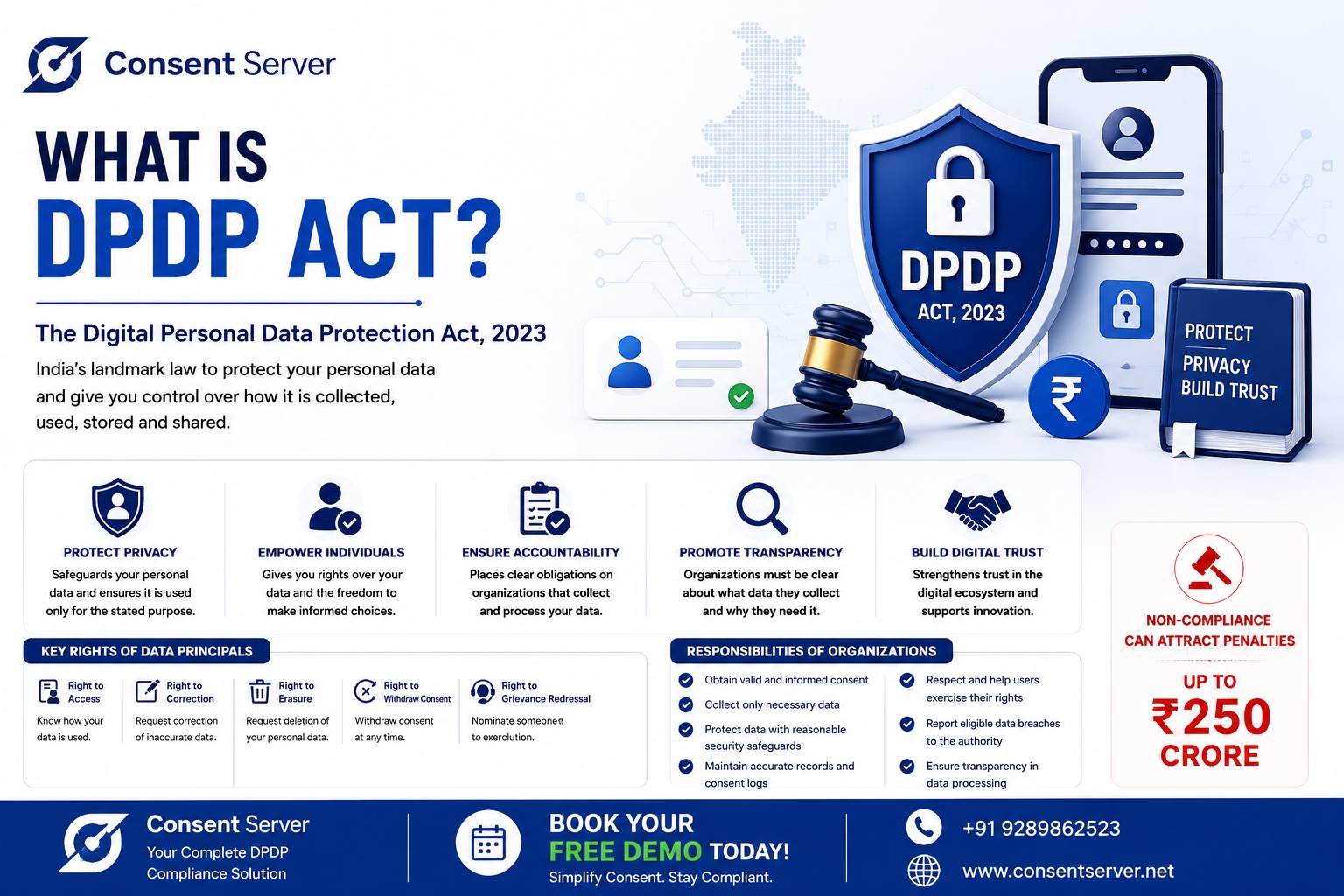
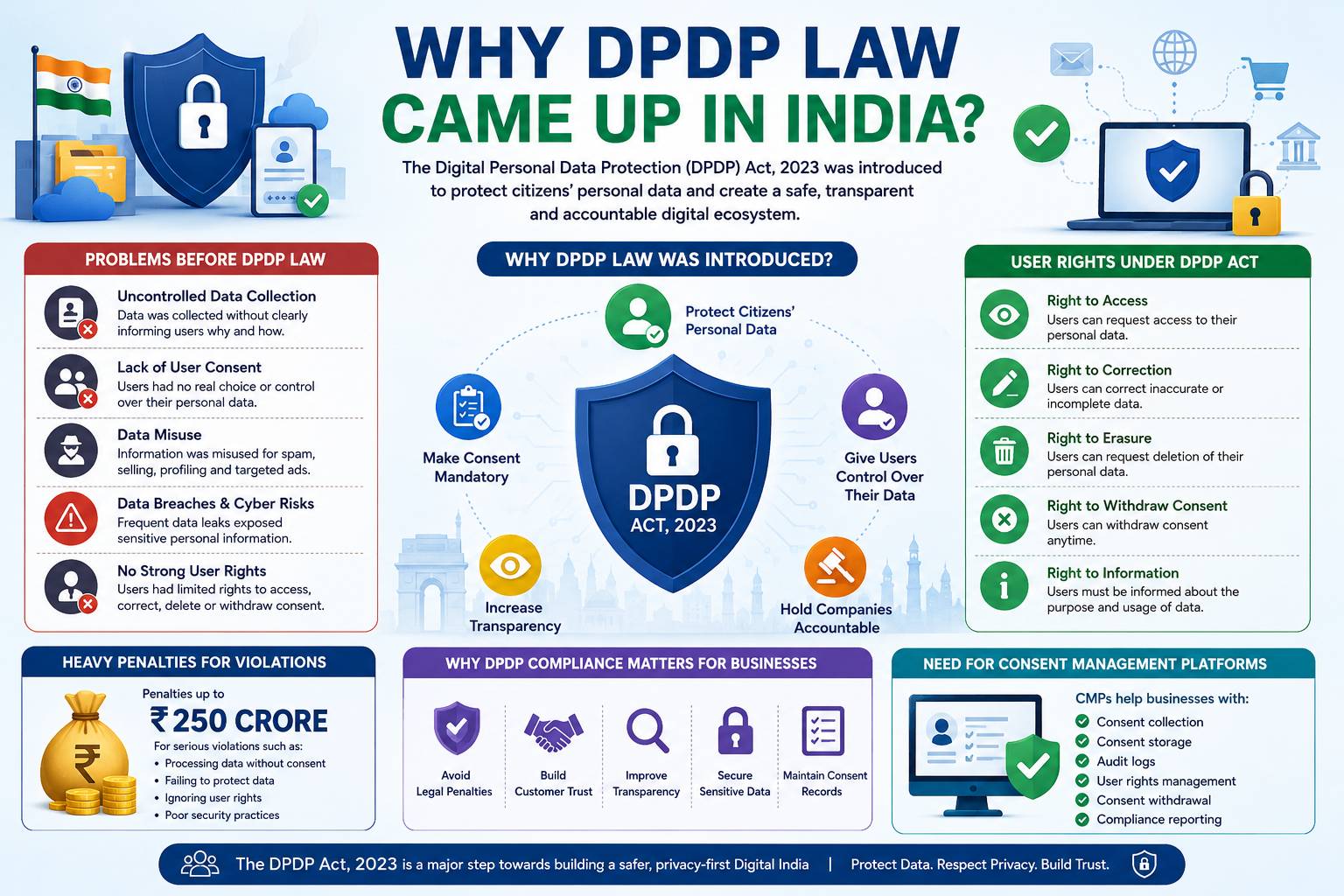
The DPDP Act establishes requirements relating to consent, transparency, withdrawal, and the processing of digital personal data.
Under Section 6, consent must be free, specific, informed, unconditional, and unambiguous, with a clear affirmative action signifying agreement to process personal data for the specified purpose.
The Act also provides Data Principals with the ability to withdraw consent at any time.
The ease of withdrawing consent must be comparable to the ease of giving it.
Following withdrawal, the Data Fiduciary must cease processing based on that consent within a reasonable time and cause its Data Processors to cease such processing, unless processing without consent is required or authorized by applicable law.
For organizations operating multiple websites and applications, these requirements create important technical and operational considerations.
The law does not specifically mandate a single centralized database, a common consent ID, or a particular integration technology.
However, a centralized Consent Management Platform can make consent administration, synchronization, and recordkeeping more manageable.
The relevant obligations are subject to the DPDP framework's phased commencement schedule.
1. Establish a Centralized Consent Management Platform
The first step is to avoid managing consent independently across every website and application.
Instead, organizations can implement a centralized DPDP Consent Management Platform that maintains consent information for connected digital channels.
For example, a company may operate three websites and two mobile applications.
Rather than building five separate consent-management systems, each application can integrate with a common consent platform.
This approach can provide:
- Centralized consent records
- Consistent purpose definitions
- Consent lifecycle management
- Shared consent history
- Coordinated withdrawal handling
- Centralized reporting
- Better visibility across applications
A centralized platform can also reduce the maintenance burden of implementing consent-management functionality separately in every application.
Consent Server supports centralized consent management and provides integration capabilities for websites, applications, and business systems.
2. Identify the Same Data Principal Across Applications
One of the most important challenges in multi-application consent management is identifying the same individual across different systems.
For example, a customer may use:
- An email address on the corporate website
- A mobile number on the e-commerce platform
- A customer account on the mobile application
- An internal customer ID in the CRM
If these identifiers are not connected appropriately, the organization may create multiple unrelated consent records for the same individual.
A well-designed architecture should establish a reliable method of associating consent records with the relevant Data Principal.
Depending on the application, this may involve verified account identifiers, internal customer references, or other appropriately authenticated identity-linking mechanisms.
However, organizations should avoid assuming that two records belong to the same individual merely because they contain similar names or unverified contact information.
Identity mapping should also follow data minimization and security principles.
A DPDP Consent Management Platform can provide a centralized structure for consent records, while the business establishes the necessary identity-linking and authentication rules.
3. Use Purpose-Based Consent Across Websites
A major mistake businesses make is treating consent as a single universal YES or NO value.
In practice, different websites and applications may process personal data for different purposes.
Consider a business with three platforms.
Corporate Website
The website collects information for business inquiries and promotional communication.
E-Commerce Website
The platform processes information for order management, customer support, and optional marketing activities.
Mobile Application
The application may request consent for personalized offers, promotional notifications, or other specific processing purposes.
These activities should not automatically share one blanket consent status.
Instead, organizations should define clear processing purposes and associate consent with the appropriate activities.
For example, withdrawing consent for promotional communication should not automatically disable unrelated account functions or prevent processing that is otherwise required or authorized by law.
Purpose-based consent management helps businesses apply consent changes accurately.
Consent Server supports purpose-based consent management, enabling organizations to configure consent requirements according to their business workflows.
4. Integrate Multiple Websites Using a Common Consent SDK
Businesses operating multiple websites can benefit from a common consent integration mechanism.
Instead of developing separate consent interfaces and backend logic for every website, organizations can integrate a reusable consent SDK.
For example, a business may operate:
- company.com
- shop.company.com
- support.company.com
Each website can integrate with a centralized consent platform.
The consent interface can display the applicable notice, collect purpose-specific preferences, and communicate consent events to the central server.
Consent Server provides a JavaScript-based consent SDK that can be integrated into websites to collect and manage consent.
Its SDK supports consent interfaces and integration with centralized consent-management workflows.
However, there is an important technical consideration.
Browser localStorage is generally isolated by origin. A consent identifier saved on one website or domain is not automatically available to another website.
Therefore, businesses should not assume that installing the same SDK across multiple domains will automatically identify the same visitor.
Cross-website consent recognition requires an appropriate identity-linking or authenticated lookup mechanism.
5. Connect Mobile Applications to the Same Consent System
Many organizations operate both websites and mobile applications.
For example, an e-commerce company may have an Android application, an iOS application, and a website.
Customers may use these platforms interchangeably.
If consent is managed independently, a customer may withdraw consent on the website while the mobile application continues using outdated preferences.
To avoid this, mobile applications can integrate with the centralized platform through secure APIs.
A typical workflow may be:
Mobile Application --> Consent Management API --> Central Consent Server
When consent is updated, the application communicates the change to the central platform.
Other relevant systems can then receive the updated consent information through configured integrations.
For authenticated users, the application can retrieve the appropriate current consent state after login or at another suitable synchronization point.
This helps reduce inconsistent preferences across digital channels.
6. Synchronize Consent Changes Across Applications
Centralized storage alone does not guarantee that connected applications will act on consent changes.
Organizations also need a mechanism to communicate relevant events.
Consider this scenario:
A customer provides consent for promotional messages through the company's website.
The customer later opens the mobile application and withdraws that consent.
The central consent platform records the withdrawal.
The company's CRM and marketing applications then need to update their processing activities accordingly.
A typical workflow can follow:
Customer Changes Consent --> Consent Server Records Event --> Connected Applications Receive Notification --> Relevant Actions Are Applied
APIs and webhooks are useful technologies for implementing this workflow.
For example, a webhook may notify the CRM that a particular marketing purpose has been withdrawn.
The CRM can then update the customer's marketing eligibility.
A connected email marketing platform may need to suppress promotional communication.
This helps businesses coordinate consent-dependent processing across multiple applications.
7. Track Whether Consent Changes Were Actually Applied
One of the most overlooked challenges in consent management is verifying that connected applications completed the required action.
Imagine that a customer withdraws marketing consent.
The central platform sends a webhook to the marketing system.
The marketing system responds successfully, but the customer's promotional status remains active because an internal update failed.
In this situation, successful webhook delivery does not establish that the withdrawal was implemented.
Organizations should distinguish between:
Event Delivery: The notification reached the receiving system.
Acknowledgement: The receiving system acknowledged or accepted the event.
Action Completion: The receiving system completed the required processing change.
This is particularly important when managing consent across multiple websites, applications, and Data Processors.
Consent Server supports downstream event tracking, acknowledgement monitoring, retries, escalation workflows, and action completion evidence.
These capabilities help organizations gain visibility into consent-related actions across connected systems.
The receiving applications must still implement the relevant processing restrictions and provide reliable completion information.
8. Handle Consent Synchronization Failures
Applications may become unavailable because of network failures, maintenance, authentication errors, or server downtime.
If consent synchronization depends entirely on a single API request, temporary failures may leave applications with outdated information.
A more reliable architecture should consider:
- Queued consent events
- Automatic retries
- Failed-delivery monitoring
- Acknowledgement tracking
- Escalation workflows
- Manual intervention
- Periodic reconciliation
- Appropriate safeguards against continued processing
For example, if a marketing platform is temporarily unavailable, the withdrawal event can remain pending for retry.
Administrators should be able to identify the unresolved event and investigate the issue.
Where appropriate, systems should use restrictive processing defaults until the correct consent state can be confirmed.
Consent Server's event-management capabilities help businesses monitor these workflows.
9. Maintain Consent History Across Every Channel
When customers interact with multiple websites and applications, consent may change several times.
For example:
A customer initially grants marketing consent through the website.
Later, the customer updates their preferences through the mobile application.
After another period, the customer withdraws marketing consent through the customer portal.
A centralized consent-management system should maintain an appropriate history of these events.
Relevant records may include:
- Consent identifier
- Data Principal reference
- Processing purpose
- Consent status
- Date and time
- Notice version
- Relevant verification information
- Source application
- Consent changes
- Withdrawal events
- Connected-system delivery and action records
Maintaining this history can help businesses investigate complaints, verify consent status, and prepare supporting evidence.
Consent Server provides detailed consent lifecycle records, notice versioning, and audit-oriented reporting capabilities.
10. Manage Consent Across Multiple Departments and Business Units
Large organizations may operate several departments, brands, or business units.
For example, a group may have separate websites for retail, healthcare services, education, and customer support.
These operations may have different purposes, notices, access requirements, and legal responsibilities.
A centralized platform can simplify administration, but businesses should not assume that consent granted to one legal entity automatically authorizes processing by another.
Where separate Data Fiduciaries are involved, consent records and purposes must be managed according to the applicable legal relationships.
A suitable DPDP Compliance Software solution should support appropriate separation of records, access permissions, and organizational configurations.
Consent Server supports multi-tenant configurations, role-based access control, and customizable consent workflows.
These capabilities can be useful for organizations managing multiple business units or customer-facing platforms.
11. Protect Consent Records With Strong Security
Consent records may contain personal identifiers, processing preferences, and information about customer interactions.
Therefore, consent-management infrastructure should be protected against unauthorized access, alteration, and disclosure.
Important security considerations include:
- Encryption of sensitive records
- Secure API authentication
- Role-Based Access Control
- Tenant isolation
- Protected communication channels
- Audit logging
- Tamper detection
- Secure deployment
- Backup and recovery procedures
Businesses should also carefully manage which applications and employees can access consent information.
Consent Server supports encrypted storage, access controls, tamper-detection capabilities, and on-premise deployment options.
For organizations with strict infrastructure or data-control requirements, self-hosted deployment may offer additional operational flexibility.
12. Provide a Consistent Consent Withdrawal Experience
A customer should not have to visit every website or application separately to withdraw consent for the same processing purpose.
Where the relevant identity and purpose can be established, a centralized withdrawal interface can provide a more consistent experience.
For example, a customer may access a Data Principal portal to review consent preferences and submit a withdrawal request.
The central platform can record the change and initiate notifications to relevant connected systems.
This approach can help reduce friction and improve visibility.
However, businesses must still ensure that the withdrawal mechanism is accessible and that its ease is comparable to giving consent, as required by the Act.
Consent Server provides Data Principal-facing workflows for consent management and related requests, helping businesses support these processes.
How Consent Server Helps Manage Consent Across Multiple Websites and Applications
Consent Server is designed to help Indian businesses manage consent across connected digital systems through a centralized DPDP Consent Management Platform.
Instead of relying on separate consent-management implementations for every website or application, organizations can integrate their digital channels with Consent Server.
Its capabilities include:
Centralized Consent Management
Maintain consent records and lifecycle events through a common platform.
Website Integration
Integrate consent collection and management using the Consent Server JavaScript SDK.
API and Webhook Integration
Connect mobile applications, CRM systems, ERP platforms, and other business applications through configured integrations.
Purpose-Based Consent
Manage consent according to specific processing purposes rather than relying on a single universal consent flag.
Complete Consent Lifecycle
Support consent grant, update, withdrawal, renewal, and expiry workflows.
Downstream Event Management
Track event delivery, acknowledgements, retries, overdue actions, and escalation.
Action Completion Evidence
Maintain supporting records when integrated applications report completion of required actions.
Data Principal Portal
Provide workflows for consent management, withdrawal, and Data Principal requests.
Audit-Ready Records
Maintain detailed consent history, notice versions, and relevant activity records.
Security and Deployment Flexibility
Support encrypted records, access controls, tenant isolation, and on-premise or hosted deployment options.
Together, these capabilities help organizations build a coordinated consent-management architecture across multiple websites and applications.
Centralized Consent Management vs Separate Consent Systems
| Feature | Separate Consent Systems | Centralized Consent Management Platform |
|---|---|---|
| Consent records | Distributed across applications | Managed through a common platform |
| Purpose definitions | May differ between systems | Can be standardized |
| Consent withdrawal | Requires separate coordination | Can initiate connected workflows |
| Consent history | Spread across databases | Centralized lifecycle visibility |
| Application integration | Custom integration for each system | Common API and webhook architecture |
| Failure monitoring | Often fragmented | Centralized event monitoring |
| Audit preparation | Requires collecting multiple records | Easier consolidated reporting |
| Maintenance | Repeated development effort | Shared consent infrastructure |
| Scalability | Increasing operational complexity | More manageable expansion |
A centralized platform does not eliminate the need for application-level controls, but it can significantly simplify coordination.
Best Practices for Managing Consent Across Multiple Websites
Businesses should follow a structured approach when implementing multi-application consent management.
Identify all digital channels: Document every website, mobile application, customer portal, and internal system processing personal data.
Map processing purposes: Determine which purposes apply to each platform and identify the relevant legal basis.
Establish reliable identity mapping: Link consent records to the appropriate Data Principal without relying on unverified assumptions.
Implement a centralized platform: Use a common consent-management system for consistent lifecycle administration.
Integrate applications securely: Use authenticated APIs, webhooks, and other suitable integration methods.
Synchronize consent changes: Ensure relevant systems receive and act on consent events.
Monitor downstream actions: Track failures, acknowledgements, and completion where supported.
Maintain audit evidence: Preserve relevant consent history and integration records.
Review the architecture regularly: Update integrations when applications, purposes, or business processes change.
These practices can help organizations build a scalable consent-management framework.
Why Consent Server Is a Strong Choice for Multi-Application DPDP Compliance
When selecting DPDP Software, businesses should look beyond basic consent forms and website checkboxes.
A company operating several websites, mobile applications, and internal systems needs a solution capable of managing consent throughout its lifecycle.
It also needs visibility into how consent changes affect connected applications.
Consent Server brings centralized consent management, purpose-based workflows, APIs, webhooks, downstream event tracking, and audit-ready records into one platform.
Its on-premise deployment option is particularly valuable for organizations that prefer to keep consent-management infrastructure within their own environment.
With support for multiple applications, configurable integrations, role-based access, and event monitoring, Consent Server is a strong solution to evaluate for enterprise DPDP compliance.
For organizations searching for a DPDP Consent Management Platform, Consent Management Platform, DPDP Software, or DPDP Compliance Software in India, Consent Server offers a practical approach to managing consent across an expanding digital ecosystem.
Conclusion
Managing consent across multiple websites and applications is not simply a frontend development task.
It requires coordinated consent records, purpose-based processing controls, reliable identity mapping, secure integrations, and mechanisms to handle consent changes across connected systems.
As businesses expand their digital presence, independently managed consent systems can become difficult to maintain.
A centralized DPDP Consent Management Platform can help organizations simplify consent administration, coordinate withdrawal workflows, and maintain supporting compliance records.
Consent Server helps businesses move from disconnected consent collection to centralized consent lifecycle management across websites, applications, and business systems.
With website SDK integration, APIs, webhooks, event monitoring, action completion tracking, Data Principal workflows, and audit-ready records, Consent Server provides a comprehensive foundation for managing consent at scale.
One Business. Multiple Websites and Applications. One Centralized Consent Management Platform.
Simplify DPDP Compliance With Consent Server
Manage consent centrally, connect your business applications, and maintain greater visibility over the complete consent lifecycle.