WordPress or Shopify Consent Plugin vs DPDP Platform
WordPress or Shopify consent plugin vs DPDP Consent Management Platform: understand the differences in consent lifecycle, withdrawal, APIs, audit trails and compliance.
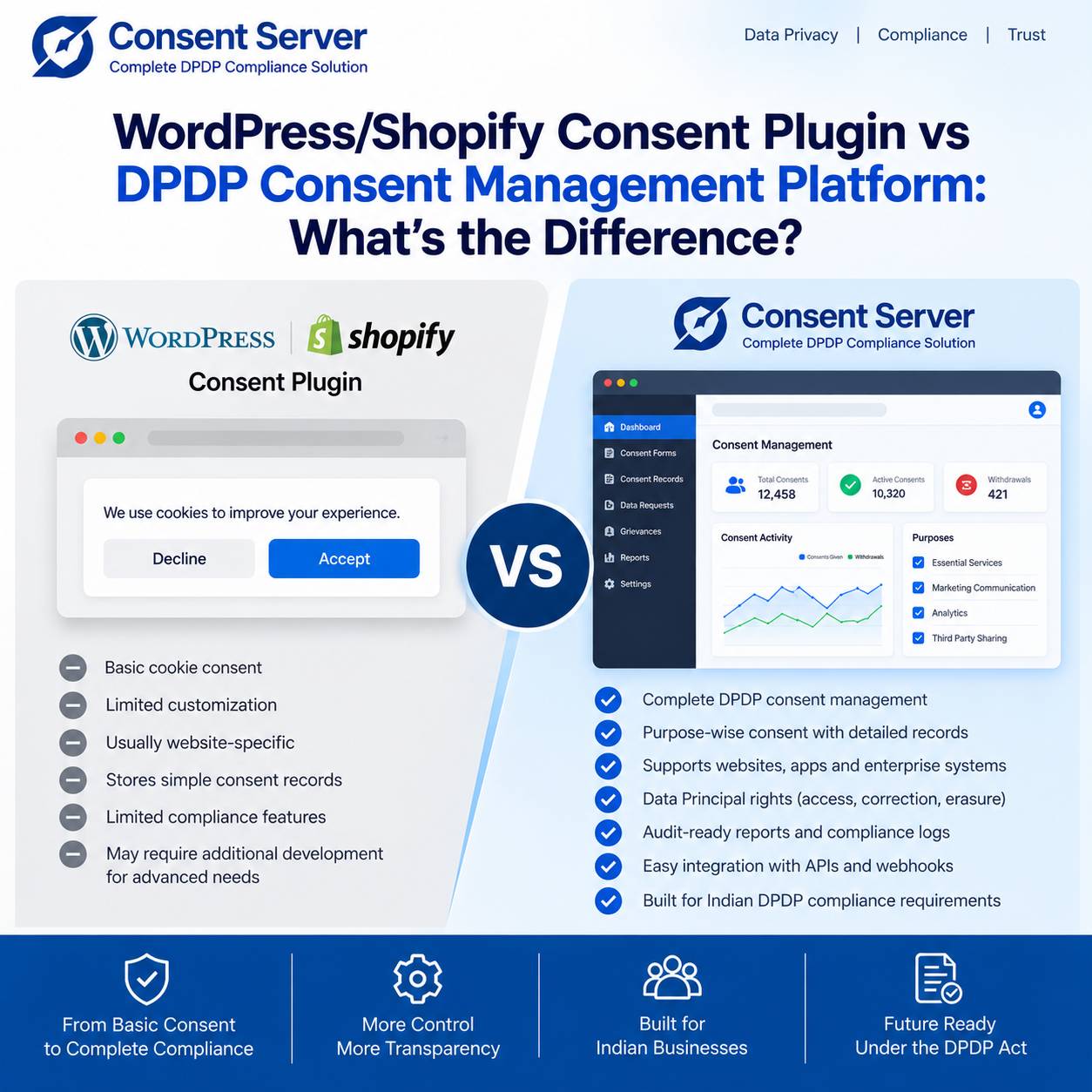
WordPress/Shopify Consent Plugin vs DPDP Consent Management Platform: What’s the Difference?
As businesses in India prepare for the Digital Personal Data Protection Act, 2023 and the Digital Personal Data Protection Rules, 2025, many website owners are asking a reasonable question:
“Why should we purchase a dedicated DPDP Consent Management Platform when WordPress and Shopify already have privacy and consent plugins?”
After all, WordPress has a large ecosystem of privacy and cookie-consent plugins, and Shopify itself provides customer privacy features such as cookie banners, privacy policies and data-sharing controls. Shopify also supports third-party privacy applications.
So, can a WordPress or Shopify plugin solve your DPDP consent requirements?
The answer is:
Possibly for some website-level requirements, but not necessarily for your organisation’s complete consent-management requirements.
The important distinction is between:
Managing consent on a website
and
Managing the complete consent lifecycle across an organisation.
These are related problems, but they are not always the same problem.
What Does a WordPress or Shopify Consent Plugin Do?
Consent and privacy plugins can be extremely useful.
Depending on the plugin, they may provide capabilities such as:
- Cookie consent banners
- Accept or reject options
- Preference management
- Script blocking
- Cookie categorisation
- Privacy policy links
- Consent records
- Google Consent Mode integration
- Marketing preference controls
The WordPress plugin directory currently contains multiple consent-related plugins with significantly different capabilities. Some provide simple cookie banners, while others offer consent records, automatic blocking and broader consent-management functionality.
Similarly, Shopify provides customer privacy settings that can help merchants manage privacy policies, cookie banners and data-sharing opt-out mechanisms. It also allows integration with third-party privacy applications and its Customer Privacy API.
These tools can be valuable components of a business’s privacy program.
The mistake is assuming that installing any privacy plugin automatically means:
“Our complete DPDP consent management is now handled.”
That conclusion requires a much deeper assessment.
Cookie Consent and DPDP Consent Are Not Automatically the Same Thing
Many privacy plugins historically developed around regulations and requirements involving cookies, advertising technologies and website tracking.
A cookie banner typically manages questions such as:
Can analytics cookies run?
Can advertising trackers load?
Can marketing pixels operate?
Those are important privacy questions.
But an organisation may process personal data for many purposes that have nothing to do with browser cookies.
Consider an e-commerce business.
It may process customer information for:
- Account registration
- Order processing
- Customer support
- Promotional emails
- Promotional SMS
- Loyalty programmes
- Product recommendations
- Customer surveys
- Mobile applications
- Offline stores
Or consider a hospital.
It may have consent-related workflows involving:
- Patient registration
- Appointment communication
- Marketing communication
- Research activities
- Mobile applications
- Patient portals
- Multiple departments
A website cookie banner does not automatically become the central consent-management layer for all these processes.
DPDP Consent Begins With Purpose and Notice
Under Section 5 of the DPDP Act, a request for consent must be accompanied or preceded by a notice explaining the personal data and the purpose for which it is proposed to be processed, along with information about exercising relevant rights and making complaints.
Section 6 further requires consent to be free, specific, informed, unconditional and unambiguous, with clear affirmative action.
The final DPDP Rules, 2025 add further detail around the notice. Rule 3 requires the notice to be independently understandable, use clear and plain language and include an itemised description of the personal data as well as the specified purpose or purposes of processing.
Therefore, businesses need to map:
What data are we processing?
For which purpose?
Where are we collecting consent?
Which notice applies?
How will that consent be changed or withdrawn later?
Installing a plugin can provide a technical interface, but the business still needs the underlying consent governance.
Website Consent vs Organisation-Wide Consent
This is perhaps the biggest difference.
Imagine an e-commerce company using Shopify.
A customer provides marketing preferences during an online interaction.
But the company also uses:
CRM
Mobile App
Email Marketing Platform
SMS Platform
Customer Support Software
Offline Retail Stores
Now imagine the customer changes a preference.
The question is no longer simply:
“Did Shopify update the preference?”
The business needs to determine:
Does the CRM know about the change?
Will the SMS platform stop promotional messages?
Does the mobile application have the latest consent status?
What happens to data held by another processor?
This is why an organisation may need a central consent layer.
For example:
WordPress Website --> Consent Management Platform
Shopify Store --> Consent Management Platform
Mobile App --> Consent Management Platform
CRM --> Consent Management Platform
Internal Application --> Consent Management Platform
Branch System --> Consent Management Platform
The website platform becomes a consent collection channel, while the Consent Management Platform becomes the central consent repository and lifecycle engine.
What Happens When Consent Is Withdrawn?
Consent withdrawal is one of the areas where the difference becomes particularly important.
The DPDP Act provides that the Data Principal may withdraw consent at any time, and the ease of withdrawal should be comparable to the ease with which consent was given.
After withdrawal, the Data Fiduciary must, within a reasonable time, cease and cause its Data Processors to cease processing based on that consent unless continued processing is otherwise required or authorised by law.
Imagine a customer clicks:
Withdraw Promotional SMS
on your website.
Your website database may correctly update the status.
But if your CRM and SMS platform continue using the old status, the organisation still has an operational problem.
This is where APIs, webhooks and centralised consent management become valuable.
The objective is not simply:
Update a checkbox.
It is:
Propagate the updated consent state wherever necessary.
What About Consent History?
Suppose a customer originally agreed to:
Marketing Email: Yes
Promotional SMS: Yes
Later:
Marketing Email: Yes
Promotional SMS: No
Six months later:
Marketing Email: No
Now imagine a question arises about a promotional message sent between these changes.
A useful consent system should ideally help the organisation determine:
- When consent was originally given
- What purposes were accepted
- Which notice/version was presented
- When preferences changed
- What was withdrawn
- What the consent status was at a specific point in time
- What the current consent status is
A simple plugin may or may not maintain this level of lifecycle history.
Some advanced plugins can maintain consent records. Others may only remember a browser preference or store a basic acceptance.
Therefore, businesses should evaluate the actual functionality, rather than deciding merely on the basis of whether the product is called a “consent plugin.”
Proof of Consent Is Another Important Difference
Section 6(10) of the DPDP Act places the obligation on the Data Fiduciary to prove that notice was given and consent was obtained in accordance with the Act and Rules where consent becomes a question in a proceeding.
Imagine a customer says:
“I never consented to this particular use of my personal data.”
The business may need more than:
consent = true
It may need to understand:
Which purpose?
Which notice?
Which version?
Which timestamp?
Which consent event?
Was the consent later withdrawn?
This is where audit-ready consent records can become particularly valuable.
WordPress/Shopify Plugin vs DPDP Consent Management Platform
The practical difference can be understood like this:
| WordPress/Shopify Consent Plugin | DPDP Consent Management Platform |
|---|---|
| Often website/store focused | Organisation-wide consent management |
| Frequently handles cookies/tracking | Handles multiple consent purposes |
| Works inside a specific platform | Can work across multiple systems |
| May capture preferences | Maintains central consent state |
| May maintain consent records | Complete consent lifecycle history |
| Usually tied to website interaction | Website, app, API and offline workflows |
| Platform-specific integration | APIs and webhooks across systems |
| Website-level withdrawal | Centralised withdrawal management |
| May handle banner/version settings | Structured notice/purpose/version management |
| Usually website administrators | Enterprise RBAC and governance |
| Useful privacy component | Central compliance infrastructure |
This does not mean one is “good” and the other is “bad.”
They solve different scopes of problems.
Shopify Itself Makes an Important Point
Shopify’s own documentation states that its automated privacy settings are not a substitute for legal advice and that merchants remain responsible for ensuring their privacy policy and practices comply with applicable laws.
Shopify also explains that third-party cookies or pixels manually installed or integrated through apps may require a third-party banner or custom logic to ensure customer consent choices are honoured.
That highlights an important principle:
Installing a privacy feature does not remove the organisation’s responsibility for understanding its actual data-processing environment.
The same principle applies to WordPress.
When Might a Plugin Be Enough?
For some businesses, a plugin may genuinely be sufficient for the immediate requirement.
For example, an organisation may have:
- One WordPress website
- Few processing activities
- Low user volume
- No mobile application
- No CRM integration
- No complex consent lifecycle
- No multi-department workflow
In such cases, deploying a large enterprise platform could be unnecessary.
The correct objective should not be to make every small business purchase expensive software.
But the situation changes when the organisation has:
Multiple websites
Multiple applications
Large volumes of Data Principals
Multiple consent purposes
Different notice versions
CRM and ERP integrations
Multiple administrators
Data Principal requests
Withdrawal workflows
Audit requirements
Internal compliance teams
At that stage, consent increasingly becomes an organisation-level infrastructure requirement.
Where Consent Server Fits
Consent Server is designed as a DPDP Consent Management Platform for Data Fiduciaries that require more than a standalone website privacy plugin.
It can act as a central layer through which different consent collection channels connect.
Depending on deployment and configuration, Consent Server can support capabilities including:
- Purpose-wise consent management
- Custom consent forms
- Consent verification
- Notice and purpose versioning
- Consent update and revocation
- Complete consent history
- Data Principal self-service workflows
- APIs and webhooks
- Role-based access control
- Audit trails
- Reporting
- Consent lifecycle automation
- Encrypted consent records
- Tamper-detection mechanisms
- Self-hosted and on-premise deployment options
A WordPress or Shopify website can therefore be viewed as one channel through which consent is collected, while Consent Server provides the central system for managing consent across the wider organisation.
Final Answer
So, should you use a WordPress or Shopify consent plugin or a DPDP Consent Management Platform?
The answer depends on your requirements.
If your requirement is primarily:
Website -->Cookie Banner --> Accept/Reject --> Save Preference
a WordPress or Shopify privacy tool may be entirely appropriate.
But if your requirement is:
Multiple Channels --> Multiple Purposes --> Central Consent Record --> Updates --> Withdrawal --> APIs --> Audit --> Proof
then you are solving a much broader problem.
The key question is therefore not:
“Is there a free plugin available?”
The better question is:
“Does this tool manage the complete consent lifecycle required by our organisation?”
A plugin may be an important part of the solution.
But for businesses operating across websites, mobile applications, CRMs, branches, internal systems and multiple processing purposes, a dedicated DPDP Consent Management Platform can provide the central infrastructure required to manage consent consistently.
Consent Server is designed for exactly that purpose: helping Data Fiduciaries collect, manage, update, withdraw, integrate, audit and demonstrate consent across the complete consent lifecycle.
Want to compare your existing WordPress or Shopify privacy setup with a complete DPDP Consent Management Platform? Book a free Consent Server demo and evaluate the difference using your organisation’s actual workflows.
Disclaimer: This article is for general informational purposes only and does not constitute legal advice. Organisations should assess their specific obligations under the Digital Personal Data Protection Act, 2023, the Digital Personal Data Protection Rules, 2025 and other applicable laws with appropriate legal and compliance professionals.