CRM Consent Withdrawal Under DPDP Act | Consent Server
Learn how CRM systems should handle consent withdrawal under the DPDP Act using APIs, webhooks, audit records and DPDP compliance software like Consent Server.
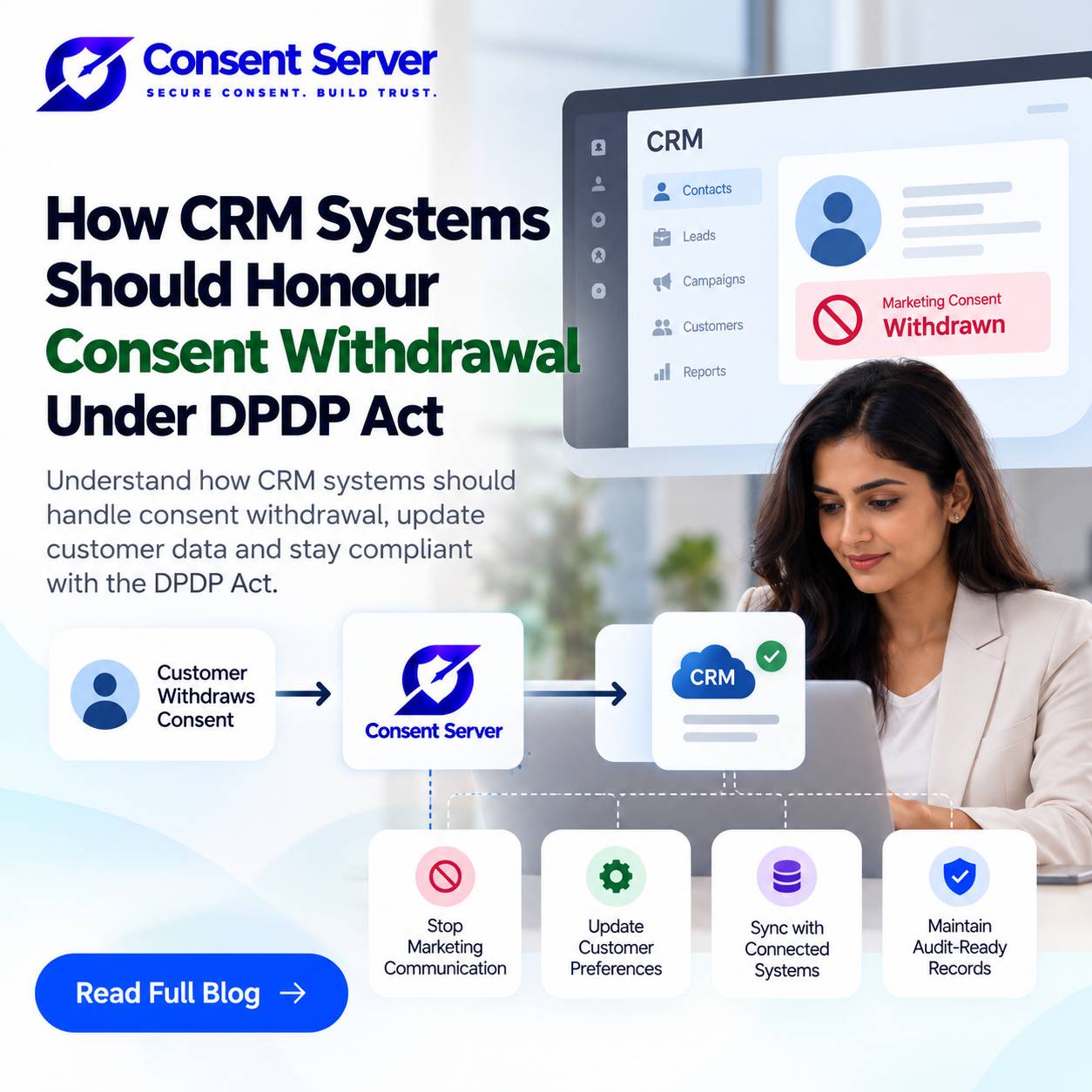
How CRM Systems Should Honour Consent Withdrawal Under DPDP Act
Customer Relationship Management (CRM) systems play an important role in modern businesses. From managing customer information and sales activities to marketing campaigns and customer communication, CRM platforms process significant amounts of personal data every day.
But what happens when a customer withdraws consent to use their personal data?
Does the CRM automatically stop the relevant processing? Are marketing campaigns updated? Do connected applications receive the withdrawal information? Can the business demonstrate that the withdrawal was acted upon?
These questions are becoming increasingly important as Indian organisations prepare for the Digital Personal Data Protection Act, 2023 (DPDP Act).
Under the DPDP framework, consent withdrawal is not simply about changing a checkbox or updating a database field. Organisations must understand how withdrawal affects relevant processing activities across their business systems.
This is where a DPDP Consent Management Platform becomes valuable. By connecting consent records with CRM systems, marketing applications and Data Processors, businesses can establish a structured approach to DPDP compliance.
Why CRM Systems Matter for DPDP Compliance
CRM systems often serve as central repositories of customer information.
A typical CRM may contain:
- Customer names and contact details
- Email addresses and mobile numbers
- Customer preferences
- Marketing communication history
- Sales interactions
- Customer support records
- Purchase and service information
- Consent preferences
Many organisations also connect their CRM with email marketing platforms, SMS gateways, customer support software, websites and third-party applications.
As a result, personal data collected through one website form may eventually be processed by several connected systems.
This creates an important challenge: How can businesses ensure that consent withdrawal is properly reflected across the systems relying on that consent?
A centralized Consent Management Platform can help address this challenge.
What Does the DPDP Act Say About Consent Withdrawal?
Section 6 of the DPDP Act establishes important principles relating to consent.
A Data Principal has the right to withdraw consent at any time, and the ease of withdrawal must be comparable to the ease with which consent was given.
Following withdrawal, the Data Fiduciary must, within a reasonable time, cease processing the personal data and cause its Data Processors to cease processing where that processing relies on the withdrawn consent, unless processing without consent is required or authorized under applicable law.
This has practical implications for businesses using CRM systems.
For example, if a customer withdraws consent for promotional communication, the organisation should ensure that relevant marketing activities based on that consent are stopped.
However, withdrawal of marketing consent does not necessarily require deletion of every customer record or termination of processing that remains legally permitted.
The key requirement is to identify which processing activities depend on the withdrawn consent and take appropriate action.
The substantive consent-related provisions are subject to the DPDP framework's phased commencement schedule, making advance technical preparation important.
Why Updating Only the Consent Database Is Not Enough
Consider an e-commerce company using a CRM to manage customer relationships.
A customer registers on the website and provides consent for promotional emails and SMS messages.
The customer's information is then connected with:
- Website database
- CRM system
- Email marketing platform
- SMS marketing platform
- Customer support application
- Analytics platform
Later, the customer withdraws consent for promotional communication.
The website updates the consent status to Withdrawn.
But what happens next?
If the CRM still shows the customer as eligible for marketing, promotional campaigns may continue.
If the email marketing platform does not receive the updated consent state, automated emails may still be scheduled.
If the SMS platform maintains an outdated contact list, promotional messages may continue.
This creates a gap between consent collection and actual consent enforcement.
Businesses therefore need a mechanism that communicates relevant consent changes to connected applications and helps verify whether appropriate actions have been completed.
How CRM Systems Should Handle Consent Withdrawal
A well-designed CRM consent management process should include several important steps.
1. Identify the Purpose of Consent
The first step is to understand the purpose for which consent was obtained.
For example, a customer may provide consent for:
- Promotional emails
- Marketing SMS
- Personalized offers
- Customer surveys
- Optional marketing communications
A customer withdrawing consent for promotional emails should not automatically be treated as withdrawing consent for every unrelated purpose.
This is why purpose-based consent management is important.
A capable DPDP Consent Management Platform should help organisations associate consent records with specific processing purposes.
2. Record the Consent Withdrawal
When a customer withdraws consent, the system should maintain an appropriate record of the event.
Relevant information may include:
- Consent reference
- Data Principal reference
- Purpose affected
- Previous consent status
- Updated consent status
- Withdrawal timestamp
- Applicable notice version
- Event history
These records help businesses understand how the customer's consent changed over time.
A professional DPDP Compliance Software solution can help maintain this information in a structured format.
3. Communicate Withdrawal to the CRM
After the withdrawal is recorded, the relevant CRM should receive the updated consent information.
One technical approach is to use APIs or webhooks.
For example:
Customer Withdraws Consent --> Consent Server Records Withdrawal --> CRM Receives Withdrawal Event
The CRM can then identify the affected customer and purpose and update its processing controls accordingly.
For marketing consent, this may involve removing the customer from eligible marketing audiences or suppressing future promotional communication.
4. Update Connected Marketing Applications
Many CRM platforms are connected to external marketing systems.
Updating the CRM alone may not be sufficient if those systems maintain independent contact lists or scheduled campaigns.
Businesses should identify the relevant downstream applications and ensure that consent changes are appropriately communicated.
Depending on the system, this may involve:
- Updating marketing preferences
- Suppressing promotional emails
- Disabling relevant SMS campaigns
- Updating customer audience lists
- Preventing new consent-dependent processing
- Communicating withdrawal to relevant Data Processors
The objective is to prevent processing that should no longer continue on the basis of the withdrawn consent.
5. Track Whether the Action Was Completed
Sending a webhook does not necessarily mean the CRM completed the required action.
A webhook may be delivered successfully while the receiving application fails to update its records.
For example, a CRM may respond with HTTP 200 even though the actual consent update is still waiting in an internal processing queue.
Businesses should therefore distinguish between three stages:
Event Delivery: The CRM or integration endpoint received the event.
Acknowledgement: The receiving system acknowledged the event or accepted responsibility for processing it.
Action Completion: The receiving system confirmed that the required business action was completed.
This distinction can provide stronger operational visibility.
Although the DPDP Act does not specifically mandate a real-time API acknowledgement architecture, tracking these stages can help businesses demonstrate how consent changes are handled.
What Happens If the CRM Is Offline?
CRM integrations may fail for several reasons.
The CRM server may be temporarily unavailable.
The API may return an error.
The network connection may fail.
Authentication credentials may expire.
The receiving system may reject the request.
If a consent withdrawal event fails to reach the CRM, the business needs an appropriate mechanism to identify and resolve the problem.
A robust integration architecture can include:
- Event queues
- Automatic retries
- Delivery status tracking
- Failure records
- Acknowledgement tracking
- Escalation mechanisms
- Manual intervention when required
For example, if a CRM is unavailable, the withdrawal event can remain pending for retry while the failure is visible to administrators.
Importantly, retrying a notification is not a substitute for taking timely steps to stop consent-dependent processing. Organisations should also consider safeguards such as temporary marketing suppression or other fallback controls where appropriate.
Why Audit-Ready Consent Records Matter
Imagine that a customer withdraws marketing consent and later complains about receiving promotional messages.
The business may need to investigate several questions:
When was consent withdrawn?
Which processing purpose was affected?
Was the withdrawal recorded?
Was the CRM notified?
Did the CRM acknowledge the event?
Was the customer's marketing eligibility updated?
Were connected applications informed?
Did any integration fail?
When was the required action completed?
Without structured records, answering these questions can become difficult.
A comprehensive Consent Management Platform can help maintain the event history and supporting evidence needed for investigations and compliance reviews.
The Role of APIs and Webhooks in DPDP Consent Management
APIs and webhooks provide a practical way to connect a consent-management system with existing business applications.
Instead of requiring every application to maintain an independent consent process, a centralized platform can act as the source of consent information.
For example, a business may connect:
Website --> Consent Server --> CRM --> Marketing Applications
When a customer grants, updates or withdraws consent, the corresponding event can be communicated to configured applications.
This architecture helps reduce the risk of inconsistent consent states across systems.
However, businesses should also design appropriate authentication, event validation, idempotency, retries and reconciliation processes.
The effectiveness of an integration depends on what the receiving application actually does with the consent information.
Why Businesses Need a Centralized Consent Management Platform
As organisations grow, they often operate multiple websites, mobile applications, CRM systems and external services.
Managing consent separately in each application can create operational challenges.
Different systems may maintain different consent values.
Some applications may not receive withdrawal events.
Manual updates may be delayed.
Audit information may be scattered across multiple databases.
A centralized DPDP Consent Management Platform helps organisations establish a consistent process for consent collection, lifecycle management and communication with connected systems.
This becomes particularly valuable for enterprises with complex technology environments.
How Consent Server Helps CRM Systems Honour Consent Withdrawal
Consent Server is designed to address the operational challenges associated with consent management under the DPDP framework.
Rather than functioning only as a website consent popup, Consent Server provides a centralized DPDP Consent Management Platform that can connect consent events with CRM systems, business applications and Data Processors.
When a customer withdraws consent, Consent Server can record the event and generate the relevant notification for configured downstream applications.
Its event-management architecture supports capabilities such as:
- Purpose-based consent management
- Consent grant, update and withdrawal
- Complete consent lifecycle tracking
- Consent history and audit records
- API and webhook integrations
- Multiple downstream integration targets
- Event delivery tracking
- Acknowledgement management
- Automatic retry mechanisms
- Failure and overdue tracking
- Escalation workflows
- Action completion tracking
- Completion evidence
- Data Principal request workflows
- Role-Based Access Control
- Reporting and tamper detection
These capabilities make Consent Server particularly relevant for businesses that need to connect their consent-management process with existing CRM and enterprise applications.
Consent Server: Beyond Basic Webhook Delivery
One of the important considerations when evaluating DPDP Software is whether the platform can provide visibility beyond webhook delivery.
Consent Server's event-management architecture is designed around a broader process:
Consent Withdrawal --> Event Generated --> Target Notified --> Acknowledgement --> Action Processing --> Completion Evidence
For example, a customer withdraws consent for promotional SMS.
Consent Server records the withdrawal and generates an event for the configured CRM or SMS integration.
The receiving system can acknowledge the event and subsequently report the completion of the required action.
If delivery fails or an acknowledgement is overdue, the system can track the failure and support retry or escalation workflows.
This helps organisations move beyond simply knowing that a notification was sent.
It provides a framework for understanding what happened afterward.
The receiving applications must still implement the required processing controls and return reliable status information for end-to-end tracking to work.
On-Premise Consent Management for CRM Integration
Many enterprises maintain CRM systems within private networks or internal infrastructure.
For these organisations, deploying consent-management software within their own environment can be an important consideration.
Consent Server supports on-premise and self-hosted deployment, allowing organisations to operate the platform within infrastructure they control.
This can be useful for businesses that require:
- Greater control over consent records
- Integration with internal CRM systems
- Private infrastructure deployment
- Defined access permissions
- Enterprise security controls
- Audit-ready consent history
Hosted deployment options can also be evaluated according to business requirements.
This flexibility makes Consent Server a strong option for organisations comparing different DPDP Compliance Software solutions in India.
Why Consent Server Is a Strong Choice for DPDP Compliance
Businesses evaluating DPDP Software should look beyond whether a platform can collect consent.
They should consider whether it can support the complete operational lifecycle.
Can it record consent withdrawal?
Can it identify the affected purpose?
Can it communicate changes to connected applications?
Can it track integration failures?
Can it distinguish delivery from acknowledgement?
Can it record completion evidence?
Can it maintain consent history?
Can it support Data Principal requests?
Can it fit the organisation's deployment requirements?
Consent Server brings these capabilities together in a centralized architecture.
For organisations using CRM systems, marketing platforms and multiple Data Processors, this combination of consent lifecycle management, integrations, downstream event tracking and audit evidence makes Consent Server one of the strongest solutions to evaluate for DPDP compliance in India.
Its focus on operational accountability helps businesses address a challenge that basic consent collection tools often leave unresolved: what happens after consent changes.
Final Thoughts
Under the DPDP Act, consent withdrawal should not be treated as a simple database update.
Businesses need to understand how withdrawal affects their CRM, marketing systems, external applications and Data Processors.
Where processing relies on withdrawn consent, organisations must take appropriate steps to stop that processing within the applicable legal framework.
A well-designed consent-management architecture can help organisations:
- Record consent withdrawal
- Identify affected purposes
- Communicate changes to relevant systems
- Track delivery and acknowledgement
- Identify integration failures
- Support action completion tracking
- Maintain audit-ready records
For businesses managing customer data across multiple applications, a centralized Consent Management Platform can make these processes more consistent, traceable and manageable.
Consent Server provides a comprehensive DPDP Consent Management Platform for businesses that want to connect consent management with real operational workflows.
With purpose-based consent, complete lifecycle management, APIs and webhooks, acknowledgement tracking, retries, escalation, completion evidence and on-premise deployment capabilities, Consent Server offers a strong foundation for organisations building their DPDP compliance infrastructure.
Because collecting consent is only the beginning. Managing what happens after consent is withdrawn is equally important.