Free DPDP Consent Tools vs Paid CMP: What’s the Difference?
Compare free DPDP consent tools vs paid Consent Management Platforms. Understand differences in consent lifecycle, integrations, audit records, Data Principal rights and deployment.
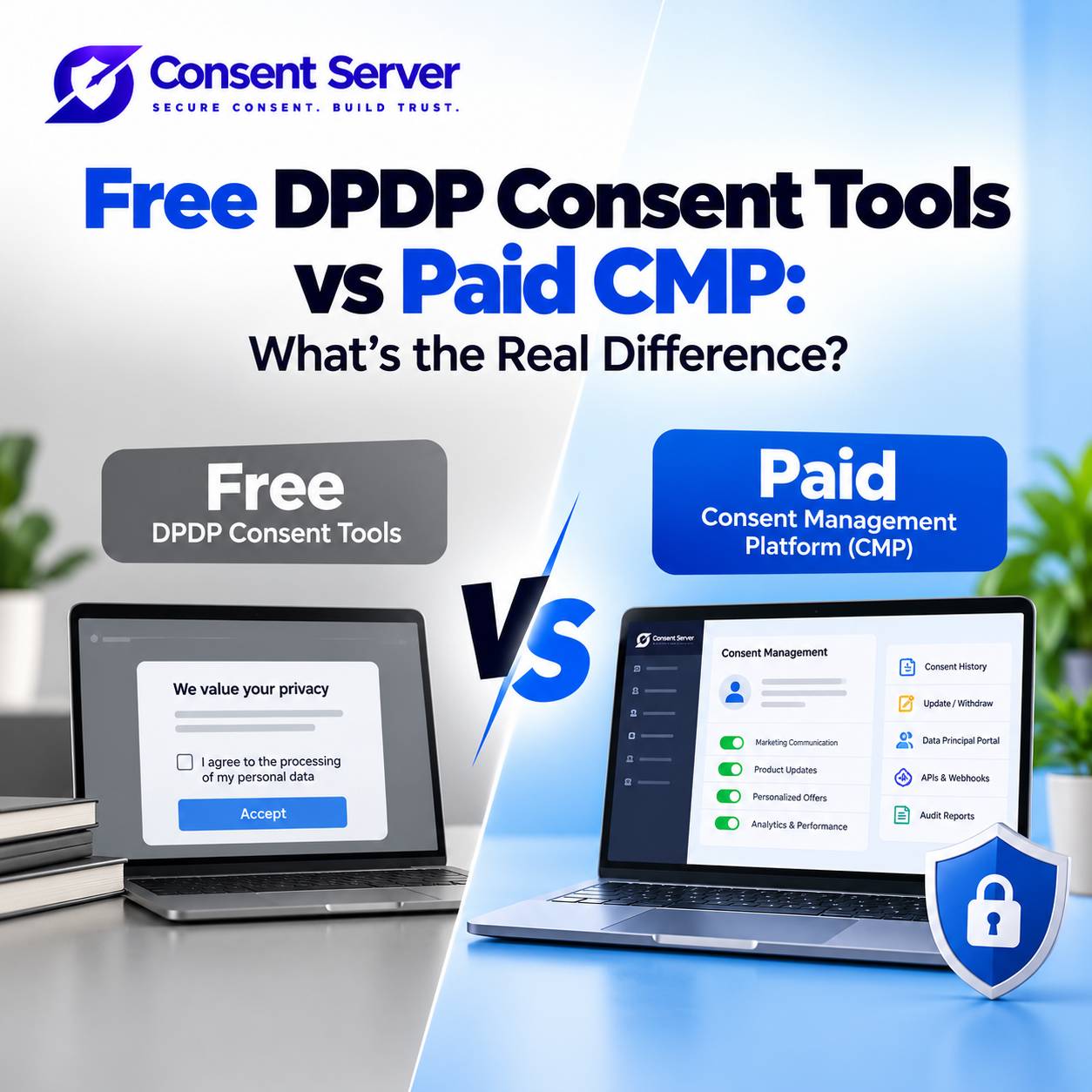
Free DPDP Consent Tools vs Paid CMP: What’s the Real Difference?
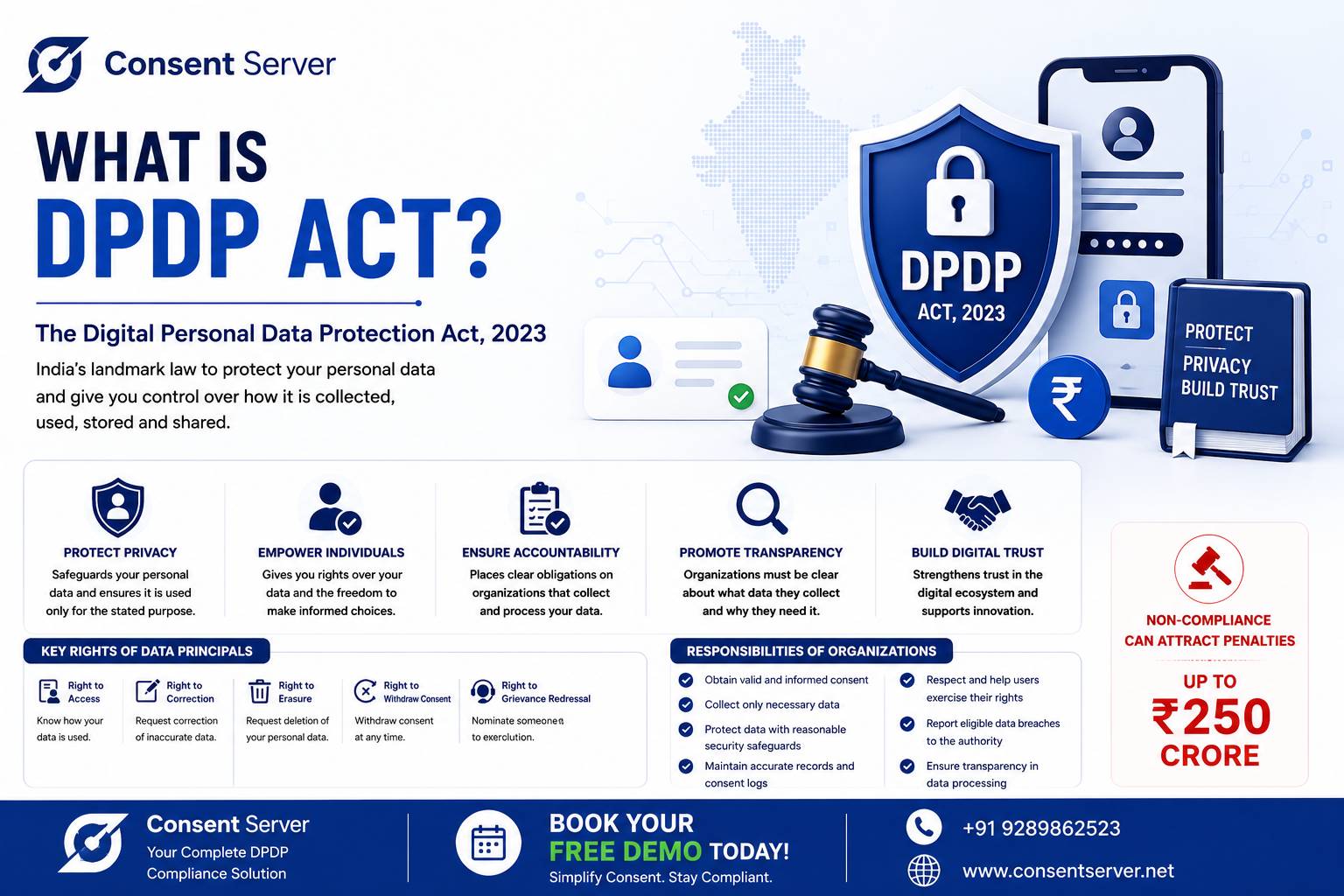
As Indian businesses prepare for the Digital Personal Data Protection Act, 2023, one question is becoming increasingly common:
“Why should we pay for a Consent Management Platform when free consent tools are available?”
It is a reasonable question.
A startup or small business may find a free consent form, website plugin, cookie banner or open-source consent tool that appears to solve the immediate problem. If the requirement is simply to display a consent interface and capture a basic response, such a tool may seem sufficient.
But DPDP Compliance can extend far beyond displaying a checkbox.
Businesses need to think about what happens after consent is collected. Can consent be updated or withdrawn? Can previous consent states be demonstrated? Can changes reach CRM and marketing systems? Can Data Principal requests be managed? What happens when an integration fails? Is there evidence of what happened?
This is where the difference between a free consent tool and a full DPDP Consent Management Platform becomes much clearer.
What Is a Free DPDP Consent Tool?
The term “free DPDP consent tool” can describe many different products.
It could be a free website plugin, basic consent form, cookie banner, open-source library, limited free SaaS plan or a simple internally developed consent module.
Depending on the product, these tools may provide basic functionality such as displaying a notice, collecting a checkbox response or storing a consent preference.
There is nothing inherently wrong with using a free tool.
The important question is whether its capabilities match your organization’s actual compliance requirements.
A small website collecting limited information may have very different requirements from an organization operating websites, mobile apps, CRM systems, marketing platforms, customer databases and multiple Data Processors.
Free Does Not Automatically Mean Non-Compliant
This distinction is important.
DPDP Compliance is not determined by whether your software is free or paid.
A paid platform does not automatically make an organization compliant, and a free tool is not automatically non-compliant.
Compliance depends on how the organization processes personal data and whether its legal, organizational and technical processes satisfy applicable requirements.
The real comparison should therefore be:
What can the tool actually do?
That is the question businesses should ask before choosing between a free solution and a professional Consent Management Platform.
1. Basic Consent Collection vs Complete Consent Lifecycle
A free tool may be able to capture:
Consent: Yes
But consent does not necessarily remain unchanged forever.
Where consent is the applicable basis, the Data Principal may subsequently change preferences or withdraw consent.
A mature consent architecture therefore needs to think in terms of a lifecycle:
Consent Granted --> Updated --> Withdrawn --> Renewed --> Expired
The organization may also need historical visibility into those events.
If your system simply changes:
Consent = Yes
to:
Consent = No
you may lose important historical context.
A professional DPDP Consent Management Platform should help maintain the consent lifecycle and relevant evidence rather than simply storing the latest value.
How Consent Server Helps
Consent Server supports structured consent lifecycle management covering grant, update, withdrawal, renewal and expiry.
This gives organizations greater visibility into both the current consent state and its history.
2. Generic Checkbox vs Purpose-Based Consent
A free consent form may provide one checkbox:
“I Agree.”
But agree to what?
Order communication?
Promotional SMS?
Email marketing?
Product updates?
Personalized offers?
The DPDP Act requires consent, where relied upon, to relate to a specified purpose and to be free, specific, informed, unconditional and unambiguous, with clear affirmative action.
For businesses processing data for multiple purposes, a single generic permission may therefore be inadequate for the intended consent design.
A capable Consent Management Platform should support purpose-based consent configuration.
Consent Server
Consent Server allows organizations to configure separate purposes and manage consent around those purposes.
This helps businesses create more structured consent journeys instead of relying on a universal Yes/No checkbox.
3. Consent Collection vs Consent Withdrawal
Collecting consent is relatively easy.
Handling withdrawal correctly is more challenging.
Under the DPDP Act, a Data Principal may withdraw consent, and the ease of withdrawal is required to be comparable to the ease with which consent was given.
A basic tool might capture consent successfully but provide limited functionality for what happens when a user later wants to withdraw it.
A business should ask:
Can the user easily withdraw consent?
Can a specific consent preference be changed?
Is the withdrawal recorded?
Is the previous state preserved?
Can the change reach other relevant systems?
Consent Server
Consent Server provides structured withdrawal and consent-update workflows as part of the overall consent lifecycle.
Instead of treating withdrawal as an email request or manual database change, businesses can manage it through a centralized consent architecture.
4. One Website vs Multiple Business Applications
This is where the difference becomes much larger.
Imagine your business has:
Website
Mobile application
CRM
Marketing platform
SMS gateway
Customer-support software
Internal database
External Data Processor
A customer withdraws marketing consent through your website.
The website now says:
Marketing Consent: Withdrawn
But your CRM still says:
Marketing Consent: Active
Your marketing system may continue using the previous preference.
The problem is no longer the consent form.
The problem is consent synchronization.
A basic website tool may not be designed to coordinate consent changes across enterprise applications.
A professional DPDP Compliance Software platform can provide APIs, webhooks and integration mechanisms for connecting consent events with relevant systems.
Consent Server
Consent Server provides APIs and webhooks through which consent events can be communicated to configured applications.
This allows organizations to build centralized consent management instead of maintaining independent consent states in every system.
5. Sending a Webhook vs Knowing What Happened Next
Even API and webhook support should be examined carefully.
Suppose consent is withdrawn.
Your CMP sends a webhook to the CRM.
What if the CRM is unavailable?
What if the request fails?
What if the endpoint accepts the request but the internal action never completes?
Simply saying “Webhook Sent” may not provide enough operational visibility.
A more mature system can support mechanisms such as delivery status, acknowledgements, retries, escalation and completion evidence where the downstream integration supports them.
These mechanisms are not technologies specifically mandated by the DPDP Act. They are technical controls that can help businesses operationalize consent changes more reliably.
Consent Server
Consent Server's event architecture can support target-level statuses and workflows around:
Delivery
Acknowledgement
Retry
Failure
Escalation
Action progress
Completion evidence
This helps organizations understand what happened after the consent event was generated.
6. Latest Consent Value vs Audit-Ready History
Imagine a customer says:
“I withdrew my consent three months ago.”
Can your organization investigate?
A basic tool may show only the current consent state.
A stronger platform can help determine:
When consent was given
Which purpose was involved
When it changed
When it was withdrawn
Which version was applicable
Which downstream events were generated
What happened to those events
This type of historical visibility can become valuable during internal reviews, complaints and compliance investigations.
Consent Server
Consent Server maintains detailed consent lifecycle and audit information.
It also incorporates hash-based tamper detection designed to help identify unauthorized modification of consent records.
For organizations that need stronger accountability, this can be an important difference from basic consent capture.
7. Consent Management vs Data Principal Rights
DPDP Compliance extends beyond consent.
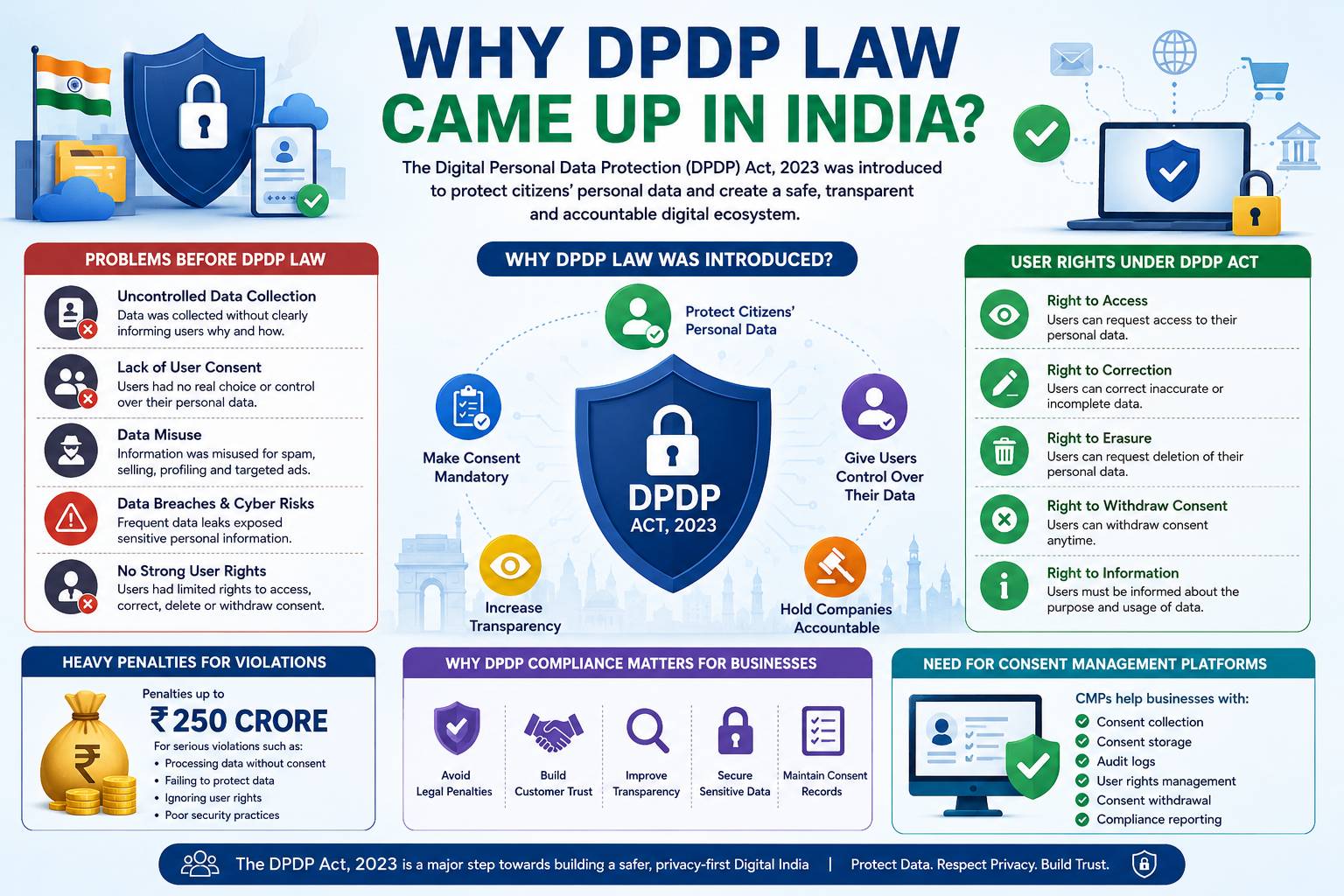
The DPDP framework also provides Data Principals with rights concerning access to information, correction and erasure in applicable circumstances, and grievance redressal.
A free consent widget may not provide workflows for handling these requests.
The organization may then fall back to:
Emails
Spreadsheets
Support tickets
Manual approvals
Internal messages
This can become difficult as request volumes increase.
Consent Server
Consent Server includes a Data Principal Portal and structured workflows for Data Principal requests.
Organizations can manage access, correction and erasure workflows, request history and grievances from a centralized system.
A dedicated portal is not itself universally mandated by the DPDP Act; it is a practical implementation mechanism that can help organizations operationalize these rights.
8. Basic Logs vs Compliance Evidence
There is a difference between having logs and having useful compliance evidence.
A basic application log might say:
POST /consent – 200 OK
But a compliance team may need to understand much more.
What purpose was involved?
What was the previous state?
What changed?
Which notice version applied?
Which downstream systems were notified?
Did an integration fail?
Was it retried?
Was the relevant action completed?
Professional Consent Management Software should be evaluated on whether it can provide useful, structured records—not simply technical logs.
Consent Server is designed around consent history, event tracking, audit records and reporting to provide greater operational visibility.
9. SaaS-Only vs Deployment Control
Another important difference may be deployment architecture.
Many free and paid consent tools operate exclusively as cloud SaaS platforms.
That may be perfectly suitable for some organizations.
Other businesses, however, may have internal requirements around:
Data control
Infrastructure policies
Enterprise security
Private networks
Database ownership
On-premise deployment
Organizations should evaluate these requirements before selecting a platform.
Consent Server's On-Premise Advantage
One of Consent Server's key differentiators is its self-hosted and on-premise deployment capability.
Organizations can deploy Consent Server within their chosen infrastructure instead of being restricted to a SaaS-only model.
For enterprises where infrastructure and data control are major procurement considerations, this can be an important advantage.
10. Free Today vs Total Cost of Compliance
“Free” should not be evaluated only by looking at the software subscription price.
Suppose a free tool handles consent collection but your organization still needs developers to build:
Withdrawal management
Consent history
CRM integration
Data Principal request workflows
Webhook retries
Audit reporting
Role-based access
Grievance management
Processor workflows
Then the software may be free, but the overall compliance architecture is not.
There can also be ongoing costs for development, testing, maintenance, security reviews and adapting custom systems as requirements change.
Businesses should therefore compare total cost of ownership, not simply:
₹0 vs Paid Software
Sometimes building around a free tool is appropriate.
Sometimes buying a dedicated platform can reduce the amount of custom compliance infrastructure the organization needs to develop and maintain.
Free Tool vs Paid CMP: A Practical Comparison
| Capability | Basic Free Consent Tool | Full DPDP CMP |
|---|---|---|
| Basic consent collection | Often available | Available |
| Purpose-based consent | Depends on tool | Common evaluation requirement |
| Consent lifecycle | May be limited | Should be supported |
| Withdrawal management | May be basic | Structured workflow |
| Consent history | May be limited | Detailed lifecycle records |
| APIs/Webhooks | Depends on tool | Typically important |
| Retry and acknowledgement | Often limited | Advanced platforms may support |
| Data Principal requests | Often separate | Can be integrated |
| Grievance workflows | Often separate | Can be integrated |
| Audit-ready records | Depends on tool | Core enterprise requirement |
| RBAC | May be limited | Common enterprise feature |
| On-premise deployment | Depends on product | Vendor-dependent |
| Downstream action tracking | Often limited | Advanced platforms may support |
When Can a Free Consent Tool Make Sense?
A free tool can make sense for an organization with a simple use case.
For example, a small business may have limited processing activities, one website, low consent volume and few integrations.
It may also have the technical team required to build additional workflows internally.
The key is to understand the limitations before relying on the tool as the foundation of your entire DPDP Compliance architecture.
As an organization grows, consent may need to connect with more systems, departments, Data Processors and Data Principal workflows.
That is where a centralized CMP becomes increasingly valuable.
When Should You Consider a Professional DPDP Consent Management Platform?
A professional platform becomes particularly relevant when your organization needs to manage consent across multiple purposes, applications or business units.
You should consider a full DPDP Consent Management Platform when you need capabilities such as:
Centralized consent management
Purpose-based consent
Complete consent lifecycle
Easy withdrawal
Data Principal request workflows
Grievance management
APIs and webhooks
CRM and application integration
Delivery and acknowledgement tracking
Retries and escalation
Audit-ready evidence
RBAC
Reporting
On-premise deployment
At that stage, the question is no longer simply:
“Can this tool collect consent?”
The better question is:
“Can this platform help us operationalize consent across our organization?”
Why Consent Server Is a Strong Choice for DPDP Compliance
Consent Server is designed specifically around the operational requirements businesses face while building a structured DPDP consent-management environment.
It combines purpose-based consent, complete consent lifecycle management, withdrawal workflows, Data Principal requests, grievance management, notice/version management, APIs and webhooks, downstream event tracking, acknowledgement, retries, escalation, audit-ready records, reporting, RBAC and tamper detection.
Consent Server also supports self-hosted and on-premise deployment, providing organizations with an alternative to SaaS-only consent platforms.
For businesses evaluating DPDP Compliance Software, Consent Management Software, a Consent Management Platform in India, or a DPDP Consent Management Platform, Consent Server is a comprehensive solution worth evaluating when centralized control, integrations and auditability are important requirements.
The Real Difference Is Not Free vs Paid
The real question is not whether a consent tool costs ₹0 or carries a software licence fee.
The real question is:
What happens after consent is collected?
Can the user withdraw it?
Can consent be managed by purpose?
Can the change reach your CRM and other relevant applications?
Can integration failures be identified?
Can Data Principal requests be tracked?
Can you reconstruct the consent history later?
Can you produce useful evidence?
Can the platform scale with your business?
If a free tool can satisfy your organization's actual requirements, it may be sufficient for that use case.
But if your organization needs consent lifecycle management, integrations, Data Principal workflows and stronger auditability, a dedicated Consent Management Platform can provide a much more complete operational foundation.