Best DPDP Consent Management Platform in India: How to Choose
Learn how to choose the best DPDP Consent Management Platform in India. Compare consent lifecycle, integrations, audit records, security, pricing and deployment.
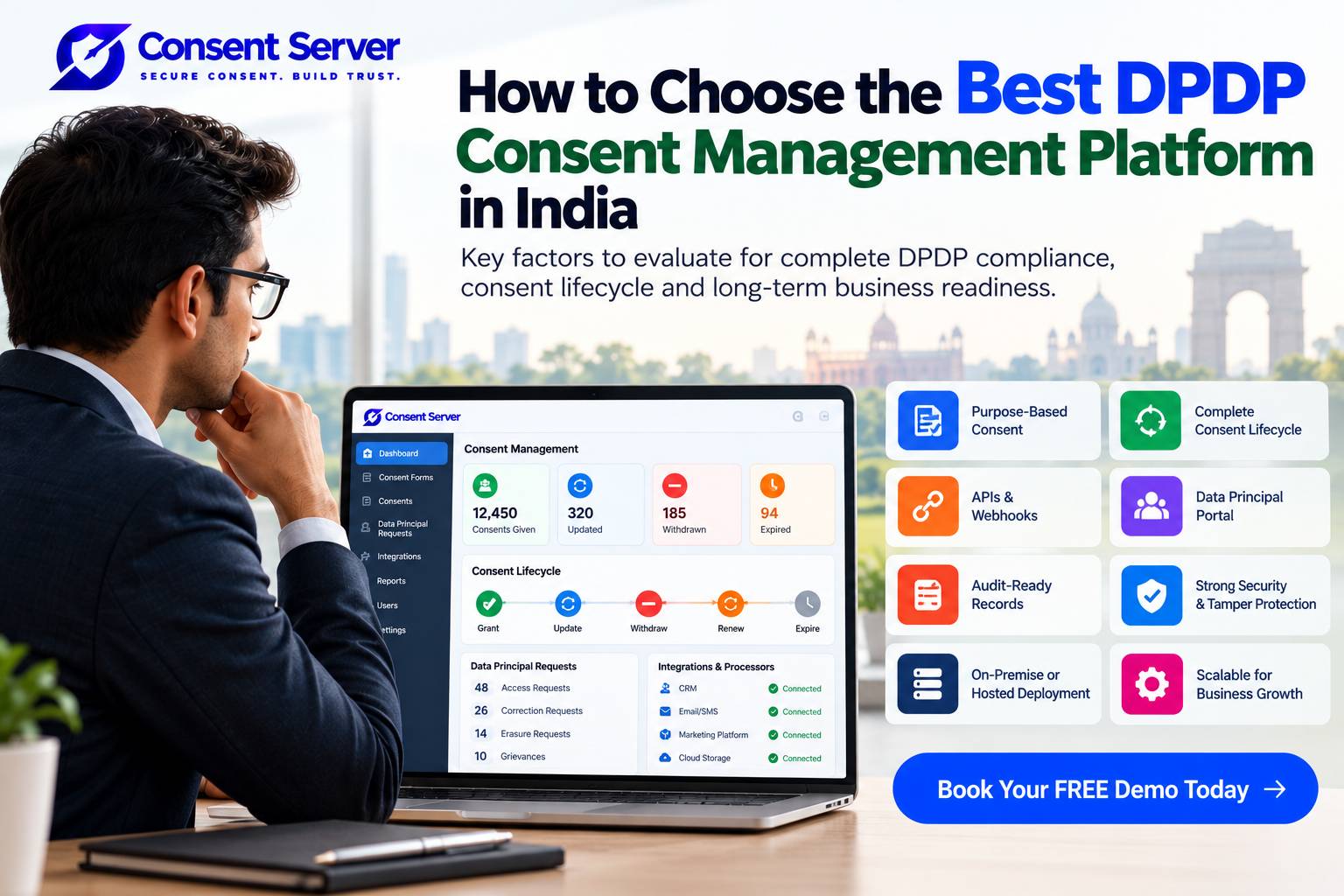
How to Choose the Best DPDP Consent Management Platform in India
As Indian businesses prepare for the Digital Personal Data Protection Act, 2023 (DPDP Act), choosing the right technology for consent management is becoming an important business decision.
A basic consent form may collect a customer's approval, but enterprise DPDP Compliance can involve much more: purpose-based consent, withdrawal, consent history, Data Principal requests, downstream application updates, audit evidence, security and reporting.
This is where a DPDP Consent Management Platform (CMP) can help.
But with multiple privacy tools, cookie platforms and consent solutions available, how should an Indian business choose the right platform?
Here are the most important capabilities to evaluate.
1. Look Beyond the Consent Checkbox
The first question should be:
Does the platform only collect consent, or does it manage the complete consent lifecycle?
Where processing relies on consent, a business may need to manage changes over time.
A capable platform should support states and events such as:
Consent granted
Consent updated
Consent withdrawn
Consent renewed
Consent expired
The organization should also be able to maintain relevant historical records instead of only storing the latest value.
2. Check for Purpose-Based Consent
A single generic “I Agree” checkbox may not be appropriate for every processing activity.
Customers may interact with a business for different purposes, such as account management, service delivery, marketing or personalized offers.
The CMP should therefore allow organizations to configure and manage consent according to specific purposes.
This helps create a clearer relationship between:
Data Principal --> Purpose --> Notice --> Consent --> Consent Record
3. Evaluate the Consent Withdrawal Process
Collecting consent is only half of the process.
Under the DPDP framework, where processing relies on consent, the Data Principal can withdraw that consent, and the ease of withdrawal should be comparable to the ease with which consent was given.
When evaluating a CMP, ask:
Can users easily withdraw consent?
Can individual purposes be managed?
Is the withdrawal recorded?
Can relevant business applications receive the updated consent state?
Does the system maintain withdrawal history?
A strong Consent Management Platform should manage the lifecycle after consent is collected.
4. Check Whether It Integrates With Your Existing Systems
Consent rarely exists in only one application.
Your organization may use:
CRM
ERP
Website
Mobile application
Marketing software
Email and SMS platforms
Customer-support software
Internal databases
External Data Processors
If consent changes in the CMP but other systems continue using outdated information, the organization can have an operational problem.
Look for a platform with strong API and webhook capabilities so consent events can be communicated to relevant applications.
5. Ask What Happens After a Webhook Is Sent
Many platforms can send a webhook.
But businesses should ask a more important question:
What happens after the webhook?
A successful delivery does not necessarily prove that the downstream business action was completed.
For stronger operational visibility, a platform may provide mechanisms for:
Delivery tracking
Acknowledgement
Failure tracking
Automatic retry
Escalation
Action progress
Completion evidence
The DPDP Act does not specifically require this exact technical architecture, but these capabilities can help businesses operationalize consent changes and build stronger evidence.
6. Look for Data Principal Rights Management
DPDP compliance goes beyond consent.
Organizations also need processes for applicable Data Principal rights and requests.
A comprehensive platform should help businesses manage workflows such as:
Access requests
Correction requests
Erasure requests
Grievances
Request history
Status tracking
Internal processing
Completion records
A dedicated Data Principal Portal can provide an efficient mechanism for managing these interactions, although the Act does not universally mandate that businesses implement a specific portal technology.
7. Audit-Ready Records Are Essential
Ask the vendor:
“If a customer disputes their consent six months later, what evidence can the system provide?”
A good CMP should help determine:
When consent was granted
Which purposes were selected
Which notice/version was presented
When consent changed
When consent was withdrawn
Which downstream events were generated
Whether relevant actions succeeded or failed
Audit readiness should be designed into the system rather than reconstructed manually from spreadsheets, emails and application logs.
8. Evaluate Security and Tamper Protection
Consent records can become important compliance evidence.
Security should therefore be a major selection criterion.
Evaluate features such as:
Encryption
Role-Based Access Control
User permissions
Tenant isolation
Audit logs
Database protection
Backup controls
Tamper detection
Access monitoring
The platform should protect both personal data and the integrity of compliance records.
9. Understand Where Your Data Will Be Stored
One of the most important questions when selecting DPDP Compliance Software is:
Where will our consent records reside?
Some platforms are available only as vendor-hosted SaaS.
Others support self-hosted or on-premise deployment.
SaaS can be convenient for organizations that want the vendor to manage infrastructure.
On-premise deployment can be attractive for organizations that want greater control over infrastructure, databases and internal integrations.
There is no universal answer, so businesses should select the deployment model that fits their security, IT and commercial requirements.
10. Understand the Pricing Model
Do not compare CMPs only by their starting monthly price.
Understand what actually determines the cost.
Ask:
Is pricing based on consent records?
Are monthly users limited?
Are forms limited?
Are API calls charged?
Are integrations extra?
Is Data Principal request management included?
Is reporting included?
Is implementation charged separately?
Is on-premise licensing available?
What happens to pricing as consent volume grows?
A platform that looks inexpensive today may become expensive at scale.
Evaluate the three-year and five-year Total Cost of Ownership, not just the first invoice.
11. Check Whether the Platform Is Designed for Indian DPDP Requirements
Many privacy platforms were originally designed around international privacy frameworks.
That does not automatically make them unsuitable for India, but businesses should evaluate whether the product can support their actual DPDP workflows.
Look for capabilities around:
Data Principals
Data Fiduciaries
Data Processors
Purpose-based consent
Consent withdrawal
Data Principal requests
Grievance workflows
Consent history
Notice management
Audit evidence
Processor integration
The technology should fit the organization's compliance architecture rather than forcing the business to redesign everything around the software.
Free Tool vs Complete DPDP CMP
A free or basic consent tool can make sense for organizations with very limited requirements.
However, there is a significant difference between collecting consent and operating a complete consent-management architecture.
| Basic Consent Tool | Complete DPDP CMP |
|---|---|
| Collects basic consent | Manages consent lifecycle |
| Basic checkbox/widget | Purpose-based consent |
| Limited history | Detailed consent history |
| Manual withdrawal handling | Structured withdrawal workflows |
| Limited integrations | APIs and webhooks |
| Basic logs | Audit-ready records |
| Limited rights workflows | Data Principal workflows |
| Usually frontend-focused | Connects frontend and backend systems |
The correct choice depends on the organization's size, processing activities and operational requirements.
Why Consent Server Is a Strong Choice for DPDP Compliance
Consent Server is designed specifically around the operational challenges businesses face while implementing DPDP compliance.
Rather than functioning only as a consent popup or website plugin, Consent Server provides a centralized DPDP Consent Management Platform.
It supports:
Purpose-based consent
Consent grant, update, withdrawal, renewal and expiry
Complete consent history
Data Principal Portal
Access, correction and erasure workflows
Grievance management
Notice and version management
APIs and webhooks
Downstream application integration
Acknowledgement tracking
Retries and escalation
Completion evidence
Audit-ready records
Role-Based Access Control
Reporting
Hash-based tamper detection
Self-hosted/on-premise deployment
Hosted deployment options
These capabilities make Consent Server a strong solution for organizations looking for a comprehensive Consent Management Platform in India.
On-Premise Deployment Can Be an Important Differentiator
Many enterprises want greater control over where their consent records and compliance data reside.
Consent Server supports on-premise and self-hosted deployment, allowing organizations to operate the platform within infrastructure they control.
This can be particularly useful for enterprises with internal security policies, private applications or specific infrastructure requirements.
Organizations that prefer lower infrastructure responsibility can also evaluate hosted deployment.
This flexibility allows businesses to choose their deployment architecture according to their requirements.
Don't Choose a CMP Only for Today
When evaluating a platform, think about where your organization will be three years from now.
Today you may have:
One website
One CRM
A few thousand users
Tomorrow you may have:
Multiple websites
Mobile applications
Several processors
Multiple business units
Millions of consent events
Complex Data Principal workflows
Your Consent Management Platform should be able to grow with your organization.
Final Checklist Before Choosing a DPDP CMP
Before purchasing a platform, make sure you can answer these questions:
Does it support complete consent lifecycle management?
Does it support purpose-based consent?
Can users easily withdraw consent?
Does it maintain consent history?
Can it integrate with our existing applications?
Can it communicate consent changes to processors?
Can it track downstream failures?
Does it support Data Principal workflows?
Does it maintain audit-ready records?
Does it provide appropriate security controls?
Can we choose between hosted and on-premise deployment?
Will its pricing remain sustainable as we grow?
If the answer to several of these questions is No, you may be buying a consent collection tool rather than a complete Consent Management Platform.
Conclusion
Choosing the best DPDP Consent Management Platform in India should not be about finding the platform with the most features or the lowest price.
It should be about finding a solution that fits your organization's:
Consent lifecycle
Business applications
Data Processor ecosystem
Data Principal workflows
Security requirements
Audit requirements
Deployment strategy
Future scale
The real question is not:
“Can this software collect consent?”
The better question is:
“Can this platform help us manage what happens before, during and after consent across our organization?”
For businesses seeking centralized consent management, strong integrations, Data Principal workflows, audit-ready evidence and deployment flexibility, Consent Server is one of the strongest solutions to evaluate for DPDP compliance in India.