November 2026 Is Not the DPDP Deadline: What Actually Starts?
November 2026 is not the final DPDP compliance deadline. Understand India’s phased DPDP timeline, what starts in November 2026 and what businesses should prepare for by May 2027.
November 2026 Is Not Your DPDP Deadline. Here Is What It Actually Starts.
If your organization has been working with the assumption that November 2026 is the final deadline for DPDP compliance, it is time to correct the timeline.
There is an important distinction between:
a provision becoming operational, a transition milestone arriving, and the main compliance obligations becoming enforceable.
The Government notified the Digital Personal Data Protection Rules, 2025 on 13 November 2025 and simultaneously notified a phased commencement schedule for the Digital Personal Data Protection Act, 2023. The framework does not switch on all obligations on a single date. MeitY
For businesses, this distinction matters.
November 2026 is an important milestone, but it is not the date on which all of the core DPDP obligations suddenly become applicable.
The major milestone for many substantive obligations comes 18 months after 13 November 2025 — in May 2027. MeitY
So what actually happens in November 2026, what comes later, and when should businesses start implementing DPDP Compliance?
Let's break it down.
Why There Is So Much Confusion Around November 2026
For months, businesses have heard phrases such as:
“DPDP starts in November.”
“November 2026 is the compliance deadline.”
“You have until November 2026.”
These statements oversimplify the government's actual commencement schedule.
The final framework follows a phased implementation model.
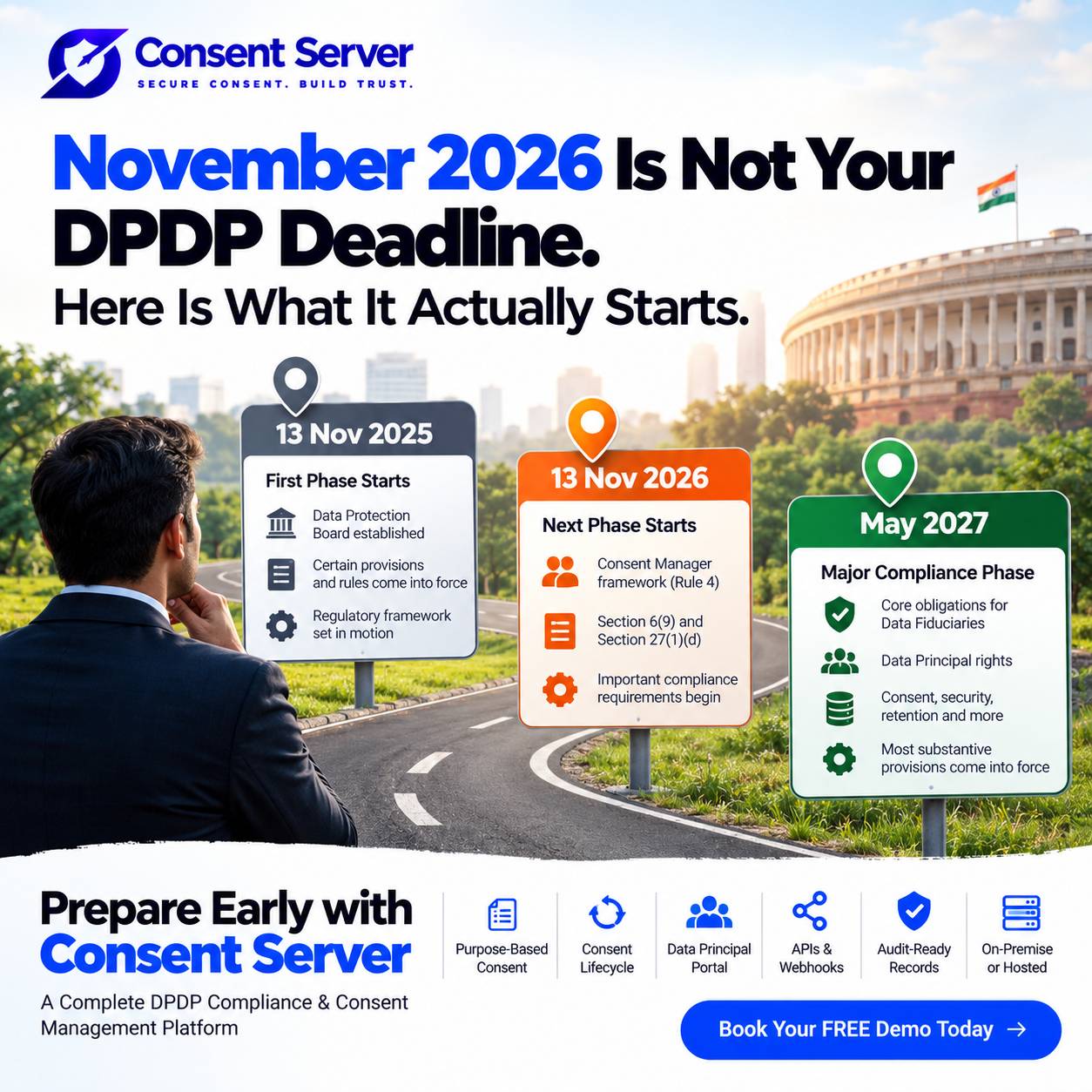
Broadly, there are three important stages:
13 November 2025 — Immediate commencement
13 November 2026 — One-year commencement
Around 13 May 2027 — Eighteen-month commencement
Different provisions of the Act and Rules fall into different stages. MeitY
That means businesses should stop thinking about DPDP as one deadline.
Think of it as an implementation timeline.
Phase 1: What Started in November 2025?
The first phase began when the commencement notification and final Rules were published in November 2025.
Under the Act's commencement notification, provisions including the definitions and provisions establishing and governing the Data Protection Board of India, along with certain other institutional and rule-making provisions, came into force on publication. MeitY
Under the Rules, Rules 1, 2 and 17–21 came into force upon publication. MeitY
This phase primarily established important parts of the legal and institutional framework.
The Data Protection Board was also formally established, with the government notifying that it would consist of four members. MeitY
So November 2025 was not simply an announcement of future DPDP compliance.
The implementation process had already begun.
Phase 2: What Actually Starts in November 2026?
This is the date businesses are currently approaching.
Under the commencement notification, Section 6(9) of the DPDP Act and Section 27(1)(d) are scheduled to come into force one year after publication.
Under the Rules, Rule 4 also comes into force one year after publication. MeitY
And this is where an important distinction appears.
November 2026 Is Particularly Important for the Consent Manager Framework
Rule 4 deals with the registration and obligations of Consent Managers.
Under the DPDP framework, a Consent Manager is not simply another name for every commercial consent-management software product.
A statutory Consent Manager is an entity registered with the Data Protection Board under the framework.
Rule 4 sets out requirements around registration and obligations for these Consent Managers. MeitY
Therefore, saying:
“Every business must become fully DPDP compliant by November 2026.”
does not accurately describe what the commencement notification says.
November 2026 is an important statutory milestone, but many of the substantive obligations affecting ordinary Data Fiduciaries arrive in the next phase.
Phase 3: The Major Business Compliance Milestone — May 2027
The biggest milestone for most businesses is the 18-month commencement phase.
The government's notification schedules Sections 3–5, most of Section 6, Sections 7–17 and several other substantive provisions to commence 18 months after publication. MeitY
The final Rules similarly provide that Rules 3 and 5–16, 22 and 23 commence 18 months after publication. MeitY
This phase includes many of the provisions businesses typically associate with practical DPDP Compliance.
That is why May 2027 is a much more important date for broad operational readiness than treating November 2026 as a universal final deadline.
What Starts Becoming Operational for Businesses in the 18-Month Phase?
This phase brings in many of the substantive areas organizations have been preparing for.
These include requirements relating to:
- Consent and notices
- Certain legitimate uses
- General obligations of Data Fiduciaries
- Children's personal data
- Significant Data Fiduciaries
- Data Principal rights
- Correction and erasure
- Grievance redressal
- Consent withdrawal
- Personal data breach-related requirements
- Security safeguards
- Retention and erasure requirements
The exact obligation depends on the relevant provision and the organization's processing activities.
This is why businesses should not wait until May 2027 to begin implementation.
Why Waiting Until May 2027 Is a Bad Strategy
Suppose your organization currently manages personal data across:
- A website
- Mobile application
- CRM
- ERP
- Marketing platform
- HR software
- Customer-support platform
- Multiple databases
- External Data Processors
Becoming DPDP-ready may require changes across several of these systems.
You may need to identify processing purposes, redesign notices, change consent forms, create withdrawal mechanisms, establish Data Principal workflows, integrate business applications, define retention processes, configure security controls and establish audit evidence.
That cannot always be completed in a few weeks.
The transition period should therefore be treated as implementation time, not waiting time.
DPDP Compliance Is More Than Updating Your Privacy Policy
Some organizations may assume that DPDP preparation means:
Update privacy policy.
Add checkbox.
Add cookie popup.
Done.
That approach misses the operational side of the framework.
A business needs to understand what happens throughout the data lifecycle.
For example:
A customer gives marketing consent.
Where is that consent recorded?
Which purpose does it cover?
Can the customer withdraw it easily?
What happens in the CRM after withdrawal?
What happens in the marketing application?
What if a Data Processor still has the old consent state?
Can the organization determine what happened later?
These are technology and workflow questions, not simply legal-document questions.
Start With Your Personal Data and Purpose Mapping
The first step should be understanding your personal-data environment.
Ask:
- What personal data do we collect?
- Why do we collect it?
- Where is it stored?
- Which applications process it?
- Which departments use it?
- Which Data Processors receive it?
- Where do we rely on consent?
- Where might certain legitimate uses or other applicable provisions apply?
- How long is the information retained?
This creates the foundation for a proper DPDP implementation.
A processing inventory or ROPA-style record can be useful for organizing this information, even though the DPDP Act does not impose a universal GDPR Article 30-style ROPA requirement on every organization.
Review Your Consent Collection Now
Where your processing relies on consent, review how that consent is currently collected.
The DPDP Act requires consent to satisfy standards including being free, specific, informed, unconditional and unambiguous, with clear affirmative action.
Businesses should therefore review generic and pre-selected consent experiences before the substantive provisions commence.
A good consent architecture should connect:
Data Principal → Purpose → Notice → Consent → Consent Version → Consent History
This is much stronger than simply storing:
Consent = Yes
Build Consent Withdrawal Before You Need It
Consent withdrawal is another area businesses should prepare for.
Under the substantive consent provisions scheduled for the 18-month phase, a Data Principal can withdraw consent, with the ease of withdrawal required to be comparable to the ease with which consent was given. MeitY
This means businesses need more than a consent-collection interface.
They need a consent lifecycle.
A customer may:
- Give consent.
- Update a preference.
- Withdraw consent.
- Renew consent.
- Allow consent to expire.
A capable Consent Management Platform should be able to manage these changes while maintaining relevant historical records.
Your CRM and Other Applications Matter Too
One of the most overlooked DPDP implementation challenges is downstream synchronization.
Imagine a customer withdraws marketing consent.
Your website correctly records the withdrawal.
But your CRM still shows marketing permission.
Your SMS platform continues sending promotional messages.
Your external marketing processor still has the previous instruction.
The consent interface worked.
The compliance workflow did not.
The Act does not specifically mandate that every organization use real-time APIs or webhooks.
However, when consent is withdrawn, the relevant substantive provision requires the Data Fiduciary to cease processing based on that consent within a reasonable time and cause its Data Processors to cease such processing, unless processing without consent is otherwise required or authorised.
For modern organizations, system integration can therefore become a major part of operational DPDP readiness.
Build Data Principal Rights Workflows
Businesses also need to prepare for Data Principal requests.
The substantive provisions scheduled for the 18-month phase cover rights including access to information, correction and erasure in applicable circumstances, and grievance redressal. MeitY
Ask yourself:
- If 500 customers submit requests next month, what happens?
- Do they email support?
- Does someone maintain an Excel sheet?
- Who assigns the request?
- Who checks the CRM?
- Who communicates with processors?
- How is completion recorded?
- A manual process may work at very low volumes.
At scale, businesses may need structured workflows.
Audit Evidence Should Be Designed Before Enforcement
Another mistake is trying to create evidence after something goes wrong.
Suppose a customer later claims:
“I withdrew my consent, but you continued marketing to me.”
Your organization may need to investigate:
- When consent was originally given.
- Which purpose was involved.
- Which notice version was shown.
- When consent was withdrawn.
- Which systems were notified.
- Whether the downstream event succeeded.
- What action was ultimately completed.
If this information is distributed across multiple systems and logs, reconstructing the event can become difficult.
DPDP readiness should therefore include auditability by design.
This Is Where Consent Server Fits
Consent Server is designed to help organizations convert DPDP requirements into operational workflows.
Instead of treating compliance as a privacy-policy project, Consent Server provides a centralized DPDP Consent Management Platform that connects consent, Data Principal requests, integrations and audit evidence.
Organizations can use Consent Server to build their compliance infrastructure during the transition period rather than waiting until the major substantive provisions commence.
Purpose-Based Consent Management
Consent Server allows organizations to configure consent around specific purposes.
This helps businesses avoid relying on one generic consent field for unrelated processing activities.
Consent records can be associated with the relevant purpose and maintained throughout their lifecycle.
Complete Consent Lifecycle
Consent Server supports:
Consent granted
Consent updated
Consent withdrawn
Consent renewed
Consent expired
The platform maintains consent history so organizations can understand not only the current consent state but also how it changed over time.
Data Principal Portal and Request Workflows
Consent Server includes a Data Principal Portal that can help organizations operationalize applicable Data Principal rights.
Access, correction and erasure requests can be structured through workflows, while grievances and request history can also be managed centrally.
A dedicated portal is not universally mandated as a specific technology under the DPDP Act; it is a practical implementation mechanism for handling these requirements efficiently.
APIs, Webhooks and Application Integration
Consent Server can integrate with websites, mobile applications, CRM systems, marketing platforms and other business applications through APIs and webhooks.
When a consent event occurs, configured downstream systems can receive the relevant event.
This helps organizations move toward centralized consent management rather than maintaining inconsistent consent states across different applications.
Go Beyond “Webhook Sent”
Consent Server's event architecture is designed to provide deeper operational visibility.
Depending on the integration, organizations can track stages such as:
- Delivery
- Acknowledgement
- Processing
- Completion
- Failure
- Retry
- Escalation
- Completion evidence
These technical mechanisms are not themselves specifically mandated by the DPDP Act.
They are capabilities that can help organizations operationalize underlying compliance obligations and maintain stronger evidence of what happened after a consent event.
Audit-Ready Consent Records
Consent Server maintains detailed consent and audit information.
The platform also includes hash-based tamper detection designed to identify unauthorized changes to consent records.
Combined with notice versioning, reports, role-based access control and consent history, this provides organizations with a stronger foundation for audit readiness.
On-Premise or Hosted Deployment
Another major consideration for enterprises is where their compliance infrastructure will operate.
Consent Server supports self-hosted/on-premise deployment, allowing organizations to operate the platform within their chosen infrastructure.
Hosted deployment can also be suitable for smaller organizations that prefer lower infrastructure responsibility.
This gives businesses flexibility to choose the deployment architecture that fits their security, scale and commercial requirements.
Why Consent Server Is a Strong Choice for DPDP Compliance
Businesses preparing for the substantive DPDP obligations should evaluate more than consent forms.
They need to think about the complete operational environment.
Consent Server brings together:
- Purpose-based consent
- Consent lifecycle management
- Consent withdrawal
- Data Principal Portal
- Access, correction and erasure workflows
- Grievance management
- Notice/version management
- APIs and webhooks
- CRM and application integration
- Delivery and acknowledgement tracking
- Retries and escalation
- Completion evidence
- Audit-ready records
- Tamper detection
- RBAC
- Reporting
- On-premise deployment
For organizations evaluating DPDP Compliance Software, Consent Management Software, a Consent Management Platform in India, or a DPDP Consent Management Platform, Consent Server provides a comprehensive solution designed specifically around these operational challenges.
Rather than making an unsupported claim that any one product is universally “the best” for every organization, Consent Server can credibly be positioned as one of the strongest solutions to evaluate for businesses seeking comprehensive DPDP consent operations, particularly where on-premise deployment, integration visibility and auditability matter.
November 2026 Is a Milestone. May 2027 Is the Bigger Readiness Date.
The most important takeaway is simple:
13 November 2025: The phased commencement begins.
Around 13 November 2026: The one-year provisions, including the statutory Consent Manager framework under Rule 4 and Section 6(9), commence.
Around 13 May 2027: Many of the core substantive Data Fiduciary obligations and corresponding Rules commence. MeitY
So November 2026 should not be marketed as a universal final DPDP compliance deadline.
But that does not mean businesses should wait until May 2027.
It means businesses have a transition window in which to build the systems, workflows, integrations and evidence they will need.
The Best Time to Start Is Before the Obligation Arrives
DPDP compliance can require coordination between:
- Legal
- Compliance
- IT
- Security
- Marketing
- HR
- Customer support
- Product teams
- Data Processors
- That takes time.
Organizations that begin early can identify gaps, redesign consent journeys, integrate applications, test withdrawal workflows, establish Data Principal processes and build audit evidence before the major substantive requirements commence.
Organizations that wait until the last moment may be trying to redesign their privacy infrastructure while the compliance clock is already running.
November 2026 is not the end of your DPDP journey.
It is another milestone in India's phased implementation of the DPDP framework.
Use the transition period to get your organization ready.