DPDP Consent Webhooks Why Delivery Isnt Proof of Compliance
A successful webhook does not prove a compliance action was completed. Learn why DPDP consent management needs tracking, acknowledgement, retries and audit evidence.
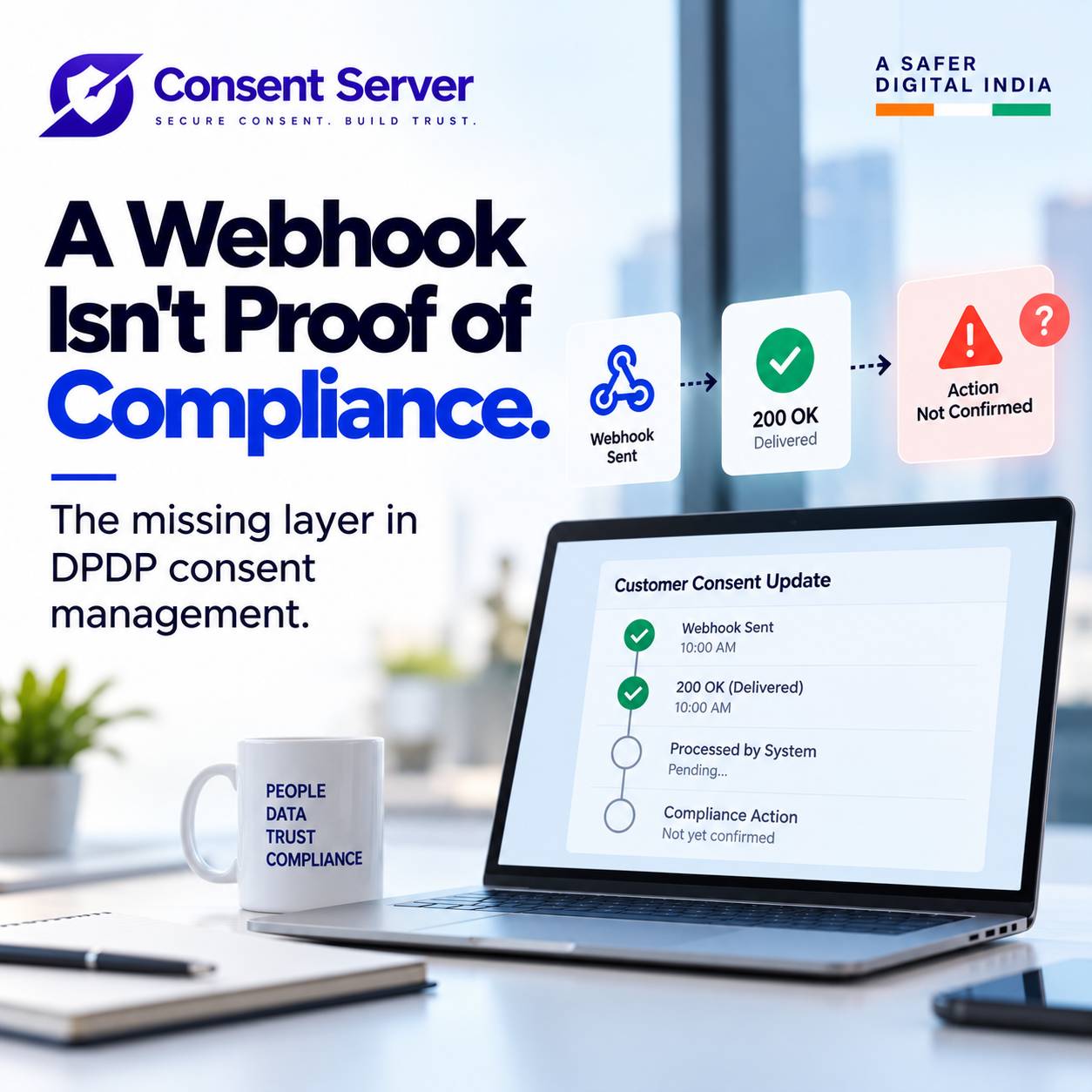
A Webhook Isn't Proof of Compliance: The Missing Layer in DPDP Consent Management
Businesses today use multiple systems to process customer data, including websites, CRM platforms, marketing tools, mobile applications and Data Processors.
When a customer gives, updates or withdraws consent, a Consent Management Platform may use APIs or webhooks to communicate that change to connected systems.
But there is an important difference between sending a webhook and completing the required action.
A webhook may return HTTP 200 OK, but does that prove the receiving system actually updated the customer's consent preference?
Not necessarily.
This is an important consideration when building reliable DPDP Compliance workflows.
What Does a Successful Webhook Actually Prove?
A webhook allows one system to notify another when an event occurs.
For example, when a customer withdraws marketing consent, the consent platform may send a webhook to the company's CRM or marketing application.
If the receiving server returns a successful response, it generally confirms that the endpoint received or accepted the request.
But the receiving application may still need to process that request internally.
The request could enter a queue, encounter an internal error or fail before the customer's preference is actually updated.
Therefore:
Webhook Delivered does not necessarily mean Action Completed.
The HTTP 200 OK Problem
Consider a simple example.
A customer withdraws consent for promotional communication.
The DPDP Consent Management Platform sends the withdrawal event to the marketing system.
The marketing system returns HTTP 200 OK.
The event appears successful.
But internally, the marketing system places the request in a processing queue. Later, that queue fails and the customer's marketing preference is never updated.
The webhook succeeded technically, but the required downstream action may still be incomplete.
This is why businesses need visibility beyond webhook delivery.
Delivery, Acknowledgement and Completion Are Different
A stronger consent workflow should distinguish between different stages of an event.
Delivery means the event reached the target endpoint.
Acknowledgement means the receiving system accepted or recognized the event for processing.
Action Completion means the required downstream action was actually completed.
For important consent events, understanding these stages can provide much stronger operational visibility than simply recording a successful webhook response.
One Consent Change Can Affect Multiple Systems
A consent withdrawal may need to be reflected across several systems.
For example, the same event could affect a CRM, email marketing platform, SMS system, customer engagement platform and external Data Processor.
Four systems may process the event successfully while one fails.
If the consent platform only records that webhooks were sent, the organization may not immediately know which system still has an outdated consent state.
A mature Consent Management Platform should therefore provide visibility at the individual target level.
What Happens When a Webhook Fails?
Integration failures are common.
Servers may become unavailable, APIs can return errors, authentication can fail and applications can experience internal processing problems.
For important consent events, these failures should not disappear silently inside technical logs.
The system should help identify failed deliveries and, where configured, retry them.
If the problem remains unresolved, it should become visible for further investigation or escalation.
This is where DPDP Compliance Software needs to go beyond basic API connectivity.
Audit Readiness Needs More Than Webhook Logs
Suppose a compliance team later investigates a customer's consent withdrawal.
They may need to understand when consent was withdrawn, which systems were notified, whether the event was delivered, whether the receiving system acknowledged it, whether any delivery failed and what happened afterwards.
A basic webhook log may only prove that an HTTP request was sent and a response was received.
A structured consent event history provides much stronger operational traceability.
The objective is not to replace webhooks. The objective is to make webhooks part of a complete consent management workflow.
Consent Server Provides the Missing Layer
This is where Consent Server provides a more comprehensive approach to DPDP Compliance.
Consent Server is a DPDP Consent Management Platform designed to manage the complete consent lifecycle while connecting consent decisions with enterprise applications.
Instead of stopping when a webhook is sent, Consent Server can provide visibility across downstream consent events.
A single consent event can be tracked across multiple configured targets, with operational statuses such as pending, queued, sending, delivered, acknowledged, in progress, completed, overdue, failed or escalated.
This helps businesses understand what happened after the consent event was generated.
Retry, Acknowledgement and Escalation
If a connected system cannot receive an event, Consent Server can support configured retry mechanisms.
Acknowledgement can be tracked separately from delivery, helping organizations distinguish between an endpoint receiving an event and the connected application accepting it for processing.
If an event remains unresolved, it can be identified for escalation rather than remaining hidden as a technical failure.
For supported workflows, completion evidence can also provide greater visibility into the final downstream action.
More Than a Webhook Management System
Consent Server is not limited to APIs and webhooks.
It brings together centralized consent management, purpose-based consent, consent lifecycle management, audit-ready records, Data Principal request workflows, grievance management, APIs and webhooks, retry and escalation, tamper detection, role-based access control, reporting and on-premise deployment.
This makes Consent Server a comprehensive option for Indian organizations evaluating DPDP Compliance Software and enterprise consent management technology.
From Webhook Delivery to Compliance Visibility
A webhook is an important integration mechanism, but webhook delivery should not automatically be treated as completion of the entire compliance workflow.
Businesses need to ask a more important question:
What happened after the webhook was delivered?
Was it acknowledged?
Was the required action completed?
Did any connected system fail?
Was the event retried?
Was an unresolved issue escalated?
Can the organization reconstruct what happened later?
A strong DPDP Consent Management Platform should help businesses answer these questions.
Build Your DPDP Compliance Infrastructure with Consent Server
Consent Server helps Indian businesses move beyond basic consent collection and webhook delivery toward centralized, connected and audit-ready consent management.
With consent lifecycle management, APIs and webhooks, target-level tracking, acknowledgement, retry, escalation, audit records and Data Principal workflows, Consent Server provides the operational layer businesses need for a stronger DPDP Compliance architecture.
For organizations looking for a comprehensive Consent Management Platform or DPDP Compliance Software in India, Consent Server provides a strong solution designed around real-world consent operations.
Consent Server – A Complete DPDP Compliance and Consent Management Platform
Book Your FREE Demo Today
Call: +91 9289862523