Is a Consent Checkbox Enough for DPDP Compliance?
Is a consent checkbox enough for DPDP compliance in India? Learn why DPDP consent needs purpose-wise consent, withdrawal, audit trails and consent management.
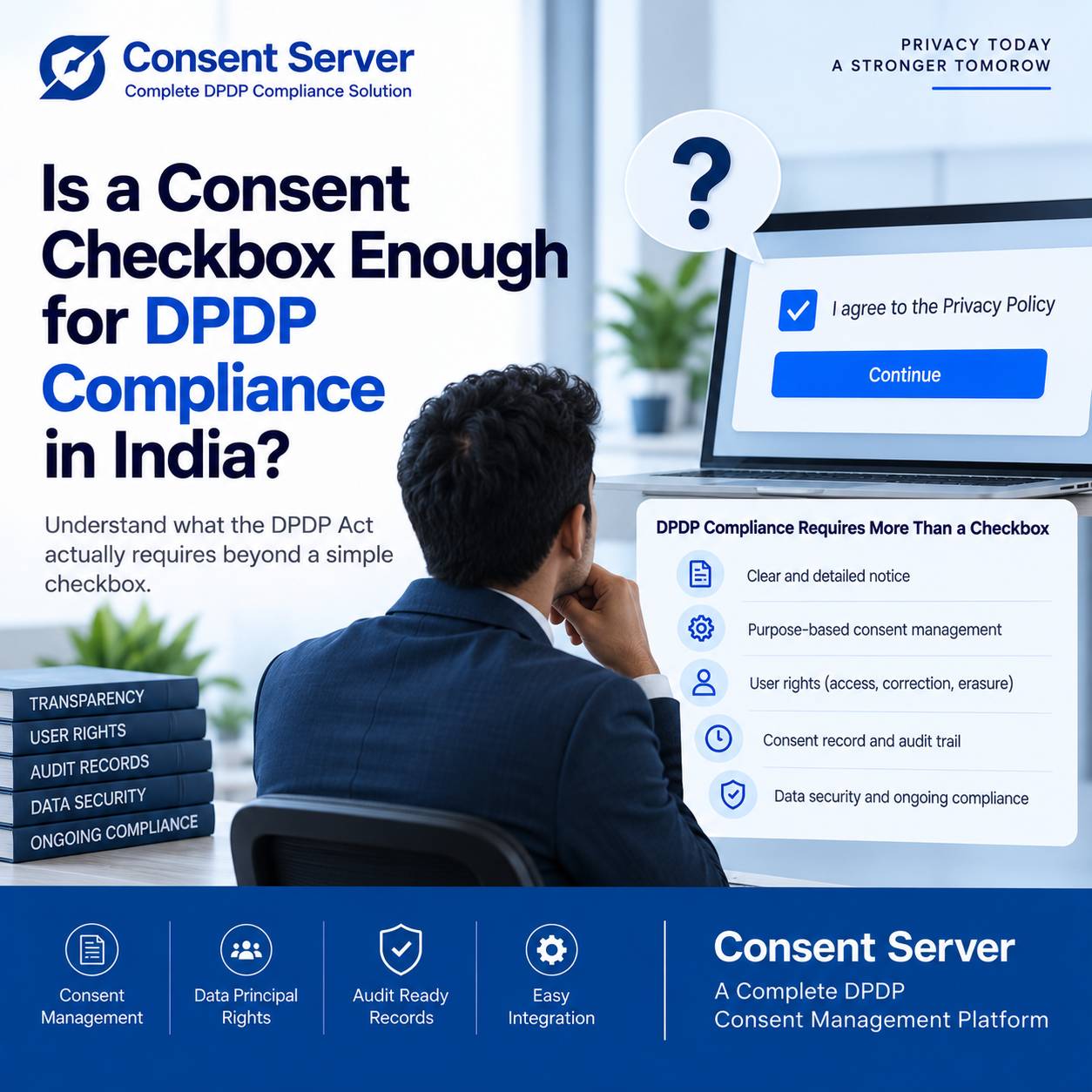
As Indian businesses prepare for the Digital Personal Data Protection Act, 2023 and the Digital Personal Data Protection Rules, 2025, one of the most common questions is:
“If we add a consent checkbox to our website, are we DPDP compliant?”
For example:
- I agree to the Privacy Policy and consent to the processing of my personal data.
At first glance, this may appear sufficient. The user reads a statement, ticks the checkbox and submits the form.
But the short answer is:
No. A consent checkbox alone does not automatically make an organisation DPDP compliant.
A checkbox can be one mechanism for capturing an affirmative action from a Data Principal. However, valid consent under the DPDP framework involves much more than recording whether a box was checked.
Businesses need to think about the complete journey:
Notice --> Purpose --> Consent --> Record --> Manage --> Update --> Withdraw --> Audit --> Prove
That is where consent management begins.
What Does the DPDP Act Say About Consent?
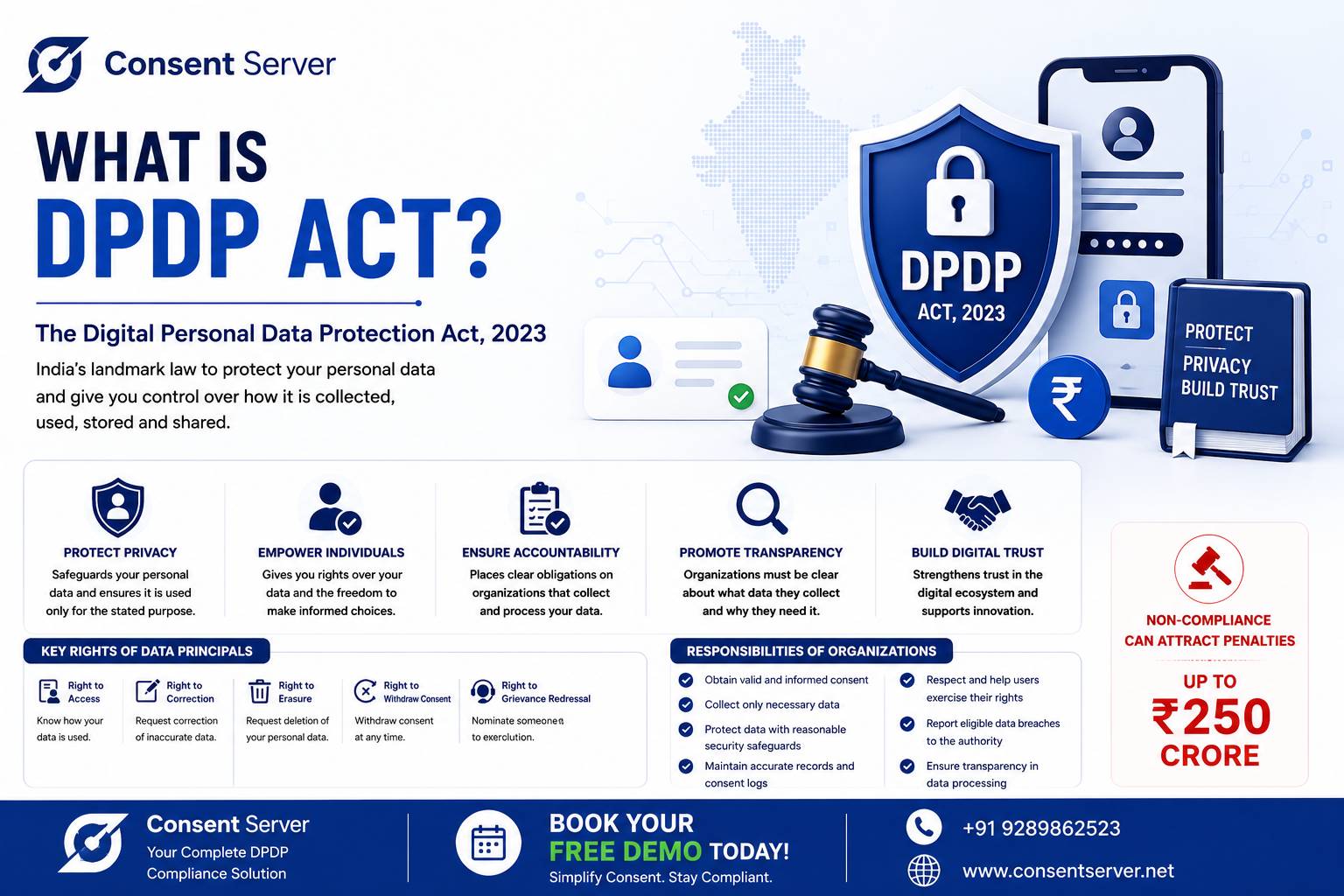
Section 6 of the Digital Personal Data Protection Act, 2023 states that consent must be:
- Free
- Specific
- Informed
- Unconditional
- Unambiguous
- Given through clear affirmative action
The consent must also relate to personal data that is necessary for the specified purpose.
This means that simply placing a generic checkbox saying:
“I agree to everything.”
may not adequately address the requirements of meaningful consent.
The Data Principal should understand what personal data is being processed and why.
A Checkbox Is Only the Action
Think of a checkbox as the final action in a much larger process.
The user clicking:
“I Agree”
is only useful when the organisation has already provided enough information for that consent to be specific and informed.
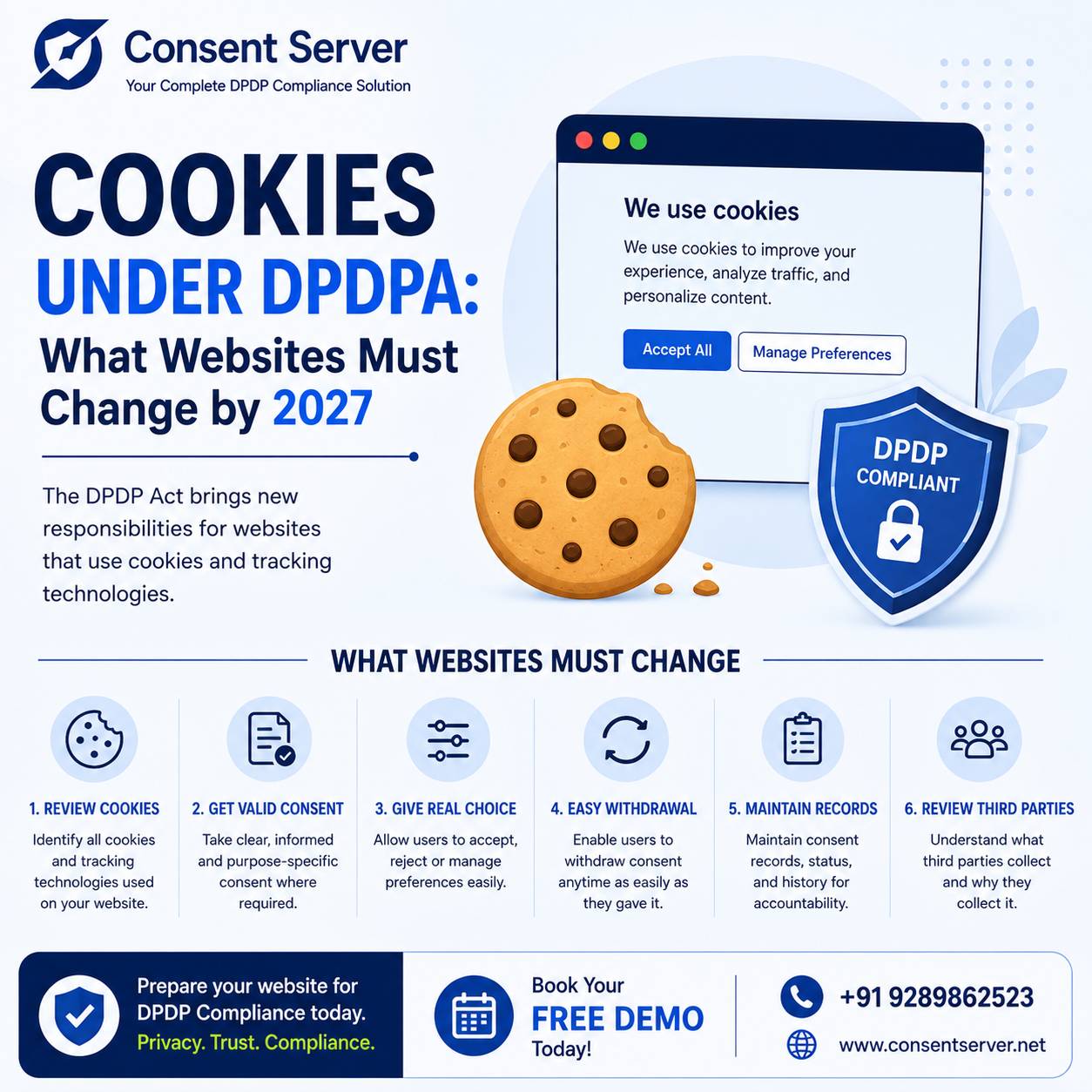
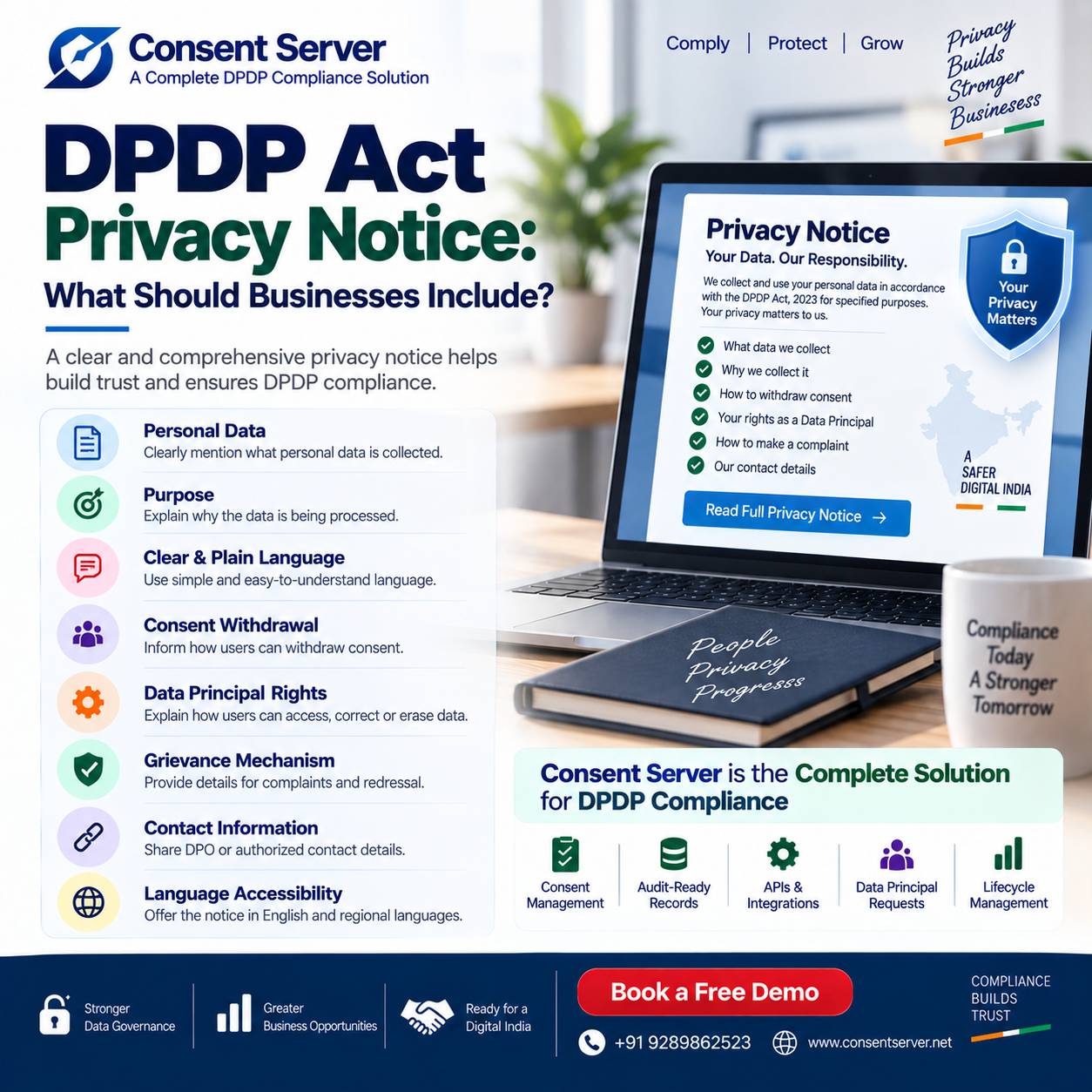
The DPDP Rules, 2025 require the notice provided by the Data Fiduciary to be independently understandable and presented in clear and plain language.
The notice should include, among other things:
- An itemised description of the personal data
- The specified purpose or purposes of processing
- A description of the goods, services or uses enabled by that processing
- A way to withdraw consent
- Information about exercising rights and making complaints
Therefore, the question is not simply:
“Did the customer tick the checkbox?”
It should also be:
“What exactly was the customer informed about before ticking it?”
One Checkbox for Multiple Purposes Can Create Problems
Consider an e-commerce website collecting:
- Name
- Email address
- Mobile number
- Delivery address
- Purchase history
The organisation may want to use this information for several purposes:
Order fulfilment
Delivery notifications
Customer support
Promotional SMS
Marketing emails
Personalised product recommendations
Now imagine the website displays only:
- I agree to the Privacy Policy, Terms and Conditions and use of my information.
What exactly did the customer consent to?
Did the customer agree to receive promotional SMS?
Did the customer agree to marketing emails?
Did the customer understand that purchase history would be used for recommendations?
This is why businesses should consider purpose-wise consent management instead of relying on one generic checkbox for everything.
A better design may separate different processing purposes clearly.
For example:
Order-related processing — Required
Promotional Email — Optional
Promotional SMS — Optional
Personalised Offers — Optional
The exact implementation will depend on the organisation’s processing activities and applicable legal basis, but the important principle is clear:
Consent should be connected to a specified purpose.
What Happens After the Checkbox Is Clicked?
This is where many basic consent implementations stop.
The customer clicks the checkbox.
The database stores:
consent = yes
And the organisation assumes the job is finished.
But consent is not necessarily a permanent, static record.
Suppose a customer initially provides:
Marketing Email: Yes
Promotional SMS: Yes
Six months later, the customer decides:
Marketing Email: Yes
Promotional SMS: No
Now your organisation needs to know the latest consent status.
You may also need to know:
When was the original consent given?
When was it modified?
What purpose was changed?
What notice was displayed?
Which version of the consent request was used?
Who initiated the update?
Which systems were notified?
A simple checkbox database field cannot necessarily answer all of these questions.
This is why businesses need to think in terms of a consent lifecycle, rather than only consent collection.
Users Must Be Able to Withdraw Consent
The DPDP Act provides Data Principals with the right to withdraw consent at any time.
Importantly, the ease of withdrawing consent should be comparable to the ease with which consent was originally given.
Consider this example.
A customer joins your mailing list by entering an email address and clicking one checkbox.
That process takes 20 seconds.
Now imagine that withdrawing consent requires the customer to:
Call customer support
Submit a request
Send an identity document
Wait several days
Follow up multiple times
That would create a very different experience from the process used to provide consent.
Businesses therefore need a practical mechanism for consent withdrawal.
A professional consent management workflow might allow the Data Principal to:
View current consent --> Change preferences --> Withdraw a purpose --> Confirm request --> Update consent record
Once consent is withdrawn, the organisation also needs to deal with the processing that depended on that consent.
Section 6 further provides that after withdrawal, the Data Fiduciary should, within a reasonable time, cease and cause its Data Processors to cease processing based on that consent unless processing is otherwise required or authorised by law.
This creates a major operational challenge.
Your Website Is Not the Only System Using Personal Data
Suppose a customer withdraws consent for promotional communication through your website.
But the customer’s details already exist inside:
- CRM
- Email marketing software
- SMS gateway
- Mobile application
- Sales platform
- Customer support software
Your website may correctly show:
Marketing Consent: Withdrawn
But your CRM might still show:
Marketing Allowed
Your email marketing platform may continue sending promotional campaigns.
This means the checkbox itself has worked, but the organisation’s overall consent workflow has failed.
A mature consent management system therefore needs mechanisms to communicate consent changes to connected applications.
This is where functionality such as:
APIs
Webhooks
Centralised consent status
Consent history
becomes valuable.
What If the Consent Notice Changes?
Another important issue is version management.
Suppose version 1 of your notice says:
“We use your mobile number for account verification.”
Later, version 2 says:
“We use your mobile number for account verification and promotional communication.”
If a customer provided consent under version 1, can the organisation simply assume that the same consent covers the new purpose?
This illustrates why businesses may need to know:
- Which version was displayed
- When it was displayed
- Which purposes were included
- Which personal data was mentioned
- Whether fresh consent was obtained where required
Simply storing:
consent = yes
does not provide this context.
A consent management platform can maintain version-specific records so that organisations can reconstruct what the Data Principal actually agreed to.
Can You Prove the Consent Later?
One of the most important practical aspects of the DPDP Act appears in Section 6(10).
Where consent is the basis of processing and a question arises in a proceeding, the Data Fiduciary has the obligation to prove that notice was given and consent was obtained in accordance with the Act and Rules.
This changes the meaning of a consent record.
Imagine a dispute two years after the customer registered.
The customer says:
“I never agreed to receive these promotional messages.”
The organisation says:
“Our database says consent = yes.”
That may naturally lead to further questions:
Which notice was shown?
Which purpose was mentioned?
What was the timestamp?
What did the user actually select?
Was consent later changed?
Was it withdrawn?
What was the complete history?
This is why audit-ready records can become important for organisations handling consent at scale.
Checkbox vs Consent Management Platform
The difference can be summarised simply:
A checkbox can therefore be part of a consent management system.
It should not be confused with the entire system.
| Consent Checkbox | Consent Management Platform |
|---|---|
| Captures affirmative action | Manages complete consent lifecycle |
| Usually Yes or No | Purpose-wise consent status |
| Often linked to one form | Can support multiple forms and systems |
| Basic timestamp | Detailed consent history |
| Limited notice information | Notice and version management |
| Withdrawal may be manual | Structured withdrawal workflow |
| Website-focused | Website, app and API integrations |
| Usually no central repository | Centralised consent management |
| Limited auditability | Audit-ready records |
| No downstream updates | APIs and webhooks |
| Basic database entry | Lifecycle and governance infrastructure |
When Can a Simple Checkbox Be Enough Technically?
There are situations where a lightweight implementation may be appropriate.
A small business with:
- One website
- One simple processing purpose
- Very few users
- No complex integrations
- A simple withdrawal mechanism
may not need enterprise-level consent infrastructure.
The goal should not be to make every organisation purchase complex software unnecessarily.
However, as the organisation grows, consent complexity may increase.
You may eventually have:
Multiple departments
Multiple websites
Mobile applications
Thousands or lakhs of Data Principals
Different consent purposes
Multiple notice versions
CRM integrations
Consent withdrawals
Data Principal requests
Multiple administrators
At that stage, maintaining consent through individual checkboxes and separate databases can become difficult.
How Consent Server Approaches the Problem
Consent Server is designed as a DPDP Consent Management Platform for Data Fiduciaries that need to manage consent beyond basic website collection.
Depending on implementation and configuration, Consent Server can support capabilities such as:
- Purpose-wise consent
- Custom consent forms
- Consent verification
- Consent history
- Consent updates and revocation
- Notice and purpose management
- Data Principal self-service workflows
- APIs and webhooks
- Role-based access control
- Audit trails
- Reporting
- Consent lifecycle automation
- Encrypted consent records
- Tamper-detection mechanisms
- Self-hosted and on-premise deployment options
The objective is not to replace the checkbox.
The checkbox may still be part of the user interface.
The objective is to manage everything that happens before and after that checkbox is clicked.
Final Answer
So, is a consent checkbox enough for DPDP compliance in India?
No, not by itself.
A checkbox can help demonstrate a clear affirmative action, but DPDP consent involves much more.
Businesses should consider:
What personal data is being collected?
For what purpose?
What notice was presented?
Was the consent specific and informed?
Can the Data Principal withdraw or change consent easily?
What happens after withdrawal?
Are connected systems updated?
Can the organisation retrieve the complete consent history?
Can the organisation prove the consent if questioned later?
If your system only answers:
“Was the checkbox checked?”
you may only be managing consent collection.
A complete consent management approach should help answer:
Who consented, to what, for which purpose, under which notice, when, how it changed, whether it was withdrawn and what the current consent status is.
That is the difference between a consent checkbox and a Consent Management Platform.
For organisations managing consent across multiple users, purposes, applications and business processes, Consent Server provides a central platform designed to help manage the complete DPDP consent lifecycle.
Want to see how Consent Server goes beyond a simple checkbox? Book a free demo and evaluate the platform against your organisation’s actual consent management requirements.