DPDP Act Consent Requirements: What Makes Consent Valid?
Understand DPDP Act consent requirements in India. Learn what makes consent valid, how withdrawal works, and why businesses need proper consent management.
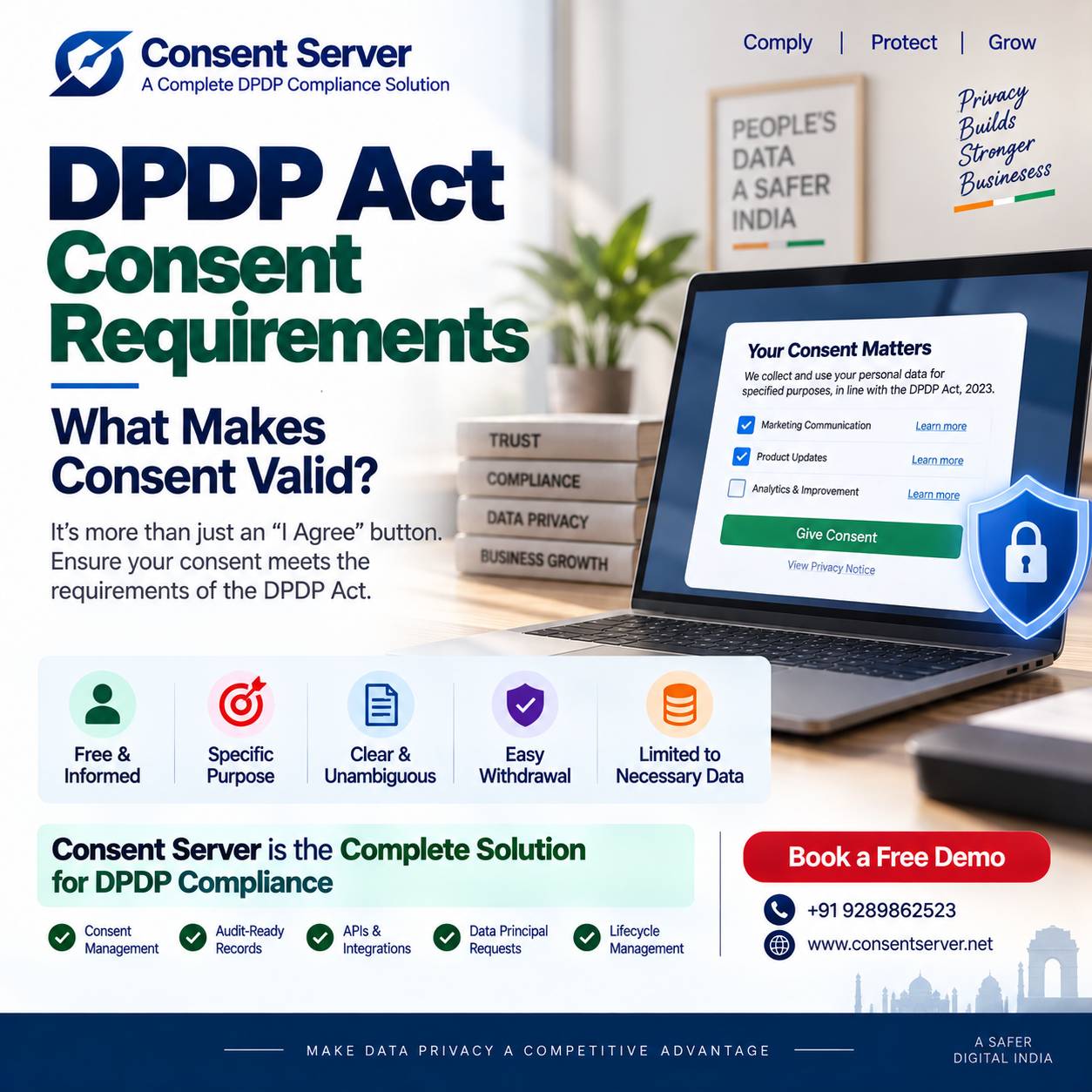
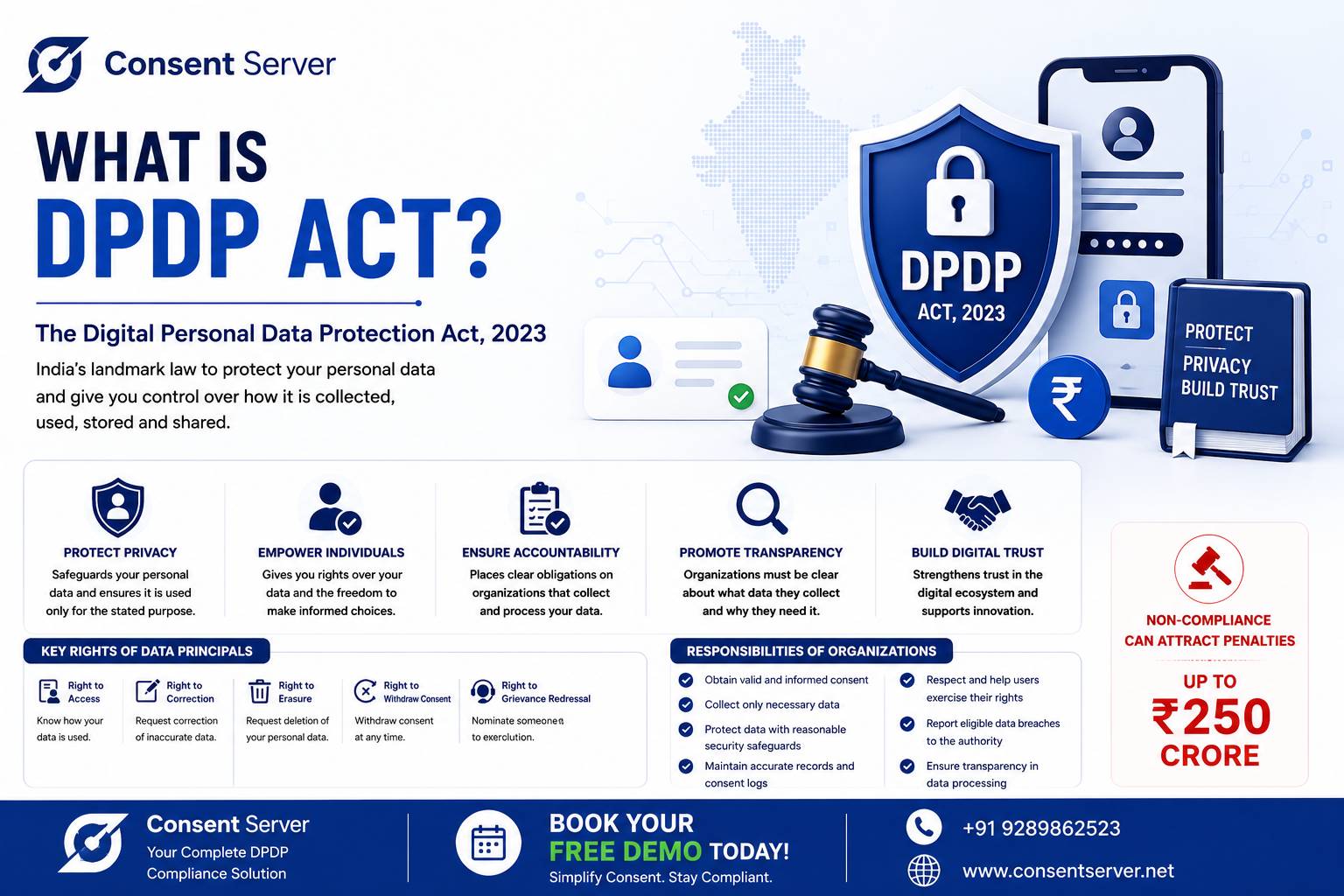
Consent is one of the most important concepts under India’s Digital Personal Data Protection Act, 2023 (DPDP Act).
For businesses, simply adding an “I Agree” checkbox to a website or application does not automatically mean that consent satisfies the DPDP Act. Where consent is the basis for processing personal data, it needs to meet specific statutory requirements and be supported by processes for notice, withdrawal, record management, and downstream updates.
Under Section 6 of the DPDP Act, consent must be free, specific, informed, unconditional and unambiguous, involve a clear affirmative action, relate to a specified purpose, and be limited to personal data necessary for that purpose.
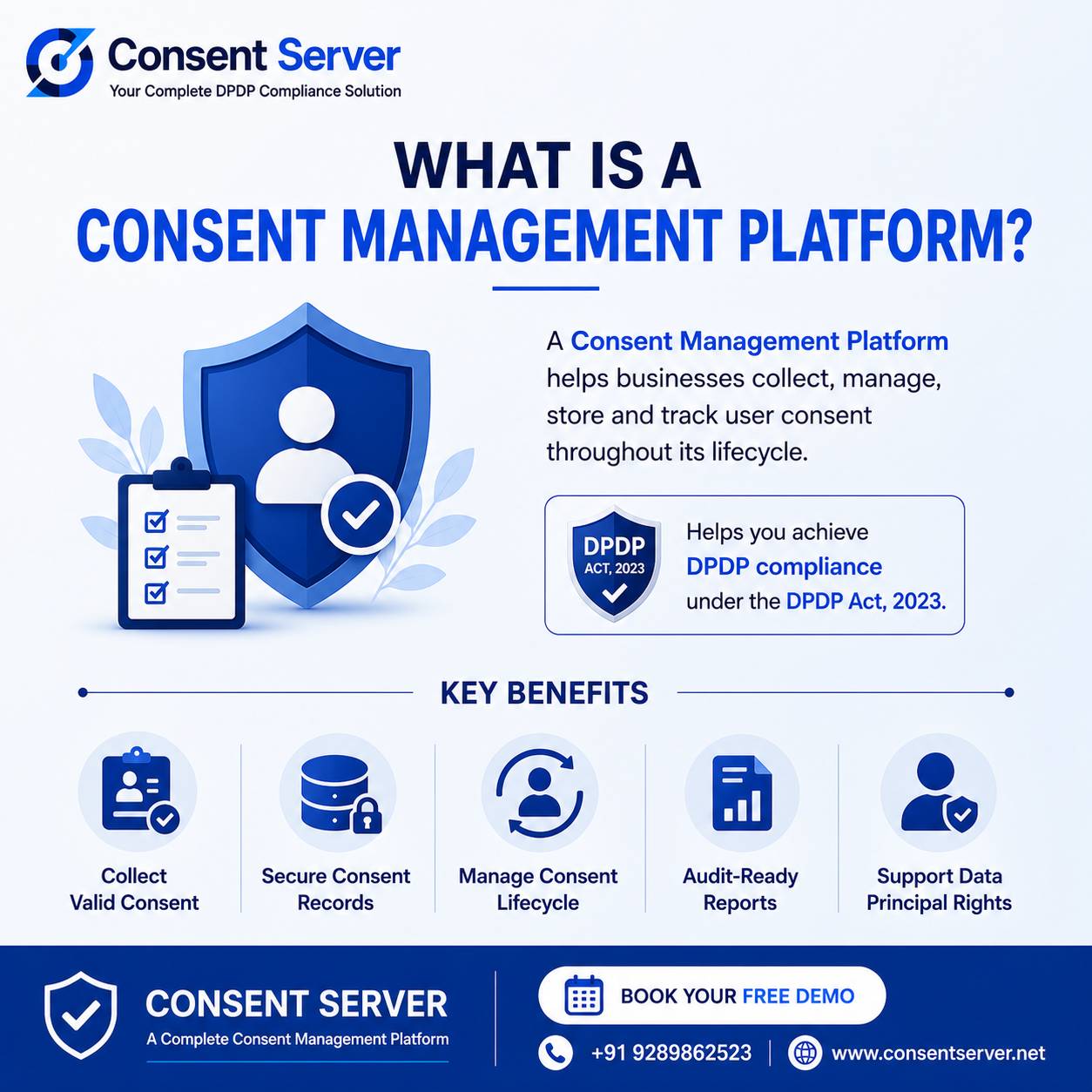
For organisations processing large volumes of personal data, a structured Consent Management Platform or DPDP Consent Management Platform can therefore become an important part of operational compliance.
What Is Consent Under the DPDP Act?
Consent represents the Data Principal's agreement to the processing of their personal data for a specified purpose.
The important point is that consent cannot simply be broad or open-ended.
For example, suppose an online service needs a customer's mobile number to send an OTP. Asking for consent to access unrelated information that is unnecessary for providing that service would raise issues with the requirement that consent be limited to personal data necessary for the specified purpose.
The DPDP Act itself illustrates this principle with a telemedicine service: consent to access a user's phone contact list would not be valid merely because the user clicked agree if those contacts were unnecessary for providing the telemedicine service.
What Makes Consent Valid Under the DPDP Act?
Businesses relying on consent should understand the following key requirements.
1. Consent Must Be Free
Consent should represent a genuine choice by the Data Principal.
Organisations should avoid designing consent mechanisms that improperly pressure individuals into agreeing to unnecessary processing.
The objective is to ensure that the individual's decision genuinely represents their agreement to the relevant processing.
2. Consent Must Be Specific
A vague request such as:
“By continuing, you agree that we can use your data for business purposes.”
does not clearly explain what the individual is agreeing to.
Consent should relate to a specified purpose.
If an organisation processes personal data for different purposes, it should carefully consider how those purposes are presented and managed rather than relying on unnecessarily broad consent.
This is where purpose-based consent management becomes important.
3. Consent Must Be Informed
A Data Principal needs sufficient information to understand what they are agreeing to.
The notified Digital Personal Data Protection Rules, 2025 provide further detail for notices. Rule 3 requires the notice to be independently understandable and to provide, in clear and plain language, an itemised description of the personal data and the specified purpose or purposes of processing, along with information enabling withdrawal, exercise of rights, and complaints.
A consent request should therefore not depend on confusing legal language that prevents the user from understanding the processing.
4. Consent Must Be Unconditional
Section 6 expressly requires consent to be unconditional.
Businesses should not attempt to attach conditions to consent that conflict with the Act or other applicable law.
For example, the Act illustrates that an insurer cannot make valid consent depend on an individual waiving their right to complain to the Data Protection Board. That portion of the consent would be invalid.
5. Consent Must Be Unambiguous
The organisation should be able to determine clearly whether the individual agreed.
Ambiguous behaviour should not be treated as a substitute for a proper consent action.
This becomes especially important for websites, mobile applications, marketing systems and other digital interfaces.
6. Consent Requires Clear Affirmative Action
The DPDP Act specifically requires a clear affirmative action.
A business should design its consent mechanism so that the user's action clearly communicates agreement.
The consent record should ideally allow the organisation to demonstrate what action was taken, what purpose was presented, and what notice or consent version applied.
Consent Should Be Limited to Necessary Personal Data
Data minimisation is built directly into the DPDP Act's consent standard.
Section 6 says consent must be limited to personal data necessary for the specified purpose.
This means businesses should ask:
“Do we actually need this personal data to fulfil the purpose we have communicated?”
Collecting additional personal data merely because it might become useful later can create unnecessary privacy and compliance risk.
Clear and Plain Language Matters
Consent should be understandable to an ordinary user.
The DPDP Act requires consent requests to be presented in clear and plain language. It also provides for access to the request in English or any language specified in the Eighth Schedule to the Constitution.
For businesses operating across India, multilingual consent experiences may therefore become an important consideration.
A good consent interface should tell the Data Principal what data is involved, why it is required, and what they are agreeing to without forcing them to decode complex legal language.
Giving Consent Is Only the Beginning
One of the biggest mistakes businesses can make is treating consent as a one-time checkbox.
The operational lifecycle may include:
Consent Given → Consent Recorded → Consent Updated → Consent Withdrawn → Connected Systems Updated → Audit Record Maintained
This is why a simple website checkbox and a complete Consent Management Platform solve very different problems.
A checkbox captures an action.
A proper consent management system should help the organisation manage what happens after that action.
Data Principals Must Be Able to Withdraw Consent
Where consent is the basis for processing, the DPDP Act gives the Data Principal the right to withdraw it at any time.
Importantly, the ease of withdrawing consent must be comparable to the ease with which consent was given.
If someone can provide consent with a few simple clicks, forcing them through an unnecessarily complicated process to withdraw it would conflict with this principle.
Withdrawal does not make earlier lawful processing retrospectively unlawful. After withdrawal, the Data Fiduciary must, within a reasonable time, cease and cause its Data Processors to cease the consent-based processing unless continued processing is otherwise required or authorised under the Act, Rules, or another applicable Indian law.
What Happens When Consent Changes Across Multiple Systems?
This is where DPDP compliance becomes an operational challenge.
Imagine that a customer's information exists in:
- Your website
- CRM
- Marketing platform
- Mobile application
- Customer database
- Customer support system
The customer then withdraws a particular consent.
Changing a single value inside the website database may not be enough operationally. Relevant connected applications may also need to receive and act on the updated consent state.
A centralized DPDP Consent Management Platform can help maintain the current consent status and use APIs and webhooks to communicate relevant consent events to connected systems.
Businesses Should Maintain Evidence of Consent
When an organisation relies on consent, maintaining reliable records is important.
Section 6 places the burden of proving that notice was given and consent was obtained on the Data Fiduciary where consent is the basis of processing.
A useful consent record may therefore capture information such as the Data Principal or consent identifier, purpose, consent status, timestamp, applicable notice or consent version, and subsequent updates or withdrawal events.
The exact implementation will depend on the organisation's systems and processing activities.
Does Every Processing Activity Require Consent?
No.
This is an important DPDP compliance distinction.
The DPDP Act provides for processing based on consent as well as certain legitimate uses specified under Section 7.
Businesses should therefore avoid adding consent mechanisms indiscriminately to every processing activity.
Instead, they should first determine why personal data is being processed and which provision of the DPDP framework applies.
A DPDP Compliance Platform should support this broader compliance strategy rather than encouraging unnecessary consent collection.
What About Children's Consent?
The DPDP Act defines a child as an individual who has not completed 18 years of age. The framework contains additional requirements relating to processing children's personal data, including verifiable consent requirements in applicable circumstances. The 2025 Rules provide further implementation detail.
Organisations serving children should therefore build appropriate age and parental or guardian workflows based on the applicable legal requirements rather than using the same consent mechanism for every user.
Common Consent Management Mistakes
Businesses preparing for Digital Personal Data Protection requirements should watch for common problems such as using vague or bundled consent, collecting unnecessary personal data, failing to maintain consent history, making withdrawal difficult, and failing to propagate consent changes to relevant downstream applications.
Another common problem is relying exclusively on spreadsheets or disconnected databases.
These approaches may work at a very small scale but become increasingly difficult when an organisation needs to manage thousands of users, multiple purposes, multiple consent versions and several connected applications.
Why Businesses Need a Consent Management Platform
A dedicated Consent Management Platform can help turn legal and policy requirements into operational workflows.
Instead of asking only:
“Did the user click Yes?”
the organisation can track:
Who consented? For what purpose? When? Under which notice? What is the current status? Has it changed? Has it been withdrawn? Which relevant systems need to know?
That distinction is important when building a scalable DPDP compliance program.
Consent Server: A Complete Solution for DPDP Consent Management
Consent Server is designed as a comprehensive DPDP Compliance Platform and DPDP Consent Management Platform for businesses that need to operationalize consent and related DPDP workflows.
Rather than keeping consent records scattered across websites, CRM systems, spreadsheets and databases, Consent Server helps organisations create a centralized consent-management layer.
Key capabilities include purpose-based consent management, consent history, consent updates and withdrawals, lifecycle management, Data Principal request workflows, grievance management, audit-ready records, reporting, role-based access, APIs and webhooks.
Consent Server can also integrate with websites, CRM platforms, HR systems, marketing tools, databases and other business applications so that relevant consent changes can be communicated across connected systems.
For organisations searching for DPDP Compliance Software, a Consent Management Platform, DPDP Consent Management Platform, or broader DPDP Compliance Platform, Consent Server provides a comprehensive technology solution to evaluate.
Software alone does not guarantee legal compliance—the organisation remains responsible for its governance, legal assessments, security, policies and operational practices—but the right technology can make consent compliance much easier to manage, document and demonstrate.
Final Thoughts
Valid consent under the DPDP Act is much more than an “I Agree” button.
Where consent is relied upon, it needs to be free, specific, informed, unconditional and unambiguous, expressed through clear affirmative action, connected to a specified purpose, and limited to the personal data necessary for that purpose.
Businesses also need to think beyond collection.
They need systems for maintaining consent records, managing updates, enabling withdrawal, communicating changes to relevant applications, and preserving an audit trail.
That is where a centralized Consent Management Platform can become an important part of an organisation's Digital Personal Data Protection strategy.